no self

  • The Ultimate Aim of Martial Arts: The Warrior’s Aura and the Power of Mushin

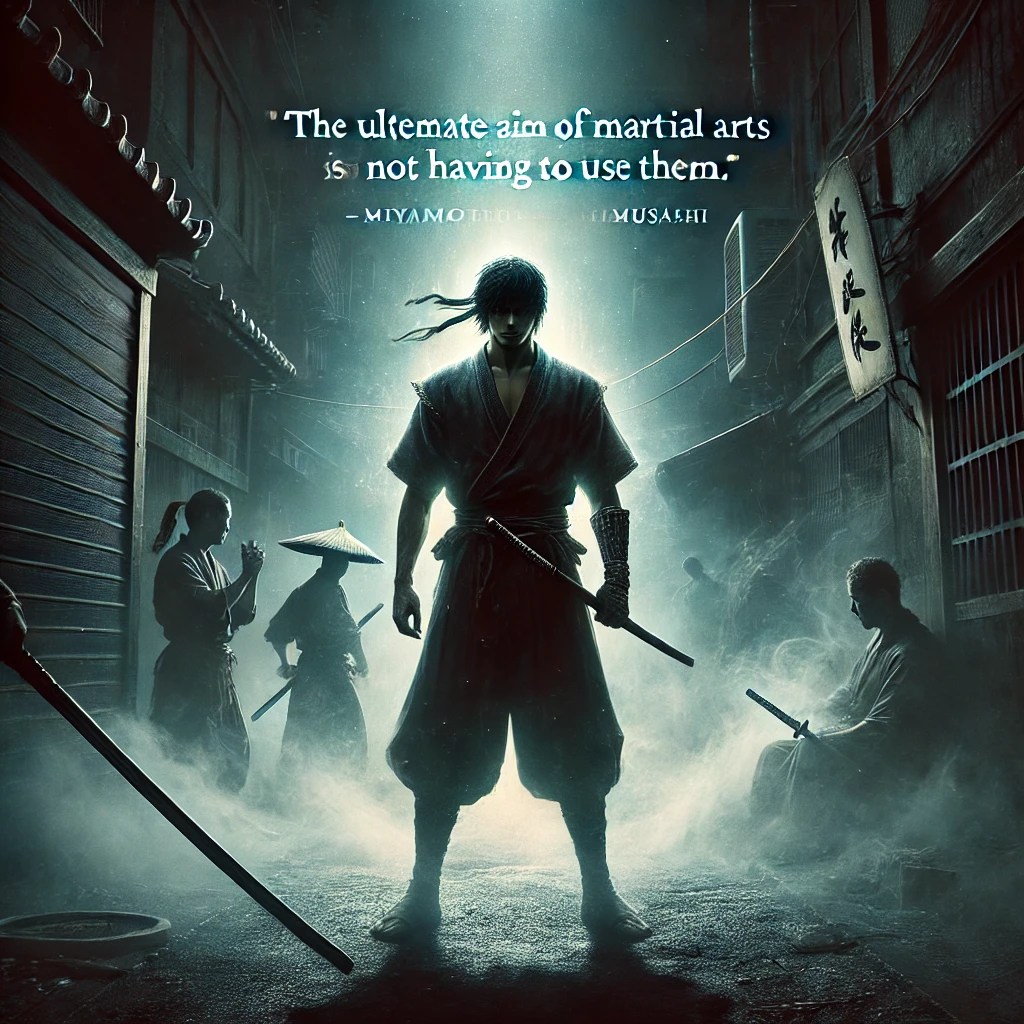
    Miyamoto Musashi, the legendary samurai and undefeated duelist, once said, “The ultimate aim of martial arts is not having to use them.” These words come from a man who fought and won over 60 life and death duels in an era when Japan was filled with warriors roaming the land, eager to test their skill and prove their worth. Musashi was no pushover—he was a master of combat, yet he understood that true mastery lies in transcending the need for battle.

    At first glance, this may seem paradoxical—why train for years in combat only to avoid it? Yet, this statement holds a deep truth: the warrior who has mastered themselves rarely needs to fight. Their presence (chi) alone commands respect, dissuading threats before they manifest.

    The Warrior’s Aura: Why Muggers Don’t Pick the Strong

    Violence is rarely random. Predators—whether in the animal kingdom or the streets of a city—seek easy prey. They don’t attack the strong; they target the distracted, the timid, and the unaware. A trained warrior, one who has internalized the principles of martial arts and strategy, exudes an unmistakable energy—a silent but powerful message:

    🚫 “Not this one.”

    Compare two individuals walking down the street:

    1. The Unaware Civilian – Eyes locked on their phone, shoulders slumped, mind elsewhere. Their body language screams distraction, vulnerability, and a lack of control over their environment. They might be daydreaming, lost in worries, or simply untrained in reading energy. To a predator, they look like an easy mark.
    2. The Trained Warrior – Walking with calm confidence, head up, peripheral vision scanning naturally, breathing deep and steady. There’s no tension—only readiness. They are not fearful but also not looking for a fight. They simply exist in a state of total awareness, in tune with the flow of the moment.

    The difference is not just physical but metaphysical. It’s an emanation of mindset which emanates chi (qi), prana, bioelectric energy—the subtle yet powerful force that martial artists cultivate through breath, meditation, and training. This energy extends beyond mere body language; it is a field that others unconsciously register.

    This is why seasoned warriors rarely get into fights. Not because they run, but because the fight never comes to them.

    Mushin: The Mind of No Mind

    In a true confrontation, the trained warrior does not react from fear or ego. Instead, they enter mushin (無心)—the state of “no mind.” “They” are not there to be frightened, they are egoless (no-self). This is not apathy or passivity but a heightened state of intuition and presence. The mind is empty of thoughts, yet fully aware. It does not dwell on past or future, on fear or hesitation. It simply acts.

    The untrained person, when faced with a threat, either:
    Panics, letting fear take over, leading to poor decisions and freezing up.
    Overreacts, engaging in unnecessary conflict due to a fragile ego.

    But the warrior trained in mushin sees the reality of the situation with clarity. They know if the threat is real or just an illusion. They sense whether to engage or simply walk away. There is no hyperbole in this—it is the direct result of deep training in martial arts, meditation, and strategic thinking.

    Intuition: Knowing When to Strike and When to Walk Away

    A well-trained martial artist does not act out of impulse, anger, or insecurity. They act from pure awareness.

    👉 If a situation does not warrant combat, the warrior sees it immediately and moves on, avoiding unnecessary conflict.

    👉 If a situation requires action, there is no hesitation, no wasted movement—just pure execution, whether that means striking, deflecting, or using words to de-escalate.

    This level of mastery means that the ego is not in control—the higher self is. The need to “prove something” disappears. There is no need to dominate or posture. Instead, the warrior moves through life with grace, like a river flowing around obstacles rather than smashing through them.

    The Metaphysics of Combat and Non-Combat

    Everything in existence vibrates at a certain frequency. Fear, insecurity, and distraction vibrate at a low frequency, attracting chaos. Confidence, centeredness, and training vibrate at a high frequency, repelling conflict before it manifests.

    A skilled warrior aligns themselves with the Tao, the flow of life, where battle is neither sought nor feared. In this way, they embody the deepest truth of martial arts:

    Train for war, but live in peace.
    Be capable of destruction, but embody restraint.
    Be so strong that you never need to fight.

    True Strength is Invisible

    In the end, Musashi’s words reflect a universal truth: those who seek violence are weak, and those who master violence become peaceful. The ultimate goal is not to win fights—it’s to transcend them entirely. To move through life untouchable—not because you fight, but because you don’t have to.

    This is the true way of the warrior.

  • No Self, Mushin, and Mastery: Lessons from Ghost Dog: The Way of the Samurai

    In the realm of spirituality and philosophy, the concept of “no self” is a recurring theme, bridging traditions like Christianity, Buddhism, and the teachings of the Dharma. This principle, often associated with humility, detachment, and a transcendence of ego, has profound implications for living effectively and navigating life’s chaos. The film Ghost Dog: The Way of the Samurai offers a modern meditation on this theme, presenting the mindset of “no self” as a practical tool for composure and excellence.

    At the heart of the movie lies the concept of mushin—a Japanese term meaning “mind of no mind.” Rooted in Zen Buddhism and the Bushido code, mushin embodies the state of being fully present, free from distractions, and unencumbered by ego. Ghost Dog, the film’s protagonist, exemplifies this principle through his disciplined life and stoic adherence to the teachings of Hagakure: The Way of the Warrior. His actions reflect a selfless commitment to a higher ideal, illustrating how letting go of ego and attachment empowers him to act with precision, clarity, and purpose.

    The Spiritual Foundation of “No Self”

    The idea of “no self” extends beyond Eastern philosophy. In Christianity, it echoes Christ’s teaching to “deny yourself, take up your cross, and follow me” (Matthew 16:24). This act of self-denial, rather than diminishing the individual, elevates them to a life of service, love, and spiritual alignment. Similarly, the Dharma speaks of anatta, the concept of no permanent self, which liberates one from suffering caused by clinging to identity and desires.

    By transcending the ego, one attains a state of flow—much like mushin—where actions arise naturally and without resistance. This aligns with Jesus’ message of surrendering to God’s will and the Dharma’s emphasis on living in harmony with the universe. In both traditions, selflessness fosters an ability to adapt, endure, and thrive amidst challenges.

    Ghost Dog as a Modern Samurai

    Ghost Dog’s character is a masterclass in applying these timeless principles to modern life. Despite being removed from the historical and cultural context of samurai warriors, his life embodies their ethos. His loyalty to his master, even at great personal cost, mirrors the spiritual virtues of surrender and devotion. His disciplined daily rituals—practicing martial arts, meditating, and caring for his pigeons—reveal the power of routine in cultivating mental clarity and focus.

    What sets Ghost Dog apart is his ability to maintain composure and purpose in the face of chaos. As his world spirals into violence and betrayal, he remains steadfast, guided by the principles of the Hagakure. This detachment from outcomes and unwavering focus on duty illustrate the profound effectiveness of a no-self mindset. By relinquishing attachment to identity and ego, Ghost Dog achieves mastery over his actions and decisions, demonstrating how selflessness can be a source of strength, not weakness.

    Thinking Outside the Box with “No Self”

    The film also challenges us to think outside the box when it comes to personal growth and effectiveness. In a world obsessed with self-promotion and individualism, Ghost Dog: The Way of the Samurai reminds us of the power of humility, discipline, and living for something greater than ourselves. It shows that even in modern, chaotic environments, the ancient wisdom of mushin and no-self can guide us to act with precision, courage, and purpose.

    Moreover, these principles can be applied to everyday life. In business, relationships, and personal challenges, adopting a mindset of no-self allows us to focus on the task at hand rather than being bogged down by fears, insecurities, or the need for validation. Like Ghost Dog, we can learn to navigate chaos with grace, remaining true to our values and purpose, no matter the circumstances.

    Conclusion: The Warrior’s Way in Everyday Life

    The teachings of mushin, no-self, and the Bushido code, as illustrated in Ghost Dog: The Way of the Samurai, offer a powerful blueprint for mastering life. Whether drawn from Christianity, Buddhism, or the Dharma, the principle of selflessness serves as a unifying thread, reminding us that true strength lies in transcending the ego. By doing so, we can maintain composure, think clearly, and act effectively—even in the face of life’s most chaotic moments.

    In the end, Ghost Dog’s journey is not just the tale of a modern samurai—it’s a call to embrace the mindset of a warrior in our own lives. Through discipline, detachment, and selflessness, we can cultivate the resilience and focus needed to excel in a world that often feels like a battlefield.


    REVOLUTIONARY BOOKS SHAKING AMAZON!

    CLICK HERE NOW!


    THE SAMURAI-YOGI ADVANTAGE!™

    Unlock the power of the SAMURAI-YOGI ADVANTAGE™ and master the path to unstoppable business leadership and transformation. This BOOK is your ultimate guide to the RAT Synthesis™ SAMURAI-YOGI ADVANTAGE™ program, offering powerful strategies and training methods for both personal and professional mastery.

    Click https://amzn.to/3ZhqCB6HERE to access your copy on Amazon and start your journey to extraordinary success today!