Because it retrains the nervous system to move with internal power, proper alignment, and integrity. Circle sparring, along with the palm-on-the-chest drill, further imprints that integrity into the nervous system. This is what makes Bagua such a profound martial art.
Once these principles become embodied within the nervous system, you no longer have to consciously think about them. You simply continue practicing the peculiar methods of Bagua to maintain, refine, and deepen that near-perfect integration.
Bagua is not a collection of techniques—it is a training method into which you place your techniques. As an example, you can use Wing Chun techniques. Bagua operates at trapping range.
At that distance, there is no time to think. You are dropped into Mushin—“no mind.” The conscious mind gets out of the way, allowing your training and programming to take over.
Meditation combined with the Bagua training methods and wide angle vision makes a devastating combination.
The program, built through thousands of repetitions and refined through Bagua training, responds with near-perfect integrity. You don’t have to think about what to do.
You simply engage—and the training fights for you.
Some real-world self-defense experts teach that during a confrontation it is wise to create distance, take a breath, and regain awareness in order to prevent tunnel vision and emotional reactivity. That is sound advice. In moments of danger, fear can narrow perception and pull the mind into panic, causing a person to react impulsively rather than clearly.
But there is a deeper dimension to this idea that is rarely discussed.
Through daily meditation and the continual practice of keeping one’s awareness centered at the spiritual eye, a person can learn to remain inwardly grounded before conflict ever arises. Instead of trying to “return” to calmness in the middle of chaos, one lives from that calmness continuously.
The breath can certainly help restore awareness for a moment. A single conscious inhale can interrupt fear and create mental space. Yet breath control is ultimately a temporary correction. Meditation, practiced consistently over time, reshapes consciousness itself. It trains the mind to remain steady, observant, and centered even under pressure.
When awareness is habitually anchored inward, reactions become less emotional and more intuitive. Perception widens instead of narrowing. The mind becomes quieter, and action becomes more precise. In this state, one does not need to desperately search for composure during a confrontation because composure was never lost to begin with.
This principle extends far beyond self-defense. Most people move through life in a state of continual distraction, constantly pulled outward by stress, fear, stimulation, and endless mental chatter. Meditation reverses that process. It teaches a person to live from the center rather than from the surface of the mind.
True strength is not merely physical readiness. It is the ability to remain inwardly undisturbed while outward circumstances change. A calm mind sees clearly. A centered spirit reacts wisely. And a person who has cultivated inner stillness daily carries that stability everywhere they go.
The breath may bring someone back to awareness for a few seconds. Meditation teaches them to stay there.
In martial arts, this teaching is not philosophy for quiet contemplation—it is a combat principle. It is the difference between a fighter who breaks under pressure and a fighter who remains free inside the storm.
At its surface, the quote appears paradoxical. How can one give “100 percent” and yet remain “unattached”? In ordinary thinking, total effort implies total investment in outcome. But the Bhagavad Gita draws a sharper distinction: effort belongs to you; outcome does not.
In martial terms, this means the difference between commitment to action and bondage to result.
A martial artist must commit fully in the moment. Hesitation is defeat. Partial intent is already loss. Whether striking, defending, or moving, the body must act without division. If the mind fractures into “What if I fail?” or “What if I win?”, speed and precision collapse. Technique becomes stiff. Timing becomes late. Fear enters the nervous system.
This is why the Gita’s instruction is absolute: act completely. Not 70 percent. Not cautiously. Not self-protectively. Full engagement.
But the second half is what makes the first sustainable.
“Unattached to results” does not mean indifferent to victory or defeat. It means the fighter does not fracture identity based on outcome. If success defines you, then failure destroys you. That creates psychological instability under pressure. The moment the stakes rise, your ego becomes fragile, and fragility slows reaction.
Detachment stabilizes the mind. It keeps attention locked on the only real battlefield: this instant of action.
In combat sports, this is visible in elite fighters. The best athletes are not the ones who “hope to win.” They are the ones who execute without emotional interruption. They adjust after failure without collapse. They do not carry the last exchange into the next one. Each moment resets.
This is the Gita in motion: action without residue.
There is also a deeper strategic truth. Results are never fully in your control. Opponent skill, timing, environment, injury, chance—all exist outside individual will. To bind identity to outcome is to surrender sovereignty to variables you do not own.
So the warrior trains a different axis of control:
Total control of effort, discipline, and attention
Zero control over outcome, therefore zero psychological dependence on it
This creates a strange advantage: freedom under pressure. When fear of losing is removed, speed increases. When ego protection is gone, perception sharpens. When the mind is not negotiating with future consequences, it fully enters present action.
In that state, technique becomes natural. Reaction becomes instant. The body acts before doubt can form.
This is not softness. It is precision without interference.
The highest expression of this principle in martial arts is what might be called unburdened aggression: full commitment without emotional clutter. The strike is complete, but the identity is untouched by whether it lands or misses.
That is why the Gita frames action itself as duty, not outcome as reward. The warrior is responsible for integrity of action, not the verdict of results.
In the end, this teaching is not about detachment from life—it is about detachment from internal collapse. It allows a fighter to remain steady whether standing victorious or recovering from defeat.
Because in the deepest sense, mastery is not measured by what happens after the fight.It is measured by whether, in the fight, the mind stayed free.
The spiritual warrior does not drown in options. He cuts through them.
He understands an ancient and ruthless truth: power comes from concentration, not accumulation. Whether standing in the dojo, facing an adversary in the street, navigating the chaos of life—or seated before the silent battlefield of the chessboard—the law remains unchanged.
Chess, rightly practiced, is not a game. It is a forge for consciousness.
When the warrior sits before the sixty-four squares, the world narrows. Breath slows. The mind gathers. The hands are steady. Thought no longer chatters—it observes. This is mushin: no-mind, no-self. Not blankness, but clarity without interference. Action arises from presence, not panic. Calculation flows without strain.
Every move is a meditation. Every position is a mirror.
Chess trains strategic consciousness—the ability to see cause before effect, pressure before collapse, victory before violence. You learn patience, the courage to wait. You learn restraint, the wisdom to improve position rather than chase glory. You learn accountability—once a piece is moved, fate advances.
These are warrior virtues.
But the deepest lesson lies not merely in playing chess—it lies in how one studies it.
The undisciplined mind hoards knowledge. It chases hundreds of openings, thousands of variations, endless novelty. It believes more equals better. This is illusion. It is the same illusion that weak fighters cling to—too many techniques, too little mastery.
The spiritual warrior knows the Pareto Principle.
Eighty percent of results come from twenty percent of causes. In truth, mastery often comes from even less.
In chess, a handful of openings produce the vast majority of decisive positions. A few core structures generate endless variation. Learn those deeply—and you dominate the rest. The warrior does not need every opening. He needs understanding.
This is why in RAT Synthesis™, we do not chase infinity. We refine forty techniques. Not because reality is small, but because depth multiplies power. Those forty techniques intersect with all others. They generate reactions, openings, collapses. Through mastery of the few, the many are already contained.
Chess mirrors this perfectly.
Choose one opening. Maybe two. Enter it repeatedly. Study its bones. Know its tensions. Understand where it breathes, where it breaks, where it strikes. Live inside that pattern until it is no longer memorized—but embodied.
Bruce Lee spoke this law across all disciplines:
“I fear not the man who has practiced 10,000 kicks once, but I fear the man who has practiced one kick 10,000 times.”
This is the Pareto Principle spoken through the mouth of a warrior.
Through one opening, you learn the whole board. Through one pattern, you understand all patterns. Through one path, you see all paths.
What is true in chess is true in personal combat.
A seasoned fighter does not need endless techniques. He needs a small arsenal refined under pressure. He uses initial actions to generate predictable reactions—and exploits them. This is chess. This is combat. This is life.
The attributes cultivated on the board transfer everywhere:
Simplicity — cutting away the nonessential
Focus — directing force without waste
Repetition — forging instinct under pressure
Strategic patience — winning before striking
Constant learning — refinement without ego
This path is not about addition. It is about subtraction.
Bruce Lee revealed the sculptor’s truth:
“In building a statue, a sculptor doesn’t add clay. He chisels away the nonessentials until the truth is revealed.”
The spiritual warrior chisels his chess. He chisels his combat. He chisels his life.
He removes excess openings. Excess techniques. Excess thought. Excess fear. What remains is clean. What remains is effective. What remains is unstoppable.
When you can sit before the chessboard in silence—seeing clearly, choosing simply, acting decisively—you are no longer merely playing.
You are training the same mind that survives chaos. You are sharpening the awareness that ends conflict before it begins. You are walking the same path that governs RAT Synthesis™, martial mastery, and the spiritual ascent itself.
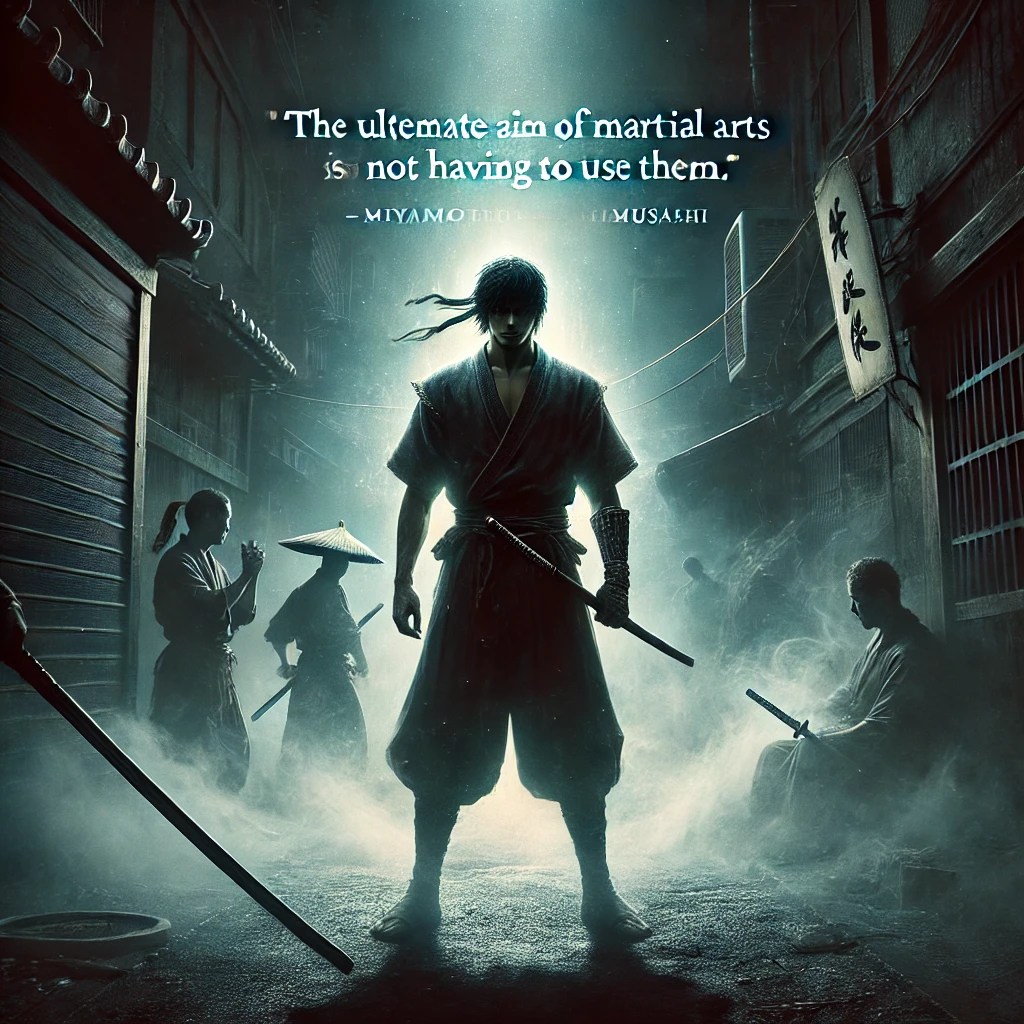
Miyamoto Musashi, the legendary samurai and undefeated duelist, once said, “The ultimate aim of martial arts is not having to use them.” These words come from a man who fought and won over 60 life and death duels in an era when Japan was filled with warriors roaming the land, eager to test their skill and prove their worth. Musashi was no pushover—he was a master of combat, yet he understood that true mastery lies in transcending the need for battle.
At first glance, this may seem paradoxical—why train for years in combat only to avoid it? Yet, this statement holds a deep truth: the warrior who has mastered themselves rarely needs to fight. Their presence (chi) alone commands respect, dissuading threats before they manifest.
The Warrior’s Aura: Why Muggers Don’t Pick the Strong
Violence is rarely random. Predators—whether in the animal kingdom or the streets of a city—seek easy prey. They don’t attack the strong; they target the distracted, the timid, and the unaware. A trained warrior, one who has internalized the principles of martial arts and strategy, exudes an unmistakable energy—a silent but powerful message:
🚫 “Not this one.”
Compare two individuals walking down the street:
The Unaware Civilian – Eyes locked on their phone, shoulders slumped, mind elsewhere. Their body language screams distraction, vulnerability, and a lack of control over their environment. They might be daydreaming, lost in worries, or simply untrained in reading energy. To a predator, they look like an easy mark.
The Trained Warrior – Walking with calm confidence, head up, peripheral vision scanning naturally, breathing deep and steady. There’s no tension—only readiness. They are not fearful but also not looking for a fight. They simply exist in a state of total awareness, in tune with the flow of the moment.
The difference is not just physical but metaphysical. It’s an emanation of mindset which emanates chi (qi), prana, bioelectric energy—the subtle yet powerful force that martial artists cultivate through breath, meditation, and training. This energy extends beyond mere body language; it is a field that others unconsciously register.
This is why seasoned warriors rarely get into fights. Not because they run, but because the fight never comes to them.
In a true confrontation, the trained warrior does not react from fear or ego. Instead, they enter mushin (無心)—the state of “no mind.” “They” are not there to be frightened, they are egoless (no-self). This is not apathy or passivity but a heightened state of intuition and presence. The mind is empty of thoughts, yet fully aware. It does not dwell on past or future, on fear or hesitation. It simply acts.
The untrained person, when faced with a threat, either: ❌ Panics, letting fear take over, leading to poor decisions and freezing up. ❌ Overreacts, engaging in unnecessary conflict due to a fragile ego.
But the warrior trained in mushin sees the reality of the situation with clarity. They know if the threat is real or just an illusion. They sense whether to engage or simply walk away. There is no hyperbole in this—it is the direct result of deep training in martial arts, meditation, and strategic thinking.
Intuition: Knowing When to Strike and When to Walk Away
A well-trained martial artist does not act out of impulse, anger, or insecurity. They act from pure awareness.
👉 If a situation does not warrant combat, the warrior sees it immediately and moves on, avoiding unnecessary conflict.
👉 If a situation requires action, there is no hesitation, no wasted movement—just pure execution, whether that means striking, deflecting, or using words to de-escalate.
This level of mastery means that the ego is not in control—the higher self is. The need to “prove something” disappears. There is no need to dominate or posture. Instead, the warrior moves through life with grace, like a river flowing around obstacles rather than smashing through them.
The Metaphysics of Combat and Non-Combat
Everything in existence vibrates at a certain frequency. Fear, insecurity, and distraction vibrate at a low frequency, attracting chaos. Confidence, centeredness, and training vibrate at a high frequency, repelling conflict before it manifests.
A skilled warrior aligns themselves with the Tao, the flow of life, where battle is neither sought nor feared. In this way, they embody the deepest truth of martial arts:
✅ Train for war, but live in peace. ✅ Be capable of destruction, but embody restraint. ✅ Be so strong that you never need to fight.
True Strength is Invisible
In the end, Musashi’s words reflect a universal truth:those who seek violence are weak, and those who master violence become peaceful. The ultimate goal is not to win fights—it’s to transcend them entirely. To move through life untouchable—not because you fight, but because you don’t have to.