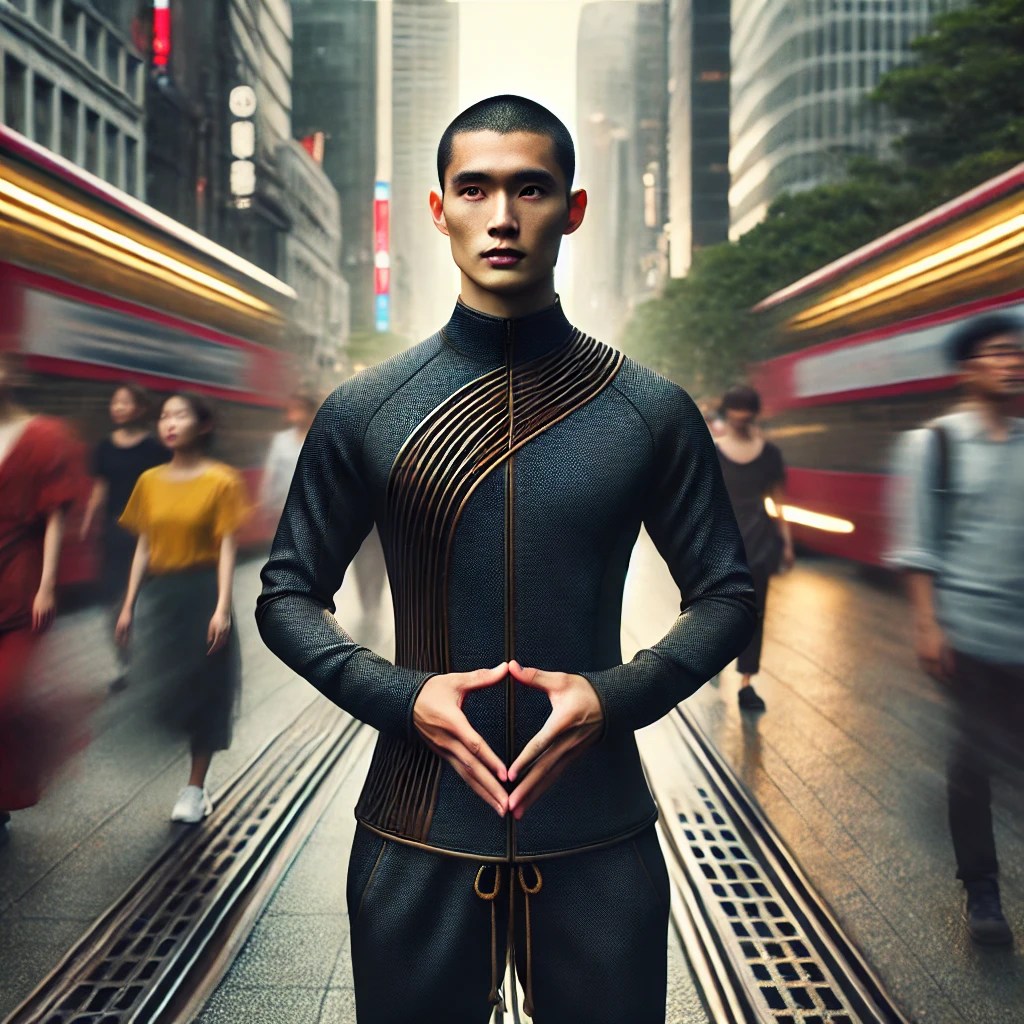
Stay centered. Pay attention. See clearly. Choose wisely.
Mindful responsiveness. Be unreactive.
As you move through life, imagine yourself at the center of an invisible sphere extending outward toward infinity.
This is your field of awareness.
Practice mindfulness—not as escape, but as paying attention. Pay attention to everything: your thoughts, your emotions, your sensations, the people around you, and the subtle changes in your environment. Observe without reacting. Maintain an eighteen inches of mental detachment.
Between stimulus and response, there is a space. In that space lies your power to choose. And in your choice lies your freedom and your growth. So said Victor Frankl, psychiatrist, neurologist, and Holocaust survivor.
Watch closely, and you will discover something profound: everything you observe is changing. Thoughts arise and disappear. Feelings arise and disappear. Sensations arise and disappear.
So if everything is changing, what are you?
You are the unchanging awareness in which all of it arises, remains for a time, and disappears.
Your awareness becomes a living radar system. You begin sensing shifts before they fully emerge. You recognize leading indicators. You perceive patterns while they are still forming.
Then you can play chess with life—anticipating its moves, adjusting your position, and acting with clarity and precision. Chess is a form of martial arts.
And you can play chess with yourself.
Through wisdom, discernment, willpower, and mindfulness, dismantle the ego piece by piece.
Every insight is a capture. Every moment of awareness is a check. Every act of surrender is a decisive move toward inner mastery.
Pay attention. Stay centered. See clearly. Choose wisely.
Most people think success comes from trying harder, thinking more, or forcing better results. While effort is important, there is another principle that has guided martial artists for centuries: Mushin, a Japanese word that I translate as “no mind, no self (ego).”
Mushin does not mean having an empty mind or becoming unconscious. It means developing a mind that is free from fear, hesitation, anger, and distraction. Instead of becoming trapped by thoughts, you respond naturally and effectively to whatever is happening.
In martial arts, Mushin is not something you simply read about—it is something you become through practice.
The training begins with seated meditation, where you learn to calm the mind and observe your thoughts without being controlled by them. As your concentration deepens, that same awareness is carried into movement through drills, partner exercises, and eventually into the high-stakes environment of sparring. Under pressure, the goal is not to think faster but to become so present that the correct action arises naturally.
This progression teaches an important lesson: calmness under pressure is a trainable skill.
The benefits extend far beyond the dojo. Life constantly places us in situations that demand clear thinking—stress at work, difficult conversations, unexpected setbacks, and important decisions. A person who has cultivated Mushin is less likely to panic or react emotionally. Instead, they can remain composed, assess the situation clearly, and respond with confidence.
Mushin does not eliminate challenges. It changes how you meet them.
Whether you are pursuing a career, building a business, strengthening relationships, or simply seeking greater peace of mind, the ability to remain centered while under pressure is one of the greatest advantages you can develop.
RAT Synthesis Martial arts offers a practical path for cultivating this state. Every training session becomes an opportunity to quiet the mind, sharpen awareness, and learn to act decisively without unnecessary tension.
If you would like to explore how awareness developed in meditation can be carried into everyday movement and martial arts practice, read my article Meditation in Motion, where I explain the bridge between stillness and action.
In my previous article, Meditation in Motion, I explained what meditation in motion is and why it matters.
Meditation should not end when you stand up from the cushion.
The goal is to carry the concentration, awareness, calmness, and equanimity developed through meditation into everything you do—walking, working, training, competing, and dealing with the unpredictable circumstances of life.
But how do you achieve this?
The answer is a progressive methodology that leads from stillness to movement, from movement to pressure, and ultimately to Mushin—the warrior’s state of no-mind, no-self.
Stillness is the foundation. Movement is the test. Life is the training hall.
STEP 1: DEVELOP CONCENTRATION
The first step is Samatha, or concentration meditation.
Sit quietly and focus your attention on the breath. When the mind wanders, notice it and gently return your attention to the breath.
The mind wanders.
You notice.
You return.
Again and again.
This simple process develops the ability to direct your attention rather than being controlled by every thought, emotion, or distraction.
This is the foundation of Meditation in Motion.
STEP 2: LEARN TO OBSERVE WITHOUT REACTING
The second step is Vipassana, or insight meditation.
Instead of focusing on one fixed object, observe whatever is most prominent in your awareness—a thought, emotion, sensation, or sound.
As the object of awareness changes, your attention changes with it.
You observe without clinging.
You observe without resisting.
This teaches you to change with change (Bagua).
The world is constantly moving. Meditation in Motion requires a mind capable of remaining present while everything around it changes.
STEP 3: DEEPEN CONCENTRATION AND INNER AWARENESS
The third step is Hong-Sau meditation, an advanced form of Samatha meditation that deepens concentration and develops inner awareness.
Through attention to the breath, the Hong-Sau mantra, and the spiritual eye, the mind gradually becomes quieter.
The purpose is not to eliminate intelligence or thought.
It is to reduce unnecessary mental interference.
As the mind becomes quieter, perception and intuition can operate more clearly.
STEP 4: ESTABLISH AN INNER CENTER
The fourth step is to develop awareness of the spiritual eye.
The spiritual eye, the point between the brows, becomes an inner anchor—a point of stillness that you can return to while the world around you continues to move.
The body moves.
Thoughts move.
Emotions move.
The world moves.
But awareness remains centered.
This is the beginning of carrying meditation beyond formal practice.
You no longer need to be sitting on a cushion to return to stillness.
STEP 5: EXPAND YOUR AWARENESS
Miyamoto Musashi, history’s greatest swordsman, used MUSHIN (Moo-shin)—the state of no-mind, no-self—as a hidden key to his invincibility. By fixing your gaze at the center while opening peripheral vision, you access this secret advantage. Thought dissolves, fear vanishes, and pure intuition takes command. This is NOT “woo woo”, this is science.
You slip into the predator’s state, where your calm presence breeds hesitation in your opponent. The eyes stay forward, yet the expanded field absorbs all, allowing the body to flow like water—fluid, instinctive, relentless.
In RAT Synthesis, mushin is not just a battlefield tactic but a total life strategy. Training it rewires your mind to stay calm, clear, and decisive under pressure. The same awareness that sharpens your sparring also amplifies focus, creativity, and success in EVERY arena of life.
The above video reveals a simple technique to help you drop into Mushin.
The fifth step is wide-angle vision.
Instead of staring intensely at one object, soften your gaze and become aware of the entire visual field.
When the eyes fixate, the mind tends to follow.
It analyzes.
It predicts.
It becomes narrow.
Wide-angle vision expands awareness and quiets excessive analysis.
You are not staring at everything.
You are perceiving everything.
This is a gateway to the predatory Mushin mind state.
The predator is relaxed, alert, and observant. It does not waste energy reacting to every movement. It remains still until action is required.
You see the whole person.
The whole environment.
The changes in distance.
The shifts in balance.
The rhythm.
The intention.
STEP 6: BRING AWARENESS INTO MOTION
The sixth step is to bring this awareness into movement.
This is where martial arts training becomes a powerful form of Meditation in Motion.
Bagua circle sparring is an excellent example.
As you move around the circle, the angle, distance, direction, and relationship to your training partner are constantly changing.
There is no time to stop and intellectually analyze every movement.
You cannot constantly think:
Should I move here?
What technique should I use?
What happens next?
If you try to consciously calculate everything, you will be too slow.
You must see.
You must feel.
You must move.
You must respond.
The pressure of the drill forces you to let go of unnecessary thought.
You drop into the moment.
You enter the Mushin mind state.
There is no time to think. Therefore, you must learn to perceive, feel, and respond.
STEP 7: PRESSURE-TEST THE MEDITATION
Circle sparring is the crucible that forges the path beyond thought. Through high stakes engagement the student enters Mushin, no-mind, no-self.
Meditation develops the mind in stillness.
Pressure testing reveals whether that stillness survives movement, uncertainty, and stress.
Bagua circle sparring constantly changes the geometry of the engagement.
The angle changes.
The distance changes.
The direction changes.
The opportunity changes.
There is no fixed script.
You must continually adapt.
This pressure strips away unnecessary intellectualization.
You cannot consciously calculate everything fast enough.
You must trust your training.
You must trust your perception.
You must remain present.
Fear, doubt, surprise, and confusion may appear.
The purpose of training is not to pretend these things do not exist.
The purpose is to train until they no longer control you.
The circle becomes a moving meditation hall.
The changing angles become your meditation object.
The pressure becomes your teacher.
STEP 8: ENTER MUSHIN
The final step is Mushin.
Mushin is not a lack of awareness.
It is freedom from unnecessary interference.
You are not lost in thought.
You are not paralyzed by fear.
You are not trapped in hesitation.
You are simply present.
You perceive.
You feel.
You respond.
This is where the boundary between meditation and action disappears.
The mind is quiet, but awareness is vast.
The body is moving, but the center remains still.
You do not need to consciously calculate every action.
You do not need to force every response.
You allow perception, training, and presence to guide your action.
This is Mushin.
FROM THE CUSHION TO THE WORLD
The goal is to make the entire day a meditation.
Walking becomes meditation.
Training becomes meditation.
Working becomes meditation.
Chess becomes meditation.
Conversation becomes meditation.
Even conflict becomes meditation.
Life becomes your training hall.
Every challenge becomes an opportunity to practice presence.
Every emotional reaction becomes an opportunity to observe.
Every moment of pressure becomes an opportunity to return to the center.
You do not escape from life to find stillness.
You discover stillness while fully participating in life.
The progression is simple:
Concentration.
Observation.
Inner awareness.
Centering.
Expanded perception.
Movement.
Pressure testing.
Mushin.
Through disciplined meditation, wide-angle vision, martial arts training, and pressure-tested movement, meditation becomes more than something you do.
It becomes something you are.
You are no longer meditating only when you sit down.
You are meditating while you move.
You are meditating while you train.
You are meditating while you work.
You are meditating while facing the unpredictable.
You have entered the state of Meditation in Motion.
Sense. Feel. Respond.
This is Mushin.
This is Meditation in Motion.
If you enjoyed this article and want to explore these ideas more deeply, consider reading my book:
Meditation is focusing your attention on one thing for a period of time or for repetitions.
Meditation is commonly associated with sitting still, closing the eyes, and withdrawing from the activity of the world. This type of meditation is valuable because it trains the mind to concentrate, observe, and remain present. However, meditation is not meant to end when we stand up. The deeper purpose of meditation is to carry awareness into movement, pressure, conflict, work, relationships, and everyday life.
This is the essence of Meditation in Motion.
Meditation in Motion is the ability to maintain awareness, composure, and freedom of choice while the body, mind, environment, and other people are constantly changing. It is the practice of bringing the stillness and clarity developed through meditation into action.
The Physiology of Reactivity
Ordinary life can repeatedly activate the body’s stress response. Something happens and we immediately react. Someone insults us, and we become angry. A problem appears, and we panic. Danger arises, and we freeze. Someone becomes aggressive, and we automatically respond with aggression.
The event and our reaction seem to be one continuous process.
When the mind perceives threat, the body can activate the fight-or-flight response. Stress hormones such as adrenaline and cortisol prepare the body for immediate action. The heart rate increases. Muscles tense. Breathing may become faster and shallower. Attention narrows toward the perceived threat.
This response is valuable when immediate physical action is genuinely required. However, the body can also activate the same stress response to arguments, financial problems, work pressure, uncertainty, criticism, anxiety, and thoughts about the future.
The body may react as if the threat is physically present even when the danger exists primarily in the mind.
If this pattern of reactivity is constantly repeated, the body and mind may spend too much time in a state of unnecessary stress and physiological activation. We become conditioned to react before we have fully perceived what is happening.
Meditation begins to interrupt this process.
Through meditation, we practice observing thoughts, emotions, and physical sensations without immediately obeying them. Instead of being automatically carried away by every thought or emotion, we learn to create space between the experience and our response.
This creates a fundamental sequence:
Event → Awareness → Choice → Action
Rather than:
Event → Automatic Reaction
This gap between stimulus and response is one of the foundations of mastery.
Meditation and the Stress Response
Meditation does not mean that we will never experience stress. Stress is a natural biological response, and it can be useful. The goal is not to eliminate the body’s ability to respond to genuine danger.
The goal is to avoid activating the entire stress response unnecessarily and to recover more effectively after stress has occurred.
When we are constantly reacting to every problem, every insult, every uncertainty, and every imagined future threat, the body can remain trapped in a cycle of tension and recovery. The mind continually sends the message:
Something is wrong. Prepare yourself.
Meditation trains us to examine that message before automatically accepting it.
A thought appears:
“This is terrible.”
Meditation teaches us to notice:
“I am having the thought that this is terrible.”
An emotion appears:
“I am angry.”
Meditation teaches us to observe:
“Anger is present.”
Fear appears:
“I am afraid.”
Meditation teaches us to recognize:
“Fear is being experienced.”
This small shift creates distance between consciousness and the experience.
We are no longer completely identified with the thought, emotion, or physical sensation. We can observe the experience without immediately becoming controlled by it.
Over time, this ability can help us respond to stress with greater composure. Instead of constantly allowing the mind to trigger unnecessary emotional reactions, we become better at recognizing what is actually happening and choosing an appropriate response.
The result is not weakness.
The result is greater regulation.
A person who is less controlled by unnecessary stress can think more clearly, recover more effectively, conserve energy, and make better decisions.
This is one of the ways meditation can contribute to a healthier way of living.
Healthier Through Meditation in Motion
Meditation in Motion extends this principle beyond the meditation cushion.
The objective is not merely to become calm while sitting in a quiet room. The objective is to carry that calm awareness into daily life.
We train ourselves to remain more centered while:
working under pressure,
dealing with difficult people,
facing uncertainty,
solving problems,
training physically,
engaging in conflict,
experiencing disappointment,
managing fear,
and adapting to unexpected change.
This does not mean that stress disappears.
It means that we become less likely to add unnecessary psychological stress to every situation.
A difficult event occurs.
Instead of immediately thinking:
“This should not be happening!”
we can observe:
“This is happening. What is the best move?”
Someone insults us.
Instead of automatically producing anger, we observe the anger.
A problem appears.
Instead of immediately producing panic, we observe the panic.
Fear appears.
Instead of automatically obeying fear, we observe fear and determine what action reality actually requires.
This process can prevent the mind from continuously escalating a situation internally.
The body may still experience stress. The heart may still beat faster. The muscles may still tense. But awareness gives us the opportunity to stop adding additional layers of fear, anger, resentment, and catastrophic thinking.
We become better at allowing the stress response to rise when necessary—and allowing it to settle when the threat has passed.
This is a healthier relationship with stress.
Meditation in Motion therefore becomes more than a mental discipline. It becomes a method of learning how to move through life with less unnecessary reactivity.
The goal is not to become immune to stress.
The goal is to become less controlled by it.
From Stillness to Movement
Seated meditation develops the ability to observe thoughts, emotions, and sensations without being immediately controlled by them. We learn to witness anger without instantly acting from anger. We learn to observe fear without automatically obeying fear. We learn to notice anxiety without allowing it to dictate every decision.
Meditation in Motion takes this ability into the real world.
The world does not remain still simply because we want to remain calm. In martial arts, an opponent moves. In life, circumstances change. People make unexpected decisions. Problems appear without warning. The future remains uncertain.
The challenge is therefore not simply to become calm while sitting in a quiet room.
The challenge is to remain centered while everything is moving.
This is why meditation and martial arts complement each other so well.
Meditation trains the mind to observe.
Martial arts train the body to act.
Meditation teaches stillness.
Martial arts teach movement.
Together, they develop the ability to remain mentally centered while physically adapting to changing circumstances.
Stillness is not the absence of movement.
Stillness is the ability to remain centered while everything moves around you.
Avoiding the Freeze Response
One of the greatest benefits of Meditation in Motion is the ability to avoid becoming paralyzed by pressure.
When people encounter danger, conflict, or extreme stress, they may freeze. The mind becomes overwhelmed. Too many possibilities appear at once. Fear and uncertainty interfere with action.
The person may know what to do intellectually, but the body does not respond.
Meditation trains us to become familiar with the experience of observing uncomfortable thoughts, emotions, and sensations without immediately being overwhelmed by them. Through practice, we develop the ability to remain present even when the situation is uncomfortable.
In martial arts, this means continuing to perceive and move under pressure.
You do not need to know the perfect technique in advance. You do not need to predict every possible action of an opponent. You need to remain present enough to see what is actually happening and respond to it.
The goal is not to eliminate stress completely.
The goal is to avoid being controlled by the first reaction to stress.
The master is not someone who never experiences fear.
The master is someone who can experience fear and still perceive clearly.
Beyond Reactivity
Reactivity is automatic behavior driven by impulse.
Someone attacks, and you attack back.
Someone becomes angry, and you become angry.
Someone creates chaos, and you allow their chaos to enter your mind.
Reactivity means that another person or circumstance has taken control of your behavior.
Meditation in Motion restores the ability to choose.
This does not mean becoming weak, passive, or indecisive. A conscious response can be extremely fast and extremely decisive. The difference is that the action comes from awareness rather than emotional confusion.
A martial artist does not want to be controlled by anger. Anger can make a person predictable. Fear can make a person freeze. Ego can make a person take unnecessary risks.
The calm mind has more options.
It can move forward.
It can move backward.
It can change angles.
It can wait.
It can negotiate.
It can disengage.
It can act decisively.
The objective is not to react to the opponent’s plan.
The objective is to understand the situation and execute the best available response.
Playing Chess with Life
This is where meditation, martial arts, chess, and life intersect.
Chess teaches us not to react emotionally to every move. We observe the position. We identify threats. We consider possibilities. We anticipate consequences. Then we make the best move available.
Life works the same way.
A problem occurs.
We do not have to immediately become the problem.
Someone makes a move.
We do not have to automatically make the move they expect.
A difficult situation develops.
We can observe the entire position before deciding how to respond.
This creates a different way of living:
Do not react to every move. Observe the position. Understand the threats. Anticipate the consequences. Make your best move.
In martial arts, the opponent is part of the position.
In chess, the pieces are part of the position.
In life, the entire situation is the position.
The people involved, the available resources, the risks, the consequences, and our own emotional state all become part of the board.
The question is no longer simply:
“How do I win?”
The better question becomes:
“What is the best move?”
The Best Move for All Parties Involved
The highest expression of Meditation in Motion is not simply learning how to defeat other people. It is learning how to respond intelligently to situations.
Sometimes the best move is to fight.
Sometimes the best move is to escape.
Sometimes the best move is to negotiate.
Sometimes the best move is to establish a boundary.
Sometimes the best move is to wait.
Sometimes the best move is to help someone.
Sometimes the best move is to do nothing.
Wisdom is knowing the difference.
The best move is the action that most effectively addresses reality while avoiding unnecessary damage. Whenever possible, it seeks the best outcome not only for ourselves but for all parties involved.
This does not mean sacrificing ourselves or allowing others to abuse us.
Compassion without wisdom can become weakness.
Strength without compassion can become destructive.
Meditation in Motion seeks integration.
We protect ourselves without unnecessary hatred.
We establish boundaries without unnecessary cruelty.
We act decisively without being controlled by anger.
We seek victory without creating unnecessary enemies.
We recognize that the best solution is often not the one that satisfies the ego’s desire to dominate, but the one that resolves the situation most effectively.
From Martial Arts Mastery to Life Mastery
Martial arts provide a laboratory for this process.
At first, the student must consciously think about every movement. The body is awkward. The techniques are separate. Under pressure, the student may forget what was practiced.
Through repetition, the movements become more natural.
Eventually, the practitioner begins to recognize patterns. Distance, timing, rhythm, balance, and intention become easier to perceive. The practitioner no longer has to consciously calculate every movement.
This is not the elimination of awareness.
It is the development of a deeper awareness.
The practitioner trains until the body can act without being paralyzed by conscious overthinking, while the mind remains present enough to adapt.
This is the union of meditation and movement.
The same principle applies to life.
We develop skills through practice. We encounter difficulties. We make mistakes. We observe the results. We adjust our strategy. Over time, we become better at recognizing patterns and making decisions.
Mastery is not perfection.
Mastery is the ability to remain present, learn from reality, adapt, and make the right move repeatedly.
The process can be expressed as:
Meditation → Less Reactivity → Better Stress Regulation → Clearer Perception → Better Decisions → Deliberate Action → Practice Under Pressure → Mastery
Meditation alone does not create mastery.
Meditation creates the mental conditions that make mastery possible.
The practitioner must then apply awareness through action and disciplined repetition.
The Warrior and the Yogi
This is the connection between the warrior and the yogi.
The yogi trains the mind to become still.
The warrior trains the body to act.
The yogi learns not to be controlled by every thought.
The warrior learns not to be paralyzed by every threat.
The yogi observes the movements of the mind.
The warrior observes the movements of the opponent.
Both are learning the same fundamental lesson:
Do not become a slave to your first reaction.
The warrior who has no control over the mind can become reckless.
The meditator who never tests awareness under pressure may remain calm only in ideal circumstances.
The integration of the two produces something greater.
The body becomes capable of action.
The mind remains centered.
The practitioner learns to move through the world without being constantly thrown off balance by every external event.
The body still possesses the ability to respond to real danger.
But the mind becomes less likely to create unnecessary danger where none exists.
This is the meeting point of spiritual practice, physical training, and health.
Meditation in Motion as a Way of Life
Ultimately, Meditation in Motion is not merely a martial arts training method.
It is a way of living.
It means remaining aware while walking, working, training, speaking, solving problems, and dealing with difficult people.
It means noticing the first emotional reaction without automatically obeying it.
It means recognizing fear without allowing fear to make every decision.
It means observing anger without becoming anger.
It means remaining flexible when circumstances change.
It means maintaining the ability to choose.
It also means developing a healthier relationship with the body’s stress response.
We learn to recognize when the body is preparing for action.
We learn to distinguish between genuine danger and unnecessary mental alarm.
We learn to allow the body to respond when action is required.
And when the danger has passed, we learn to return to a more centered state rather than remaining trapped in prolonged emotional reactivity.
The goal is to become like a chess player who is constantly aware of the position of life.
You observe the board.
You recognize the threats.
You see the opportunities.
You anticipate consequences.
You remain flexible.
Then you make your best move.
Sometimes the best move is powerful.
Sometimes it is subtle.
Sometimes it is immediate.
Sometimes it requires patience.
But the move comes from awareness rather than unconscious reaction.
This is the path from meditation to martial arts mastery and ultimately to life mastery.
Meditation teaches you to become still.
Meditation in Motion teaches you to remain still within while moving through a constantly changing world.
And when you can remain centered while everything around you is moving, you become increasingly difficult to freeze, manipulate, overwhelm, or control.
You are no longer merely reacting to life.
You are participating consciously in it.
You are playing chess with reality.
And with every moment of awareness, every act of discipline, every controlled response, every recovery from stress, and every wise decision, you make your next move toward mastery.
Meditation in Motion: remain centered, regulate the response, perceive clearly, and make your best move.
Some real-world self-defense experts teach that during a confrontation it is wise to create distance, take a breath, and regain awareness in order to prevent tunnel vision and emotional reactivity. That is sound advice. In moments of danger, fear can narrow perception and pull the mind into panic, causing a person to react impulsively rather than clearly.
But there is a deeper dimension to this idea that is rarely discussed.
Through daily meditation and the continual practice of keeping one’s awareness centered at the spiritual eye, a person can learn to remain inwardly grounded before conflict ever arises. Instead of trying to “return” to calmness in the middle of chaos, one lives from that calmness continuously.
The breath can certainly help restore awareness for a moment. A single conscious inhale can interrupt fear and create mental space. Yet breath control is ultimately a temporary correction. Meditation, practiced consistently over time, reshapes consciousness itself. It trains the mind to remain steady, observant, and centered even under pressure.
When awareness is habitually anchored inward, reactions become less emotional and more intuitive. Perception widens instead of narrowing. The mind becomes quieter, and action becomes more precise. In this state, one does not need to desperately search for composure during a confrontation because composure was never lost to begin with.
This principle extends far beyond self-defense. Most people move through life in a state of continual distraction, constantly pulled outward by stress, fear, stimulation, and endless mental chatter. Meditation reverses that process. It teaches a person to live from the center rather than from the surface of the mind.
True strength is not merely physical readiness. It is the ability to remain inwardly undisturbed while outward circumstances change. A calm mind sees clearly. A centered spirit reacts wisely. And a person who has cultivated inner stillness daily carries that stability everywhere they go.
The breath may bring someone back to awareness for a few seconds. Meditation teaches them to stay there.
In martial arts, this teaching is not philosophy for quiet contemplation—it is a combat principle. It is the difference between a fighter who breaks under pressure and a fighter who remains free inside the storm.
At its surface, the quote appears paradoxical. How can one give “100 percent” and yet remain “unattached”? In ordinary thinking, total effort implies total investment in outcome. But the Bhagavad Gita draws a sharper distinction: effort belongs to you; outcome does not.
In martial terms, this means the difference between commitment to action and bondage to result.
A martial artist must commit fully in the moment. Hesitation is defeat. Partial intent is already loss. Whether striking, defending, or moving, the body must act without division. If the mind fractures into “What if I fail?” or “What if I win?”, speed and precision collapse. Technique becomes stiff. Timing becomes late. Fear enters the nervous system.
This is why the Gita’s instruction is absolute: act completely. Not 70 percent. Not cautiously. Not self-protectively. Full engagement.
But the second half is what makes the first sustainable.
“Unattached to results” does not mean indifferent to victory or defeat. It means the fighter does not fracture identity based on outcome. If success defines you, then failure destroys you. That creates psychological instability under pressure. The moment the stakes rise, your ego becomes fragile, and fragility slows reaction.
Detachment stabilizes the mind. It keeps attention locked on the only real battlefield: this instant of action.
In combat sports, this is visible in elite fighters. The best athletes are not the ones who “hope to win.” They are the ones who execute without emotional interruption. They adjust after failure without collapse. They do not carry the last exchange into the next one. Each moment resets.
This is the Gita in motion: action without residue.
There is also a deeper strategic truth. Results are never fully in your control. Opponent skill, timing, environment, injury, chance—all exist outside individual will. To bind identity to outcome is to surrender sovereignty to variables you do not own.
So the warrior trains a different axis of control:
Total control of effort, discipline, and attention
Zero control over outcome, therefore zero psychological dependence on it
This creates a strange advantage: freedom under pressure. When fear of losing is removed, speed increases. When ego protection is gone, perception sharpens. When the mind is not negotiating with future consequences, it fully enters present action.
In that state, technique becomes natural. Reaction becomes instant. The body acts before doubt can form.
This is not softness. It is precision without interference.
The highest expression of this principle in martial arts is what might be called unburdened aggression: full commitment without emotional clutter. The strike is complete, but the identity is untouched by whether it lands or misses.
That is why the Gita frames action itself as duty, not outcome as reward. The warrior is responsible for integrity of action, not the verdict of results.
In the end, this teaching is not about detachment from life—it is about detachment from internal collapse. It allows a fighter to remain steady whether standing victorious or recovering from defeat.
Because in the deepest sense, mastery is not measured by what happens after the fight.It is measured by whether, in the fight, the mind stayed free.
STRATEGIC CONSCIOUSNESS: UNLOCK THE SCIENCE OF VICTORY
Most people don’t realize they’re in a game. And that’s exactly why they keep losing.
They get checkmated in relationships. Outmaneuvered at work. Trapped in emotional loops, crisis cycles, and spiritual stagnation. And they never understand why.
They’re trying to win at life with no strategy. No training. No inner game.
They’re trying to fight a Grandmaster—called Reality—without even knowing how to move the pieces.
⚔️ THE PROBLEM: YOU’RE IN A STRATEGIC BATTLEFIELD… AND YOU’RE UNARMED
Whether you’re dealing with a heated argument, a business setback, a health collapse, or a spiritual crisis—the problem isn’t just what you’re facing.
The problem is how you’re thinking about it.
You react instead of respond. You clash when you should flow. You freeze when you should strike. You chase when you should anchor.
You’re living like it’s checkers… But life is chess.
And chess requires something far more than hustle, strength, or good intentions.
It requires Strategic Consciousness.
🧠 WHAT IS STRATEGIC CONSCIOUSNESS?
Strategic Consciousness is the awakened capacity to perceive, plan, and act with higher awareness.
It’s:
Seeing the full board of life—not just the next move.
Understanding patterns, not just reacting to events.
Responding from centered clarity, not emotional chaos.
Aligning every move with your highest mission, not just chasing wins.
In other words, it’s martial arts for the mind and soul. It’s life mastery—played like a Grandmaster.
⚠️ WHY MOST PEOPLE NEVER ATTAIN IT
Because they’ve been trained to think in fragments.
Spirituality in one box.
Business in another.
Relationships over here.
Crisis over there.
Martial arts… maybe never.
But life doesn’t play by categories. Life attacks wherever you’re weak.
And without a unified system—a strategy that bridges the physical, mental, emotional, and spiritual—you remain vulnerable.
📕 THE SOLUTION: THE WAY OF THE WARRIOR-SAGE
This is not just a book. It’s not just about martial arts or mindset.
It is the Field Manual for Strategic Consciousness.
It fuses ancient martial wisdom, real-world tactical mastery, spiritual discipline, and modern psychological warfare into one living system.
🔺Inside, you’ll learn to:
Live by the Elemental Triad of Supreme Strategy™ — your energetic chessboard for reality.
Diagnose any opponent or challenge as:
Fire (Jammer)
Earth (Blocker)
Water (Runner)
Respond with:
Power
Finesse
Centering to restore harmony and regain control.
Activate the Master’s Code:
Enter the Void(空)-Spirit(ॐ) (divine stillness, intuition)
Flow into Mushin (no-mind, no-self,instant action)
Anchor in Fudoshin (unshakable calm)
Apply Strategy (tactical clarity)
Unleash Killer Instinct (decisive strike)
Maintain Zanshin (constant awareness)
Master the inner battlefield before you ever enter the outer one.
Incorporating the wisdom of masterminds Musashi, Sun Tzu, Clausewitz, Bruce Lee, Tyson, Yogananda, and the Samurai-Yogi.
Includes: the Art of War, the Art of Yoga, the Art of Manifestation, and the Art of Wu Wei.
It’s the system the world never gave you. But your soul always craved.
♟️ LIFE IS CHESS. YOU’RE THE PIECE… OR THE PLAYER.
If you don’t choose your moves, life will choose them for you.
If you don’t awaken your inner general, your inner child will keep reacting.
If you don’t develop strategic consciousness, you will be ruled by unconscious programs, emotional reactions, and karmic patterns.
This is the Age of Energy—Dwapara Yuga. The battlefield is everywhere. So must your awareness be.
Successful warriors and teams address the problem before the meeting even begins, while struggling warriors and teams dive in unprepared and scramble to fix it afterward.
🔓 READ THE BOOK. UNLOCK THE CODE. BECOME THE MASTER.
The Way of the Warrior-Sage isn’t theory. It’s action. It’s transformation. It’s your ascension playbook for dominating every arena with soul.
Master yourself. Master the moment. Master the world.
“Perceive that which cannot be seen with the eye.” — Miyamoto Musashi
Why Practice Meditation in Motion?
In a chaotic world where distractions, stress, and reactive behavior dominate, Meditation in Motion (MIM) offers a path to inner and outer mastery and tactical clarity. This method trains you to stay centered, aware, and decisive—even under pressure.
By anchoring your awareness at the third eye and cultivating full-spectrum perception, you gain the power to respond strategically instead of reacting emotionally. Learn how to play chess and win in life.
Whether you’re a martial artist, entrepreneur, elite athlete, leader, or seeker on the spiritual path, this practice helps you sharpen intuition, remain calm under fire, and take impactful action in alignment with your higher purpose. It’s not just meditation—it’s transformation in motion.
PROCESS:
Anchor your awareness at the third eye center: This engenders focus and clarity and allows you to connect with the universe. Paramahansa Yoganandataught that focusing on the spiritual eye—the point between the eyebrows—is a gateway to experiencing God.
Enter your calm center: calm, clear, meditative. Visualize a sphere of energy surrounding your body—moving with you as you flow through life. Objects and circumstances can approach your sphere from any angle.
Expand into wide-angle awareness: wide-angle vision. See everything, all at once.
PAUSE TECHNIQUE — Interrupt automatic reaction: The moment you sense an impulse to react, stop immediately. Focus your awareness on the third eye and hold for a beat. You could also take a deep, slow breath—but when was the last time you were able to do that in the heat of battle? That’s why RAT Synthesis prioritizes third eye focus as the primary method. This micro-pause breaks the cycle of knee-jerk responses, opening a window to deliberate choice and clarity. This is your tactical reset.
Merge with the moment: Each moment is the entire universe. Use your intuition. This is your leverage. “Don’t think, FEEL” – Bruce Lee
Maintain inner detachment: Maintain 18 inches of inner distance. This space dissolves knee-jerk reactions. Never react—respond with mastery. “The only freedom we have is not to react” – Robert Adams“In battle, if you make your opponent flinch, you have already won.” — Musashi
Observe and choose wisely: See your options without emotion. Choose the one that creates the highest good—a win-win outcome.
Ask the right question: “What is the most impactful move I can make right now to fulfill my mission or goal?“
Always follow conscience: Always choose conscience over selfishness. At times, it may demand sacrifice—even blood. But this is the path of the spiritual warrior.
Ready to Take It Further?
Meditation in Motion is the gateway—but MUSHIN: THE WARRIOR’S SECRET TO UNSTOPPABLE POWER is the master key.
If you’re serious about transcending fear, sharpening your intuition, and mastering your mind under pressure, Mushin takes you deeper. It distills the warrior’s path into a clear, powerful system you can apply quickly—in combat, business, or life.
This isn’t just knowledge. It’s a code for living with precision, presence, and unstoppable momentum.
Unlock the secret. Own the mindset. Grab your copy of MUSHIN now—and start your rise to mastery.
The Samurai warriors practiced Zen to gain an edge in battle, and at the heart of Zen lies yoga.
Yoga Asanas
When most people think of yoga, images of contorted bodies twisted into pretzel-like poses often come to mind.
While the physical asanas (postures) of yoga have gained tremendous popularity, especially in the West, they represent only one aspect of this ancient practice.
What many overlook is the meditation and mental training that is deeply embedded within the roots of yoga, which not only offers spiritual enlightenment but also plays a pivotal role in the Art of War and the cultivation of true inner strength.
The Deeper Roots of Yoga: Meditation Over Asanas
Yoga has long been recognized as a path to spiritual awakening, but it’s crucial to understand that the physical postures are just the surface of a much deeper tradition.
At its core, yoga is about stilling the mind—calming the endless chatter that often clouds our perception and hinders our ability to act decisively.
This meditation aspect of yoga is far more powerful than just performing physical poses.
It’s about transcending the ego and achieving a state of deep awareness, where one’s true self is realized and one can access a state of inner peace that is not shaken by external circumstances.
In fact, this meditation aspect is so powerful that it became the foundation for other profound traditions, such as Chan Buddhism (which later evolved into Zen) in China.
The story of Bodhidharma, the enlightened Indian guru who traveled to China, is a testament to how meditation in the form of yoga helped shape not only spirituality but warrior philosophies too.
Bodhidharma’s Influence: Yoga’s Link to the Warrior Spirit
Bodhidharma (Dà Mó), the founder of Chan Buddhism and the key figure in elevating Shaolin Kung Fu.
Bodhidharma’s journey from India to China is legendary.
He arrived at the Shaolin Temple, where he established Chan Buddhism, a fusion of meditation and martial arts.
This blend of mindfulness, discipline, chi (pranayama), and physical training would lay the foundation for what became the Shaolin monks’ renowned martial arts expertise, later influencing countless warriors around the world.
This ancient tradition directly links yoga and meditation to the art of war, demonstrating that the true power of yoga lies not in the ability to perform physical poses but in the mental clarity, discipline, energization (chi), and fearlessness it fosters.
The meditation-based aspects of yoga create a “no-mind” state—where actions flow effortlessly, free from hesitation, and without the clutter of doubt or distraction.
This mental fortitude, honed through yoga and meditation, would become the edge in battle, just as it has in life.
Lord Krishna instructing Arjuna
The Bhagavad Gita: A Battle Between the Mind and the Self
One of the most powerful texts that blends yoga, meditation, and warriorship is the Bhagavad Gita, the epic dialogue between Lord Krishna and the warrior prince Arjuna.
The Gita isn’t just a spiritual treatise; it’s an internal battlefield where Arjuna struggles with his mind, emotions, and sense of duty.
Through Krishna’s guidance, Arjuna learns to transcend his inner conflict and reach a state of clarity, allowing him to perform his duties without attachment or hesitation.
This is the essence of the yoga of action—Karma Yoga—where the practitioner performs their duty without attachment to outcomes, free from the limitations of fear, desire, or ego.
In this state, one is not swayed by external forces but remains anchored in the present moment, ready to take decisive action when necessary.
This same mental discipline is key for warriors, athletes, and anyone who seeks to live with unwavering focus and clarity.
The Warrior Caste and the Path of Zen
Yoga’s connection to warrior philosophy is not just confined to the spiritual practices of ancient India.
Buddha himself, who was born into the warrior caste, understood the discipline and mental training that warrior culture required.
Though his journey took him away from the battlefield, the underlying principles of warrior ethos—such as fearlessness, discipline, and acting in the moment—remain closely tied to the teachings of Buddhism and the path of meditation.
The Samurai of Japan, revered for their code of honor and exceptional skills, fully embraced Zen practice.
Through Zen meditation, they cultivated a deep mental focus, allowing them to enter battle without fear or hesitation, fully present and aware of every movement.
The Samurai’s Zen practice allowed them to move beyond themselves, acting as a vessel for the art of war.
The ultimate goal was to reach a state of “no-self” or “no-mind”, where the mind does not interfere with action and one acts purely out of intuition and experience.
No Mind, No Self: The Power of Yoga in Life and Battle
The concept of “no-mind” (or “mushin”) is integral to both Zen and yoga, and it is perhaps one of the most powerful aspects of the practice.
When we let go of the ego and the constant chatter of the mind, we open up to a state of pure presence, where our actions are aligned with the flow of life.
This state of non-attachment is essential not only in meditation but also in battle, business, sports, and every area of life that demands focused action.
In yoga, this concept is cultivated through deep meditation and mindful breathing, allowing the practitioner to reach a state where actions are effortless, clear, and precise.
The “no-self” principle helps us overcome the limitations of the ego and the fear that often holds us back in life.
Whether in war or in daily struggles, this mental discipline gives you the edge—the ability to act without hesitation, free from distractions, and aligned with your highest purpose.
Yoga: More Than Just Feel-Good Poses
So, the next time you think of yoga, remember: it’s not just about tying yourself in pretzel-like shapes or doing trendy stretches.
At its core, yoga is about transcending the physical, finding inner peace, and cultivating the mental strength to face any challenge—be it on the battlefield or in the daily struggles of life.
The meditation practices of yoga, developed over millennia, are the key to unlocking the true power within you.
Just as the great warriors of history relied on the mental clarity and fearlessness gained through meditation and yoga, so too can we all benefit from its profound teachings.
Yoga, when practiced in its fullest sense, is not just a physical exercise; it is a way to elevate your warriorship, to act with precision, and to live without fear or limitation.
Final Thoughts
Yoga is not just about the body.
It is the way to train your mind, to enter a state of no-mind, and to cultivate the clarity and fearlessness necessary to face life’s battles—whether physical, mental, or spiritual.
Just as the ancient warriors did, we too can embrace the meditation aspect of yoga and unlock the deeper power that lies within us all.
Sri Paramahansa Yogananda
BE CALMLY ACTIVE
AND ACTIVELY CALM
In short, don’t think all the time of just making money. Exercise, read, meditate, love God, and act peacefully, at all times. Learn to be calmly active and actively calm, carrying into your daily activities the calmness gained in the spiritual activity of meditation.
In the Gita, Bhagwan Krishna teaches: “Remaining immersed in yoga, perform all actions, forsaking attachment (to their fruits). Remain indifferent to success and failure (while performing all actions). The mental evenness during all states of activities (resulting in success or failure) is termed yoga.
This blog post is a blueprint for transcending human limits and evolving into a superhuman. Through RAT Synthesis, Mind Range™, and Mushin, it trains mastery of mind, body, and destiny.
By overcoming fear, hesitation, and ego, individuals unlock peak performance, ultimate awareness, and unshakable freedom—becoming unstoppable forces in life.
Warrior of Stillness:
No-self, No-mind.
The enemy cannot penetrate—for who is there to be penetrated?
Into a soul absolutely free From thoughts and emotion, Even the tiger finds no room To insert its fierce claws.
One and the same breeze passes Over the pines on the mountain And the oak trees in the valley; And why do they give different notes?
No thinking, no reflecting, Perfect emptiness; Yet therein something moves, Following its own course.
The eye sees it, But no hands can take hold of it – The moon in the stream.
Clouds and mists, They are midair transformations; Above them eternally shine the sun and the moon.
Victory is for the one, Even before the combat, Who has no thought of himself, Abiding in the no-mind-ness of Great Origin.
KAMON (FAMILY CREST): RAT SYNTHESIS WAY OF THE SAMURAI-YOGI
Miyamoto Musashi once said, “The way of the warrior is the resolute acceptance of death.”
Does this mean one should seek death? Should a warrior simply surrender to fate in battle?
No. The meaning runs much deeper—it is not about dying physically but about letting go of self-centeredness. It is about removing the limitations of the ego, fear, and hesitation. This teaching, mirrored in both Eastern philosophy and Christianity’s concept of “dying to self,” is the key to mastering combat and life itself.
The Power of Mushin: No Mind, No Fear
The RAT Synthesis system of Mind Range™ instills Mushin—the state of “no-mind, no-self.” This is the warrior’s ultimate edge in combat and life. When in Mushin, the fighter is free from self-conscious thought, worry, and doubt. The mind does not dwell on success or failure—it simply acts with pure clarity and precision.
Musashi also stated, “If you make your opponent flinch, you have already won.”Why is this so powerful?
Because flinching means hesitation. Hesitation comes from self-centeredness—the fear of losing, the fear of pain, the fear of failure. Remember Mike Tyson in the ring and how he would intimidate his opponents? Bruce Lee was also a master of psychological warfare.
When an enemy is preoccupied with their survival, their actions become reactive, not strategic. They are not meditating; they are panicking. Their responses become weak, erratic, and fear-driven.
A warrior trained in Mushin, however, does not react—he responds. He plays chess in the middle of battle. His counterattacks are not egoistic, fear-based, or selfish; they are efficient, devastating, and inevitable.
Mind Range™: The Key to Ultimate Awareness
Mind Range™ in RAT Synthesis is the practice of expanding one’s awareness beyond the self. It trains a practitioner to:
By mastering Mind Range™, the warrior is no longer trapped in the narrow perspective of “me vs. them.” Instead, they become one with the Moment and the opponent, intuit their intentions, and flow with the fight, becoming an unstoppable force.
This principle extends beyond combat. In life, those who are attached to their fears and doubts hesitate. They operate within limited programming. They second-guess opportunities. They remain in the prison of their own limitations.
But those who embody Mind Range™ and Mushin act decisively, embracing life with a warrior’s resolve.
Mastering the Art of No-Self
To truly win—whether in battle or in life—one must remove the distractions of self-importance. Arrogance, fear, hesitation, and overthinking are all obstacles. The path of the warrior is to transcend these limitations.
Through RAT Synthesis and Mind Range™, you can achieve Mushin and cultivate a level of awareness that grants absolute control in any situation. Whether you are fighting an opponent, navigating a business deal, or making a life-changing decision, the principles remain the same:
Meditate and Let go of self-centeredness. Dissolve into the eternal Now.
Act without fear
Master your responses
The moment is the nexus to all of reality(the matrix of Consciousness).
The moment is the lever.
By following this path, you embody the warrior’s ultimate truth: total freedom and unshakable mastery over yourself and your destiny.
Are you ready to embrace Mushin and unlock your full potential? The path is before you. Step forward without hesitation.