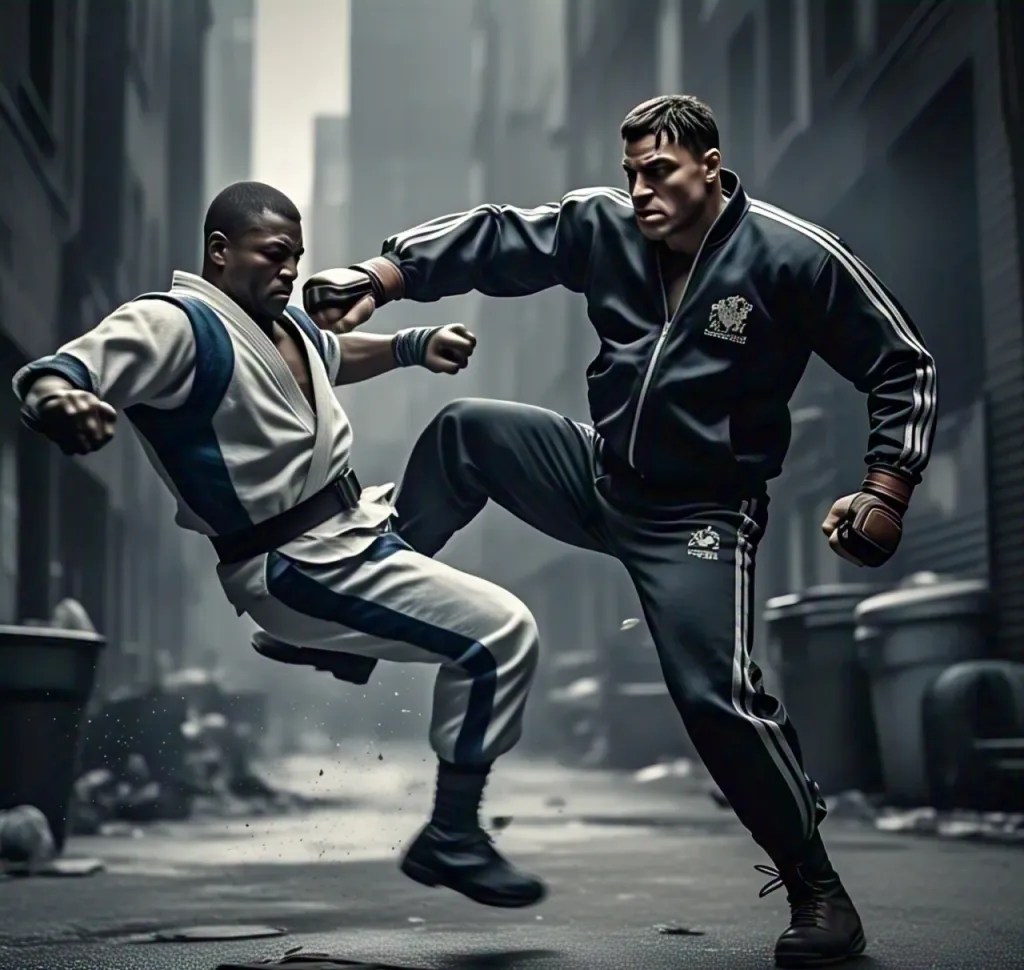
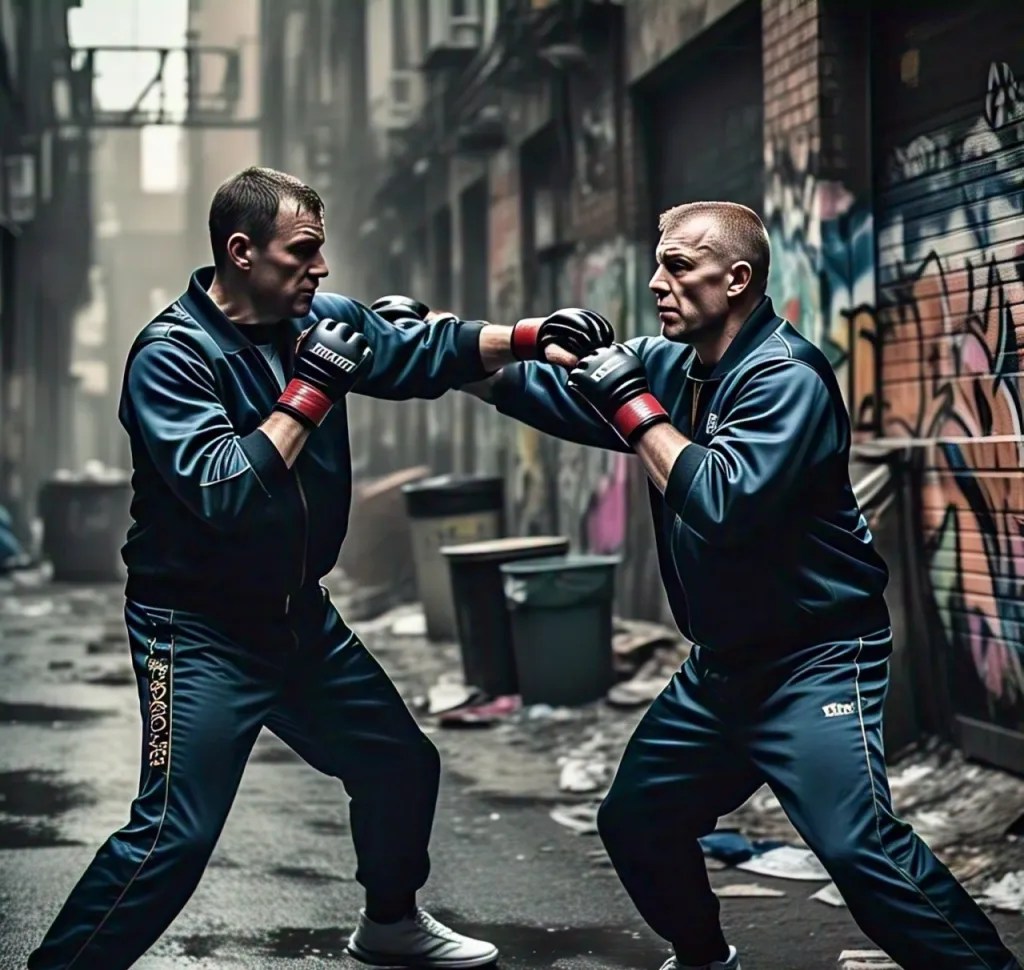
Relentless Straight Blast: When set up properly, a nearly unstoppable force—pure momentum in motion.
THE WAY OF STRATEGY
Attack is the secret of defense; defense is the planning of an attack. – Sun Tzu
In the realm of combat, hesitation is defeat. RAT Synthesis embraces the philosophy of proactive aggression—the ability to take control of the fight by inflicting pain as defense.
This method is built on the principles of destruction and interception, ensuring that every movement cripples the attack before it can manifest.
NO HESITATION.
RAT Synthesis Mind Range™ training helps transform you into the ultimate warrior
No Fear, No Hesitation, No Surprise, No Doubt – Miyamoto Musashi
To eliminate hesitation, fear, and other inner interference, we train Mushin no shin (無心の心) mindset. Pure awareness.No-self. Wide angle vision.
Learn to tap into no-mind, no-self and move faster, think sharper, and respond with an intelligence beyond the limits of the conditioned self.
The benefits extend beyond the kwoon (training hall) and into all areas of your life, allowing you to become the calm, still, highly effective center in the midst of life’s storms and chaos.
“It is not the strongest of the species that survive, nor the most intelligent, but the one most responsive to change.” — Charles Darwin
When still, we are relaxed yet ready.Same when moving around at a distance.
When counter attacking, we use intense explosive motion to overwhelm our opponent and throw them off balance.
There’s a reason Japan’s most fearless warriors, the samurai, embraced Zen.
Mushin no shin, prepared to intercept and destroy.
Not being tense but ready; not thinking yet not dreaming; not being set but flexible – ready for whatever may come – Bruce Lee
The Art of Pain: Destruction & Interception
“The best way to predict your future is to create it.” — Abraham Lincoln
A successful defense isn’t about blocking; it’s about ensuring your opponent regrets ever initiating the attack. RAT Synthesis employs two devastating approaches:
Interception: Striking into the attack, stopping it before it reaches you.
Destruction: Counterattacking the attacking limb itself to “defang the snake,” making further attacks impossible.
“An idiot with a plan can beat a genius without a plan.”
– Warren Buffet
THE BATTLE PLAN: PAIN – PRESSURE – TERMINATE – FOLLOW UP – FINISH!
Pain: Strike a vital point or destroy the attacking limb, creating an opening.
Pressure: Engage with a relentless Straight Blast, overwhelming their defenses.
Terminate: Close range and destroy with headbutts, knees, and elbows.
Follow Up: Ensure they have no chance to recover.
Finish: End the encounter decisively.
FOLLOW-UP
Powerful boxing punches inspired by Mike Tyson
Devastating PaGua palm strikes
Chops to the throat (life or death)and neck
Ridge Hand Strikes(throat and back of the neck) Life or death
Doubles
Palm strikes to the side of the head
FINISH
Push them away
Push them away, then kick
White Snake Spits Out Tongue (Tai Chi)
Chin Lift and Rear Takedown
Rear Strangle
Arm Bar
This battle-tested strategy draws from the legendary Bruce Lee’s Jeet Kune Do, combined with GrandmasterDenis Decker’s Gung Fu, and the explosive power of Mike Tyson’s boxing and kicking. At its core is Rapid Assault Tactics (RAT), pioneered by Sigung Paul Vunak, a system designed for pure combat efficiency. This is the synthesis of battle-tested strategies from some of the most legendary street fighters in history.
Lead sidekick interception
TACTICAL BREAKDOWN: THE ART OF INTERCEPTION AND DESTRUCTION
A simple elbow destruct eliminates their weapons.
We do not attempt to out box a superior boxer. Instead, we intercept, destroy, and simultaneous block and hit.
”Imagine Muhammad Ali with no legs or arms, all he would be is a stump, just bouncing around with no way of harming you”.
– Dan Inosanto.
Vs. Straight Punches
Destructions:
Leopard Fist – Attacking the incoming limb with a sharp, penetrating strike.
Elbow Destructs – Using your elbow to smash into the opponent’s fist.
Gunting (Scissors) – A cutting strike with the middle knuckle to disable the attacking arm.
Phoenix Eye Fist – Targeting sensitive areas with precision.
Strike their biceps
A simple knee destruct obliterates their shin when they Thai round kick
Eye jab interception
Interceptions:
Eye Jab – As they close the distance, blind them immediately.
Leopard Fist to Throat – In life-or-death scenarios, neutralize instantly.
Front/Side Kick to Groin or Legs – Stop their advance cold.
Pat the Jab, Pat the Cross + Intercept:
Lead Low Sidekick
Rear Thai Kick to Thigh
Low Front Kick or Oblique Kick
Evade and Counterattack Simultaneously
Angle and Fire with Hand strikes or Kicks
Intercepting with a groin kick and taking them down
Simultaneous counter punch takes the initiative
Simultaneous Blocking and Striking
Vs. Hook Punches: Outside block while launching an eye jab.
Vs. Overhand Punches: Rising block at a 45-degree angle while launching an eye jab.
Vs. Kicks:
High Round Kick: Elbow destruction.
Low Round Kick: Knee destruction.
Middle Round Kick: Shelf the leg, knee strikes up, elbow strikes down, front groin kick, and trip.
MiddleSide Kick: Elbow strike down while retreating slightly.
Low side kick to leg: raise your knee and tuck your heel a little.
Spin Kick: Front heel kick to their butt or lower back to stop it.
Heel Hook Kick: Elbow destruction to disable.
Counter Ground Fighting (RAT).
We do not attempt to out grapple a superior grappler. Instead we create pain and escape opportunities. We want to be on our feet and in a mobile position.
Vs. Grappler:
If they shoot in, use Bagua internals to prevent it. If you end up on the bottom, use RAT counter ground fighting.
“Float like a butterfly, sting like a bee” – Muhammad Ali
THE BACKUP PLAN: PURE BLOCKING & EVASION
While proactive aggression is the core of RAT Synthesis, there’s always a need for defensive fallbacks:
Western Boxing Guard: Tight cover, patting punches, and strong blocking.
At higher levels, we introduce advanced Gung Fu and Bagua principles, emphasizing taking the sides and flanking attacks.
Once the cross-arm position or a connection with their body occurs, Denis Decker Gung Fu principles are applied to manipulate their centers and dominate the encounter.
Become a Master Warrior
“The more you sweat in peace, the less you bleed in war.” — Norman Schwarzkopf
FINAL THOUGHTS: CONTROL THE FIGHT, CONTROL YOUR DESTINY
RAT Synthesis is not just a fighting system—it is a philosophy of dominance. It is built for those who refuse to be victims, who understand that true self-defense means eliminating the threat before it becomes one.
Through the synthesis of the most effective martial arts strategies in history, this system ensures that when danger arises, you dictate the outcome.
Train hard.Attack the attack. Finish decisively. Master the art of proactive aggression.Win.
In the RAT Synthesis™ fighting method, we integrate Mike Tyson–inspired kickboxing into our offensive, follow-up, and finishing phases. Rather than bobbing and weaving, we emphasize interception, destruction, and simultaneous block-striking. Iron Mike–style Street Kickboxing makes up 20% of the RAT Synthesis™ system.
This video is a Masterclass in Mike Tyson’s boxing style:
Peek-a-boo guardwith head movement to slip punches and close distance
Jab
Jab-Jab
Blinding Jab-overhand
Hooks – Body and Head
Lead hook head, rear uppercut chin
Hook to the Body, then Uppercut (same hand) (open guard, lift chin)
Uppercut to the Chin in Close Range (capitalize on tight space)
Left Hook (signature weapon, powerful finisher)
“Punches in bunches”
“Throw punches with bad intentions“
Breaking Down Mike Tyson’s Signature Uppercut | His Most Dangerous Punch 🥊
Mike Tyson’s Deadliest Combos (Breakdown)
Animals Wide 23 📅 January 27 at 4:10 PM
Kevin Rooney was asked when Mike Tyson was at his absolute prime. His answer? 😳
“When he beat Michael Spinks… He knocked out Michael Spinks in 90 seconds. It wasn’t a joke. I mean, he knocked him out. So l think that fighter, in my opinion, could have and should have probably beaten anybody that was in his path. Anybody including Rocky Marciano and Muhammad Ali. Well, I’ll give Muhammad Ali and Rocky, well it could have been different, I mean, Rocky punched like hell. Muhammad punched like hell. Rocky had beat everyone. Muhammad had heart and was hard to hit. The fights would have been interesting. But I believe that Mike would have come out the better. Because he punched very hard. I believe that Mike is one of the hardest punchers in history. He punches harder than Rocky. Punches harder than Joe Louis. Punches harder than George Foreman.”
Core Combat Principles:
Indomitable Warrior Spirit
Psychological Warfare
Discipline and Simplicity
Adaptability and Resilience
Peek-a-Boo Style
Power Punching
Aggressive Counterpunching
Body Attacks and Combinations
Angles and Footwork
Mike Tyson is a lifelong student, deeply dedicated to learning. He meticulously studied the techniques of the old-time great fighters and drew inspiration from legendary warriors throughout history. His success wasn’t merely the result of raw power and physical prowess; it was built on a foundation of profound knowledge, strategy, and insight. Beyond the ring, Tyson is a highly intelligent individual and a reflective philosopher. Despite facing his share of flaws and challenges, he has grown and matured significantly over the years, embodying resilience and transformation.
This blend of intelligence, strategy, and resilience has made Tyson a living legend in the world of boxing. His ability to master both the mental and physical aspects of his craft serves as a powerful example of achieving greatness. Let’s break down the key components of Tyson’s mindset and strategic principles that propelled him to the top and explore how these principles can be applied to success in any endeavor.
The Mindset: A Foundation of Strength and Resilience
Mike Tyson’s mindset was shaped by his difficult upbringing and the guidance of his trainer, Cus D’Amato. Below are the essential elements that define Tyson’s powerful mental game:
1. Unwavering Confidence
Tyson’s belief in himself was a cornerstone of his mindset. From the very beginning, he was taught by D’Amato to visualize success and maintain a positive self-image. Tyson was certain of his greatness and knew that without this unshakeable confidence, he would lose before the fight even began. His confidence allowed him to take on any opponent, no matter the odds.
2. Mind Over Matter
Tyson understood that controlling his mind was just as important as controlling his body. He learned to channel fear into aggression, using mental conditioning to push through pain and doubt. By visualizing his opponents folding before him, Tyson was able to dominate the psychological aspect of his fights, gaining a mental edge over his adversaries.
Tyson’s ability to visualize his opponents folding aligns with the Law of Attraction, which emphasizes the power of focused thought and belief in manifesting outcomes. By visualizing victory and mentally dominating his opponents, Tyson tapped into the energy of his intentions, attracting success and psychological dominance in the ring.
3. Discipline and Relentless Work Ethic
Despite his chaotic public persona, Tyson was known for his intense work ethic. Under D’Amato’s mentorship, he developed a disciplined approach to training that included mastering the fundamentals, conditioning, and mental preparation. Tyson’s mindset was one of constant improvement—never satisfied with “good enough,” he was always striving for excellence.
“If someone is doing more than me, I’ll do more. If he gets up at 5 to go running, I get up at 4. If he gets up at 4, I get up at 3. If he gets up at 3, I won’t sleep.” — Mike Tyson
4. Focus on the Present Moment
Tyson emphasized the importance of focusing entirely on the present moment, particularly in the ring. He left behind distractions like fame or external pressures and concentrated solely on the task at hand. This intense focus allowed him to stay in the zone, operating with precision and clarity during his fights.
Tyson’s intense focus on the present moment mirrors the essence of Zen and yoga, where mindfulness and presence are key to mastering both the mind and body. Just as Tyson shut out distractions to perform with precision, Zen and yoga teach us to center our attention, shedding external pressures and embracing the flow of the present to achieve clarity and inner power.
5. Embracing Fear
Rather than being paralyzed by fear, Tyson learned to harness it. Fear, to him, was a natural emotion that could be transformed into energy. By embracing fear and using it as fuel, Tyson became more intense and aggressive, turning an obstacle into a powerful motivator.
Tyson’s ability to transmute fear into powerful motivation mirrors the yogic practice of transmutation, where negative emotions are transformed into positive energy. Just as yogis convert inner turmoil into strength, Tyson harnessed fear, turning it from a hindrance into a driving force that propelled him to greater intensity and focus.
6. Anger as Motivation
Tyson often channeled his anger into his fights. His personal struggles, from his troubled upbringing to his turbulent emotions, gave him the fire to fight harder. Anger became a source of energy that propelled him to perform with even more intensity in the ring.
In RAT Synthesis, anger is not something to channel or use as fuel. A yogi doesn’t engage with anger but either cuts it off or simply observes it as a passing phenomenon, detached from the self. Tyson’s approach of using anger as motivation contrasts with this teaching, where emotional mastery and detachment are key to maintaining clarity and inner peace.
7. Mental Toughness and Resilience
Tyson’s life was filled with obstacles, from growing up in poverty to facing legal issues. Yet, he always believed he could rise above these challenges. This mental toughness and resilience made him a formidable force, allowing him to handle pressure and adversity like few others.
8. The Will to Win
Tyson’s mindset wasn’t just about physical preparation—it was about an unrelenting psychological drive to win. His desire to dominate in the ring was so intense that he couldn’t imagine losing. This drive, combined with his skill and mental focus, made him an overwhelming opponent.
9. The Influence of Cus D’Amato
Cus D’Amato played a pivotal role in shaping Tyson’s mindset. Beyond teaching Tyson boxing techniques, D’Amato instilled in him the belief in his own invincibility. D’Amato’s coaching taught Tyson the importance of mental strength and the development of a champion’s mindset, which became one of Tyson’s most valuable tools.
Yoga teaches the invincibility of the soul, a concept embodied by Arjuna in the Bhagavad Gita, who realizes that his true self is beyond the limitations of the body and mind.
10. Humility and Self-Awareness
In his later years, Tyson reflected on the destructive power of unchecked pride and ego. He recognized the importance of humility and balance, seeking peace within himself. This self-awareness became a key aspect of his mindset as he continued to grow, learn, and evolve.
Masters embrace egolessness because it allows them to remain open to learning and growth. By letting go of unchecked pride and ego, they cultivate humility and inner peace, which creates the space for true wisdom and adaptability. This self-awareness, as Tyson discovered later in life, becomes a powerful advantage, enabling one to transcend limitations and evolve both personally and professionally.
The Strategy: Aggression, Adaptability, and Psychological Mastery
Tyson’s strategic approach in the ring was built on a blend of intense preparation, psychological warfare, and sheer aggression. Here are the key elements of his strategy:
1. Intense Preparation
Preparation was the foundation of Tyson’s success. He trained rigorously, mastering both his physical and mental skills. This included perfecting his fundamentals, conditioning, and mental resilience. Tyson believed that preparation wasn’t just about the body—it was about ensuring that the mind was equally prepared to face the challenge ahead.
Sun Tzu, like Tyson, emphasized the importance of preparation as the key to success. In The Art of War, he stresses that victory is won long before the battle begins, through careful planning, strategy, and mental readiness. Sun Tzu believed that thorough preparation of both the body and mind is essential to achieving victory, a principle that Tyson applied both in and out of the ring.
2. Fearlessness and Aggression
“A good offense is the best defense”
Tyson’s approach to fighting was rooted in fearlessness and aggression. He was known for overwhelming his opponents right from the start, using his speed and power to take control of the fight. Tyson believed that the key to success was to never back down and to be the aggressor in every fight.
The Samurai Warriors, particularly under figures like Miyamoto Musashi, were trained in the art of swift, aggressive action. Musashi’s philosophy emphasized striking first, using speed and precision to overwhelm the opponent.
Similarly, Bruce Lee’s martial arts philosophy was about dominating with precision and fluidity. Lee believed in creating the action rather than waiting for the opponent, staying one step ahead at all times.
3. Adaptability and Flexibility
While Tyson was known for his aggressive style, he also understood the importance of adaptability. He didn’t rely on a single strategy but adjusted his approach based on the strengths and weaknesses of his opponent. This flexibility allowed him to stay unpredictable and maintain control over the flow of the fight.
Similarly, Joe Lewis, the karate champion, used Bruce Lee’s five ways of attack to defeat different fighter archetypes. By blending speed, timing, and the right choice of attack, Lewis was able to adapt his strategy to overwhelm counterfighters, defensive fighters, and aggressive fighters, much like Tyson, remaining unpredictable and in control of the fight’s flow.
4. Intimidation and Psychological Warfare
Tyson was a master of psychological warfare. He used his intense presence and reputation to break down his opponents mentally before the fight even began. Whether through staring them down, trash-talking, or simply projecting dominance, Tyson’s ability to plant seeds of doubt in his opponent’s mind was a key component of his strategy.
Like Tyson, MuhammadAli used psychological tactics such as trash talk and mind games to break his opponents before the fight. His ability to dominate mentally as well as physically was a key part of his strategy, famously using his trash talk to get into the heads of fighters like Sonny Liston and George Foreman.
Bruce Lee used psychological warfare by projecting confidence and unpredictability to unsettle his opponents. His intense presence, quick movements, and direct eye contact often created a mental edge, destabilizing adversaries before the fight even began. Lee’s adaptability and calm focus also kept opponents guessing, giving him control both mentally and physically.
5. Simplicity and Directness
Tyson’s in-ring strategy was simple yet effective. His coach, Cus D’Amato, taught him the “peek-a-boo” style, focusing on quick movements, head fakes, and powerful combinations. Tyson’s strategy was to keep things direct and to the point, minimizing the risk of mistakes while maximizing his offensive power.
Similarly, Bruce Lee embraced simplicity and directness in his approach, favoring efficiency over complexity. Lee’s philosophy of “absorb what is useful” was about using the most effective techniques with minimal movement, eliminating unnecessary actions to create maximum impact. Both Tyson and Lee understood the power of clarity and focus in achieving success.
6. The Power of the First Punch
Tyson believed that the first punch could change the trajectory of the fight. His strategy often centered on delivering a powerful, decisive blow early on to set the tone and gain the psychological advantage. This first punch often left his opponents reeling, both physically and mentally.
Under leaders like Miyamoto Musashi, samurai often struck first to gain the initiative. Musashi’s philosophy of “sword drawing first” emphasized the importance of taking control from the start to dominate the opponent both physically and mentally.
Bruce Lee’s approach in martial arts also revolved around striking first, using speed and fluidity to surprise opponents. His emphasis on controlling the fight from the start aligned with Tyson’s principle of taking the initiative early.
7. Control and Domination
Ultimately, Tyson’s strategy was about controlling the pace and rhythm of the fight. He aimed to dominate every aspect—physically, mentally, and emotionally—by staying aggressive and keeping his opponent on the defensive.
Conclusion: The Tyson Mindset and Strategy for Success
Mike Tyson’s mindset and strategic approach were essential to his rise as one of the greatest boxers in history. His blend of confidence, fearlessness, mental toughness, and adaptability helped him dominate in the ring. Tyson’s strategy, which combined psychological mastery with aggressive offense, became a blueprint for success.
The lessons from Tyson’s mindset and strategy aren’t confined to boxing. They can be applied to any area of life—whether it’s business, personal growth, or overcoming challenges. By developing an unshakable belief in yourself, embracing fear, staying disciplined, and adapting to changing circumstances, you can unleash your own power and achieve success, just like Tyson did.
SIFU RUSSO’S BOXING AND KICKBOXING EXPERIENCE
Guro Martin Gross Extensive training in Jeet Kune Do, Kali/Eskrima, and Kickboxing under the mentorship of Guro Martin Gross, a student of Dan Inosanto at the Inosanto Academy of Martial Arts in the 1970s.
Tony Bersani Studied some western boxing under the tutelage of Tony Bersani, Fitness Works Boxing Center, Philadelphia, PA.
Multiple sparring sessions with other practitioners, including a Golden Gloves-level amateur boxer.
Twelve Rounds with Mike Tyson
Sifu Russo completed 12 Rounds with Tyson, a transformative program designed by Mike Tyson to help individuals develop a champion’s mindset for success.
The Fundamentals of the Peekaboo & Power Punching by Mike Tyson
Sifu Russo completed The Fundamentals of the Peekaboo & Power Punching by Mike Tyson, an online course from Dynamic Striking where the legendary boxer shared his iconic Peekaboo style and the secrets behind his unparalleled power and speed.