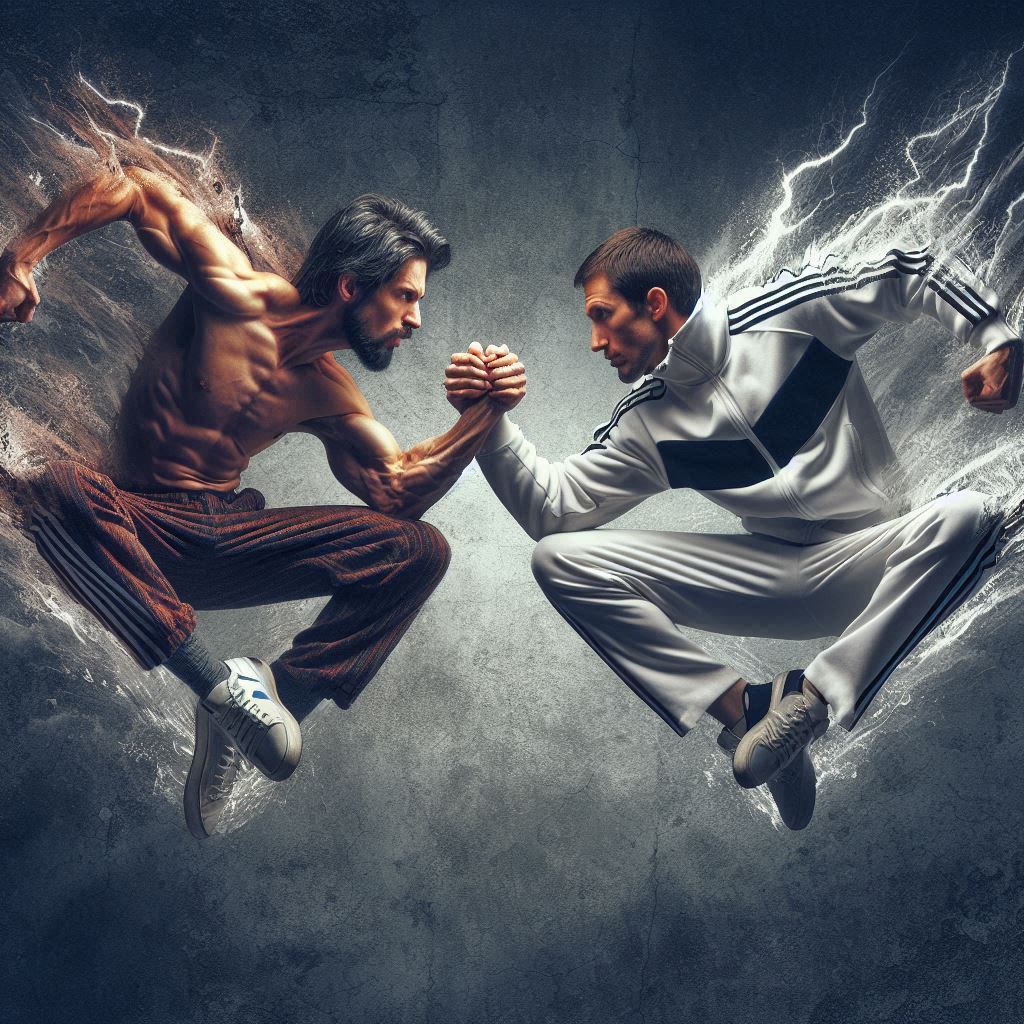
Meditation is focusing your attention on one thing for a period of time or for repetitions.
Meditation is commonly associated with sitting still, closing the eyes, and withdrawing from the activity of the world. This type of meditation is valuable because it trains the mind to concentrate, observe, and remain present. However, meditation is not meant to end when we stand up. The deeper purpose of meditation is to carry awareness into movement, pressure, conflict, work, relationships, and everyday life.
This is the essence of Meditation in Motion.
Meditation in Motion is the ability to maintain awareness, composure, and freedom of choice while the body, mind, environment, and other people are constantly changing. It is the practice of bringing the stillness and clarity developed through meditation into action.
The Physiology of Reactivity
Ordinary life can repeatedly activate the body’s stress response. Something happens and we immediately react. Someone insults us, and we become angry. A problem appears, and we panic. Danger arises, and we freeze. Someone becomes aggressive, and we automatically respond with aggression.
The event and our reaction seem to be one continuous process.
When the mind perceives threat, the body can activate the fight-or-flight response. Stress hormones such as adrenaline and cortisol prepare the body for immediate action. The heart rate increases. Muscles tense. Breathing may become faster and shallower. Attention narrows toward the perceived threat.
This response is valuable when immediate physical action is genuinely required. However, the body can also activate the same stress response to arguments, financial problems, work pressure, uncertainty, criticism, anxiety, and thoughts about the future.
The body may react as if the threat is physically present even when the danger exists primarily in the mind.
If this pattern of reactivity is constantly repeated, the body and mind may spend too much time in a state of unnecessary stress and physiological activation. We become conditioned to react before we have fully perceived what is happening.
Meditation begins to interrupt this process.
Through meditation, we practice observing thoughts, emotions, and physical sensations without immediately obeying them. Instead of being automatically carried away by every thought or emotion, we learn to create space between the experience and our response.
This creates a fundamental sequence:
Event → Awareness → Choice → Action
Rather than:
Event → Automatic Reaction
This gap between stimulus and response is one of the foundations of mastery.
Meditation and the Stress Response
Meditation does not mean that we will never experience stress. Stress is a natural biological response, and it can be useful. The goal is not to eliminate the body’s ability to respond to genuine danger.
The goal is to avoid activating the entire stress response unnecessarily and to recover more effectively after stress has occurred.
When we are constantly reacting to every problem, every insult, every uncertainty, and every imagined future threat, the body can remain trapped in a cycle of tension and recovery. The mind continually sends the message:
Something is wrong. Prepare yourself.
Meditation trains us to examine that message before automatically accepting it.
A thought appears:
“This is terrible.”
Meditation teaches us to notice:
“I am having the thought that this is terrible.”
An emotion appears:
“I am angry.”
Meditation teaches us to observe:
“Anger is present.”
Fear appears:
“I am afraid.”
Meditation teaches us to recognize:
“Fear is being experienced.”
This small shift creates distance between consciousness and the experience.
We are no longer completely identified with the thought, emotion, or physical sensation. We can observe the experience without immediately becoming controlled by it.
Over time, this ability can help us respond to stress with greater composure. Instead of constantly allowing the mind to trigger unnecessary emotional reactions, we become better at recognizing what is actually happening and choosing an appropriate response.
The result is not weakness.
The result is greater regulation.
A person who is less controlled by unnecessary stress can think more clearly, recover more effectively, conserve energy, and make better decisions.
This is one of the ways meditation can contribute to a healthier way of living.
Healthier Through Meditation in Motion
Meditation in Motion extends this principle beyond the meditation cushion.
The objective is not merely to become calm while sitting in a quiet room. The objective is to carry that calm awareness into daily life.
We train ourselves to remain more centered while:
working under pressure,
dealing with difficult people,
facing uncertainty,
solving problems,
training physically,
engaging in conflict,
experiencing disappointment,
managing fear,
and adapting to unexpected change.
This does not mean that stress disappears.
It means that we become less likely to add unnecessary psychological stress to every situation.
A difficult event occurs.
Instead of immediately thinking:
“This should not be happening!”
we can observe:
“This is happening. What is the best move?”
Someone insults us.
Instead of automatically producing anger, we observe the anger.
A problem appears.
Instead of immediately producing panic, we observe the panic.
Fear appears.
Instead of automatically obeying fear, we observe fear and determine what action reality actually requires.
This process can prevent the mind from continuously escalating a situation internally.
The body may still experience stress. The heart may still beat faster. The muscles may still tense. But awareness gives us the opportunity to stop adding additional layers of fear, anger, resentment, and catastrophic thinking.
We become better at allowing the stress response to rise when necessary—and allowing it to settle when the threat has passed.
This is a healthier relationship with stress.
Meditation in Motion therefore becomes more than a mental discipline. It becomes a method of learning how to move through life with less unnecessary reactivity.
The goal is not to become immune to stress.
The goal is to become less controlled by it.
From Stillness to Movement
Seated meditation develops the ability to observe thoughts, emotions, and sensations without being immediately controlled by them. We learn to witness anger without instantly acting from anger. We learn to observe fear without automatically obeying fear. We learn to notice anxiety without allowing it to dictate every decision.
Meditation in Motion takes this ability into the real world.
The world does not remain still simply because we want to remain calm. In martial arts, an opponent moves. In life, circumstances change. People make unexpected decisions. Problems appear without warning. The future remains uncertain.
The challenge is therefore not simply to become calm while sitting in a quiet room.
The challenge is to remain centered while everything is moving.
This is why meditation and martial arts complement each other so well.
Meditation trains the mind to observe.
Martial arts train the body to act.
Meditation teaches stillness.
Martial arts teach movement.
Together, they develop the ability to remain mentally centered while physically adapting to changing circumstances.
Stillness is not the absence of movement.
Stillness is the ability to remain centered while everything moves around you.
Avoiding the Freeze Response
One of the greatest benefits of Meditation in Motion is the ability to avoid becoming paralyzed by pressure.
When people encounter danger, conflict, or extreme stress, they may freeze. The mind becomes overwhelmed. Too many possibilities appear at once. Fear and uncertainty interfere with action.
The person may know what to do intellectually, but the body does not respond.
Meditation trains us to become familiar with the experience of observing uncomfortable thoughts, emotions, and sensations without immediately being overwhelmed by them. Through practice, we develop the ability to remain present even when the situation is uncomfortable.
In martial arts, this means continuing to perceive and move under pressure.
You do not need to know the perfect technique in advance. You do not need to predict every possible action of an opponent. You need to remain present enough to see what is actually happening and respond to it.
The goal is not to eliminate stress completely.
The goal is to avoid being controlled by the first reaction to stress.
The master is not someone who never experiences fear.
The master is someone who can experience fear and still perceive clearly.
Beyond Reactivity
Reactivity is automatic behavior driven by impulse.
Someone attacks, and you attack back.
Someone becomes angry, and you become angry.
Someone creates chaos, and you allow their chaos to enter your mind.
Reactivity means that another person or circumstance has taken control of your behavior.
Meditation in Motion restores the ability to choose.
This does not mean becoming weak, passive, or indecisive. A conscious response can be extremely fast and extremely decisive. The difference is that the action comes from awareness rather than emotional confusion.
A martial artist does not want to be controlled by anger. Anger can make a person predictable. Fear can make a person freeze. Ego can make a person take unnecessary risks.
The calm mind has more options.
It can move forward.
It can move backward.
It can change angles.
It can wait.
It can negotiate.
It can disengage.
It can act decisively.
The objective is not to react to the opponent’s plan.
The objective is to understand the situation and execute the best available response.
Playing Chess with Life
This is where meditation, martial arts, chess, and life intersect.
Chess teaches us not to react emotionally to every move. We observe the position. We identify threats. We consider possibilities. We anticipate consequences. Then we make the best move available.
Life works the same way.
A problem occurs.
We do not have to immediately become the problem.
Someone makes a move.
We do not have to automatically make the move they expect.
A difficult situation develops.
We can observe the entire position before deciding how to respond.
This creates a different way of living:
Do not react to every move. Observe the position. Understand the threats. Anticipate the consequences. Make your best move.
In martial arts, the opponent is part of the position.
In chess, the pieces are part of the position.
In life, the entire situation is the position.
The people involved, the available resources, the risks, the consequences, and our own emotional state all become part of the board.
The question is no longer simply:
“How do I win?”
The better question becomes:
“What is the best move?”
The Best Move for All Parties Involved
The highest expression of Meditation in Motion is not simply learning how to defeat other people. It is learning how to respond intelligently to situations.
Sometimes the best move is to fight.
Sometimes the best move is to escape.
Sometimes the best move is to negotiate.
Sometimes the best move is to establish a boundary.
Sometimes the best move is to wait.
Sometimes the best move is to help someone.
Sometimes the best move is to do nothing.
Wisdom is knowing the difference.
The best move is the action that most effectively addresses reality while avoiding unnecessary damage. Whenever possible, it seeks the best outcome not only for ourselves but for all parties involved.
This does not mean sacrificing ourselves or allowing others to abuse us.
Compassion without wisdom can become weakness.
Strength without compassion can become destructive.
Meditation in Motion seeks integration.
We protect ourselves without unnecessary hatred.
We establish boundaries without unnecessary cruelty.
We act decisively without being controlled by anger.
We seek victory without creating unnecessary enemies.
We recognize that the best solution is often not the one that satisfies the ego’s desire to dominate, but the one that resolves the situation most effectively.
From Martial Arts Mastery to Life Mastery
Martial arts provide a laboratory for this process.
At first, the student must consciously think about every movement. The body is awkward. The techniques are separate. Under pressure, the student may forget what was practiced.
Through repetition, the movements become more natural.
Eventually, the practitioner begins to recognize patterns. Distance, timing, rhythm, balance, and intention become easier to perceive. The practitioner no longer has to consciously calculate every movement.
This is not the elimination of awareness.
It is the development of a deeper awareness.
The practitioner trains until the body can act without being paralyzed by conscious overthinking, while the mind remains present enough to adapt.
This is the union of meditation and movement.
The same principle applies to life.
We develop skills through practice. We encounter difficulties. We make mistakes. We observe the results. We adjust our strategy. Over time, we become better at recognizing patterns and making decisions.
Mastery is not perfection.
Mastery is the ability to remain present, learn from reality, adapt, and make the right move repeatedly.
The process can be expressed as:
Meditation → Less Reactivity → Better Stress Regulation → Clearer Perception → Better Decisions → Deliberate Action → Practice Under Pressure → Mastery
Meditation alone does not create mastery.
Meditation creates the mental conditions that make mastery possible.
The practitioner must then apply awareness through action and disciplined repetition.
The Warrior and the Yogi
This is the connection between the warrior and the yogi.
The yogi trains the mind to become still.
The warrior trains the body to act.
The yogi learns not to be controlled by every thought.
The warrior learns not to be paralyzed by every threat.
The yogi observes the movements of the mind.
The warrior observes the movements of the opponent.
Both are learning the same fundamental lesson:
Do not become a slave to your first reaction.
The warrior who has no control over the mind can become reckless.
The meditator who never tests awareness under pressure may remain calm only in ideal circumstances.
The integration of the two produces something greater.
The body becomes capable of action.
The mind remains centered.
The practitioner learns to move through the world without being constantly thrown off balance by every external event.
The body still possesses the ability to respond to real danger.
But the mind becomes less likely to create unnecessary danger where none exists.
This is the meeting point of spiritual practice, physical training, and health.
Meditation in Motion as a Way of Life
Ultimately, Meditation in Motion is not merely a martial arts training method.
It is a way of living.
It means remaining aware while walking, working, training, speaking, solving problems, and dealing with difficult people.
It means noticing the first emotional reaction without automatically obeying it.
It means recognizing fear without allowing fear to make every decision.
It means observing anger without becoming anger.
It means remaining flexible when circumstances change.
It means maintaining the ability to choose.
It also means developing a healthier relationship with the body’s stress response.
We learn to recognize when the body is preparing for action.
We learn to distinguish between genuine danger and unnecessary mental alarm.
We learn to allow the body to respond when action is required.
And when the danger has passed, we learn to return to a more centered state rather than remaining trapped in prolonged emotional reactivity.
The goal is to become like a chess player who is constantly aware of the position of life.
You observe the board.
You recognize the threats.
You see the opportunities.
You anticipate consequences.
You remain flexible.
Then you make your best move.
Sometimes the best move is powerful.
Sometimes it is subtle.
Sometimes it is immediate.
Sometimes it requires patience.
But the move comes from awareness rather than unconscious reaction.
This is the path from meditation to martial arts mastery and ultimately to life mastery.
Meditation teaches you to become still.
Meditation in Motion teaches you to remain still within while moving through a constantly changing world.
And when you can remain centered while everything around you is moving, you become increasingly difficult to freeze, manipulate, overwhelm, or control.
You are no longer merely reacting to life.
You are participating consciously in it.
You are playing chess with reality.
And with every moment of awareness, every act of discipline, every controlled response, every recovery from stress, and every wise decision, you make your next move toward mastery.
Meditation in Motion: remain centered, regulate the response, perceive clearly, and make your best move.
“Jeet Kune Do is using No Way as Way, Having No Limitation as Limitation” – Bruce Lee
Critics of modern fighting systems often lean on traditional boxing theory—the idea that a fighter must keep their hands “at a distance,” high and fixed in a textbook orthodox guard from the 1800’s—and dismiss anything that deviates from that model. They may point to Mike Tyson’s peek‑a‑boo stance as evidence that one should “model themselves on a different boxer” and conform to a prescribed hand position to be effective.
There are valid historical and technical observations behind this critique. The peek‑a‑boo stance—developed by Cus D’Amato and perfected by Tyson—places the hands directly in front of the face and relies on constant head movement: bobbing, weaving, slipping, and tight defensive structure. It was designed to help shorter fighters close distance against taller opponents, protect the chin, negate reach advantages, and explode with hooks and uppercuts at close range.
The mistake comes when a single technique—or even an entire sport‑specific system—is treated as a universal rule rather than a solution to a specific problem.
For Tyson, peek‑a‑boo was never about passivity or “hiding behind pillows.” It was an aggressive method of closing distance, slipping strikes at close quarters, and delivering devastating power through a precise rhythm of head and body movement. It worked exceptionally well within the constraints of professional boxing: gloves, referees, rounds, and the absence of kicks, grappling, or street variables.
This is where RAT Synthesis diverges—not from ignorance of tradition, but from strategic necessity.
“You should not have a fixed stance. Stance changes according to the situation.” – Miyamoto Musashi, sword saint of Japan
RAT Synthesis deliberately integrates:
Bruce Lee’s pragmatic street‑attack philosophy, emphasizing simplicity, directness, and adaptability—where a functional “gun‑sight” guard may be employed.
Tyson‑style power striking and forward pressure, without reliance on boxing‑specific head movement or stance—though a peek‑a‑boo–type guard may still be used when appropriate.
Denis Decker’s Gung Fu / Baguazhang principles, including fa jing (explosive energy release) and center manipulation—expressed through a p’eng–hèng‑inspired guard.
RAT Synthesis is not trying to be boxing. It is not trying to be kung fu. It is not trying to be Muay Thai. It extracts what works against real threats—where rules do not exist and encounters do not last three‑minute rounds. We can adopt one of the three guards above or other guards as the situation dictates.
In this context, debates about keeping the hands “at a distance” or “high like an orthodox boxer” become largely academic. Real violence rarely allows time to establish ideal range, assume a sport‑correct stance, or fight to a decision. The objective is to end the encounter quickly through decisive action, efficient energy use, and strategic intent. Accordingly, RAT Synthesis emphasizes takedown prevention, center disruption, and intent‑driven movement over rigid positional guard theory.
Because RAT Synthesis trains fa jing at Tier 3, practitioners learn to generate and project force explosively—even when ranges close, structure shifts, or the guard momentarily releases. Real combat does not reward attachment to idealized postures; it rewards adaptability, timing, and the ability to create openings under pressure.
So yes, traditional boxing critiques have merit—within their own framework. But RAT Synthesis does not operate inside that framework. We are not training for sanctioned competition. We are training for survival, adaptability, and real‑world effectiveness in environments where sport rules do not apply.
That is not a rejection of boxing wisdom. It is an evolution beyond it.
“You can only fight the way you train.” – Miyamoto Musashi, A Book of Five Rings
Let’s get real.
The UFC and modern MMA are a spectacle. Entertaining? Absolutely. Effective? To a point. But if you think what happens in the cage reflects the savage, unpredictable, and dirty nature of real violence—you’ve bought into the modern classical mess Bruce Lee warned us about.
Let’s break it down:
Weight Classes. Rules. Referees.
You don’t get those on the street.
In the octagon, you’ve got timed rounds, doctors, tap-outs, padded gloves, and strict rules that ban the very tools that end real fights in seconds: groin strikes, eye jabs, throat shots, ear slaps, bites, claws, leg fractures, and stomps. That’s not a knock on the athletes—some are phenomenal. But it is a knock on the idea that MMA as a sport is the end-all-be-all of combat training.
Street fighting is no-holds-barred. And if you’re not training for that reality, you’re not ready.
Horrendous EYE POKES That Lead to Fight Stoppages
RAT Synthesis™: MMA for the Street, Not the Cage
(Inspired by Rapid Assault Tactics™ R.A.T.)
RAT Synthesis™ was born from battle and built for victory. This isn’t theory. This isn’t art for art’s sake. This is a combat and mindset system forged from the raw truth of street altercations, military encounters, and years of refining what actually works under real pressure.
👉 Rapid-fire low-line kicks to shatter knees. 👉 Eye jabs that disorient or disable. 👉 Ear slaps that rupture eardrums and shut down balance. 👉 Carotid stuns that drop attackers like a sack of bricks. 👉 Groin destruction that ends the fight before it starts.
This is not “tough guy talk.” These are surgical, ballistic tools you deploy when your life, your loved ones, or your mission is on the line.
“If You Can’t Beat a Trained Fighter With Rules, How Can You Without Rules?”
This is a common misunderstanding.
In reality, removing the rules changes everything. It doesn’t level the playing field—it flips it entirely. The sport-trained fighter operates inside a framework. That framework conditions the fighter’s nervous system, instincts, and tactics. When those rules are stripped away, so is their operating system.
RAT Synthesis™ was built outside that system.
This is chess, not checkers.
While some train to score points or win on the judge’s card, we train to cause pain, break structure, and end the encounter instantly.
💥 Eye jab before they even know the fight started. 💥 Elbow spike into a punch to fracture the attacking limb. 💥 Lead sidekick into the knee as they step forward—fight over before it began. 💥 Intercept, destroy, terminate.
In RAT Synthesis™, defense isn’t passive. We don’t block—we break. We don’t wait—we intercept. We don’t counter—we destroy and finish.
Our method relies on the pain–pressure–termination sequence:
Pain (via destructions, nerve shocks, or sensory disruption like eye jabs), This steals the initiative
Pressure (overwhelming, nonstop forward barrage using a STRAIGHT BLAST that turns them into a pedestrian—backpedaling, panicked, and off-balance),
Termination (decisive, brutal end using headbutts, knees, elbows). If this doesn’t seal the deal, we have more.
This is not theory. It’s not for points. It’s not sparring. It’s survival.
So yes, a highly trained MMA fighter may dominate inside a controlled ruleset—but when the rules are gone, so is their edge.
The way you train is the way you fight.
Another example: when two fighters are tangled on the ground, each scrambling for position with endless counters—why play that game? Instead of trading move for move, a direct attack to a vital target—like seizing the groin—ends the fight immediately. Why memorize a hundred counters when a few ruthless, well-placed moves let you dominate?
RAT Synthesis™ turns chaos into strategy. We operate in the shadows of the rulebook—where speed, ruthlessness, and targeting vital structures matter more than endurance, points, or submission games.
The Missing Link: The Warrior Mind
What’s even more dangerous than technique? Mindset.
The modern martial arts world is missing its heart—the warrior spirit. What gave the Zen Samurai their edge wasn’t just their sword. It was their mind. Calm under chaos. Focused. Fierce. Fully present. Stillness in motion. And killer instinct.
At RAT Synthesis™, we train that. Through warrior meditation and strategic mental conditioning, we forge fighters who are as mentally sharp as they are physically deadly. Because when fear hits, when adrenaline spikes, when the chaos surges—you fall back on your training.
And if your training was built for sport, you lose.
UFC = Entertainment.
RAT Synthesis™ = Survival.
The modern MMA world may laugh now—but in a real violent encounter, they’ll wish they trained for what we train for.
This isn’t a game. This isn’t about belts or titles. This is about walking away alive—every time.
Lastly, as you get older, you don’t have time to play and roll around. You need to end it quickly.
Learn the system that cuts through the noise. Train in the art that ends fights in seconds, not rounds. Forge the mindset that wins before the battle begins.
Bruce Lee wasn’t just a movie icon — he was a nearly unbeatable street fighter in both the U.S. and Hong Kong, the heart of Chinese Kung Fu.
Legends like Chuck Norris, Joe Lewis, Bolo Yeung, Jim Kelly, and Mike Stone (91 straight wins in full-contact karate) all recognized one thing: Bruce had a deadly edge that conventional martial arts never captured. But the complete, real-world system of domination? It was never released. Almost lost forever. Until now.
After decades of relentless study, brutal training, and real-world testing, Sifu Matt Russo has cracked the Bruce Lee code— and now it’s yours. Forget flashy kicks and cage rules. This isn’t for sport. Not for show. This is raw, brutal street fighting — built for one thing: Dominate. Survive. Walk away alive.
Inside this book, you’ll discover:
The hidden blueprint of Bruce Lee’s street-fighting genius — decoded and made battle-ready
Why traditional martial arts and conventional MMA fall short in real-life violence — and what actually works when your life depends on it
The radical simplicity of Jeet Kune Do.
Master the art of striking first and applying offensive defense — with battle-tested tactics to control the fight and end it fast
How Bruce’s vision inspired elite fighters to break from tradition and master the true art of survival
This isn’t a history lesson — it’s a revolution in real-world self-defense.
“Life is really simple, but we insist on making it complicated.” — Confucius The pieces were scattered— but I’ve assembled the puzzle for you. This is your street fighting blueprint: distilled from Rapid Assault Tactics™ (R.A.T.) and the Joe Lewis Fighting System™ — both rooted in Jeet Kune Do — and sharpened through 44 years of training and deep study of Bruce Lee. While Joe Lewis’s system was designed for sport, what I share here is forged specifically to dominate on the street. This recipe gives you clear, decisive advantages in real-world combat, even against larger experienced fighters.
You could study every JKD style, concept, and system, read every JKD book, watch every JKD video, train in multiple arts, and even learn from JKD legends like I did — and still miss the mark. That was me. Lost in the trees. Couldn’t see the forest. Until I found this recipe — and now you can too.
Avoid years of confusion, frustration, or worse—believing you know it all when you don’t. Get this book. Because in the end, truth is simple: “Jeet Kune Do is simply to simplify.” — Bruce Lee
About the Author: Sifu Matt Russo is a warrior, teacher, and seeker with 44+ years of martial arts mastery across Kung Fu, Kickboxing, Kali, and Jeet Kune Do — including years of study with a Bruce Lee lineage instructor, multiple seminars with JKD legends, and training in Chi Ling Pai® under Grandmaster Denis Decker. A spiritual mentor grounded in Raja Yoga and the teachings of Paramahansa Yogananda, Matt blends physical mastery with mental clarity — plus 35 years of corporate strategy experience — to decode Bruce Lee’s ultimate system for survival and success.
When chaos erupts, you won’t rise to the occasion — you’ll fall to your training. If you’re done with illusions… If you want power, precision, and survival skills that work in the real world… Click the link below and unleash Bruce Lee’s complete street-fighting system — finally decoded and battle-ready. The street doesn’t wait. Neither should you.
TABLE OF CONTENTS
INTRODUCTION
UNLEASHING THE STRATEGIC GENIUS OF BRUCE LEE
CONCLUSION: THE RETURN OF THE DRAGON’S CODE
PROGRESSIVE TRAINING SYSTEM
APPENDIX / RESOURCES
ABOUT THE AUTHOR
If you’re done playing games—and ready to unlock real-world fighting power—click HERE
UNLOCK THE SECRET TO UNSTOPPABLE POWER Transcend Fear, Doubt, and Confusion. Awaken the Warrior Within.
What if you could move through life with laser precision, unwavering clarity, and unstoppable effectiveness? What if every decision, every action, every moment was infused with calm power and strategic mastery?
This isn’t a fantasy. This is Mushin.
MUSHIN: THE WARRIOR’S SECRET TO UNSTOPPABLE POWER isn’t just a book—it’s a breakthrough. A battlefield-tested guide forged from ancient Eastern wisdom, elite martial arts, and modern performance science. This is the manual for those who refuse to live an average life.
Mushin means “no-mind, no-self”—a state where fear disappears, doubt vanishes, and action flows effortlessly from a place of higher awareness. It’s how the samurai dominated the battlefield. It’s how world-class CEOs and Hollywood icons stay centered, sharp, and powerful under pressure. And now, it’s how you will rise.
Through this transformational guide, you’ll learn how to:
Eliminate fear and inner resistance
Cultivate unshakable equanimity and calm under chaos
Develop killer instinct—the ability to act decisively and without hesitation under pressure
Develop razor-sharp intuition and lightning-fast clarity
Master perfect timing, distance, and strategic precision
Move with speed, grace, and explosive power
Enhance every aspect of your life—from combat to career
Achieve success faster—and with purpose
This is more than self-help. This is self-mastery.
If you’re ready to break limits, silence the noise, and embody the mindset of warriors and masters—this is your moment.
Don’t just read about greatness. Become it. Get your copy of MUSHIN: THE WARRIOR’S SECRET TO UNSTOPPABLE POWERnow—and begin the journey to supreme mastery. Click HERE to rise!
In war, as in life, everything is uncertain and the outcome depends on the will to persevere and adapt.
RAT SYNTHESIS: THE ART OF STRATEGIC DOMINANCE.
Introduction:
Carl von Clausewitz (1780–1831), the legendary Prussian general and strategist, left an indelible mark on the world with his timeless work On War. Known for his profound understanding of the nature of conflict, Clausewitz saw war not just as a physical battle, but as a continuation of politics by other means.
His insights into strategy, willpower, and the unpredictability of war have extended far beyond the battlefield, offering powerful lessons for leadership, personal mastery, and success in all areas of life.
At the core of Clausewitz’s philosophy are concepts like the “fog of war” (the uncertainty of conflict), “friction” (the unexpected obstacles that arise), and the immense power of moral forces—courage, leadership, and resilience. These principles, though born from military thought, can be applied to daily challenges, personal growth, and achieving mastery over one’s own path.
In this post, we’ll dive into the essential teachings of Clausewitz and explore how his strategies can be adapted to navigate the chaos of life, achieve success, and lead with strength and clarity. Whether in business, relationships, health, or personal development, Clausewitz’s insights provide a blueprint for mastering both the internal and external battles we all face.
The Yin and Yang of Strategy — Sun Tzu & Clausewitz Unified
Sun Tzu teaches how to win through preparation, positioning, and strategy—the art of fighting without fighting. He embodies Yin—subtle, fluid, and indirect.
Clausewitz teaches how to win through decisive action in chaos—the art of fighting through the storm. He represents Yang—forceful, direct, and bold.
Together:Outsmart the conflict before it begins (Sun Tzu / Yin), and overcome it when it’s unavoidable (Clausewitz / Yang).
The Essence of Clausewitz: Mastering Strategy, Chaos, and Victory with the 80/20 Rule
War is the continuation of politics by other means. Strategy must always serve political objectives.
Friction defines reality. No plan survives contact with the enemy; real-world uncertainty always disrupts perfect plans.
The “fog of war” clouds judgment. Commanders must act with limited information and maintain clarity under pressure.
Moral forces (will, courage, leadership) often outweigh material strength. Victory depends as much on spirit and resolve as on weapons and numbers.
Center of gravity. Identify and strike at the enemy’s core source of power to break their will.
Absolute vs. real war. Absolute war is theoretical and total; real war is always shaped by limitations—political, moral, and practical.
Genius in warfare = coup d’œil + boldness
Coup d’œil is a French term that translates to “stroke of the eye” or “a glance.” It refers to the ability to quickly assess a situation, understand its core elements, and make a decisive judgment or decision. It’s the skill of seeing through the chaos, understanding the essence of the moment, and acting swiftly and effectively.
It combines keen perception with the boldness to act without hesitation—key traits of great generals or leaders. Great generals see clearly through chaos and act decisively with courage.
🔥 STRATEGY IN THE STORM 🔥
Real-Life Power Plays from Clausewitz — Master the Chaos, Win the War
Here’s how Clausewitz’s strategic wisdom can be applied in real-life across multiple domains, grounded in his principles like friction, fog of war, decisive action, moral forces, and political alignment:
🥋 Martial Arts Example
Clausewitz Principle: Friction and Moral Forces In a sparring match, unexpected obstacles arise—fatigue, pain, the opponent’s unpredictability. Clausewitz reminds us that even simple moves become difficult in real combat. The fighter who maintains composure, adjusts tactics on the fly, and stays mentally resilient will win. Lesson: Prepare, but expect friction. Stay adaptive and centered under pressure.
💼 Work Example
Clausewitz Principle: Fog of War & Decisive Action A project derails due to unclear communication or sudden market shifts. You don’t have all the answers, but waiting too long causes more damage. Channel Clausewitz: make the best possible decision with imperfect information, then commit fully. Lesson: In uncertainty, bold and timely action often wins over hesitation.
❤️ Relationship Example
Clausewitz Principle: War as Continuation of Politics Conflicts in relationships often stem from deeper emotional “politics.” Instead of reacting emotionally, step back, understand the underlying motives, and realign your shared goals. Lesson: Don’t fight to win—fight to restore unity and direction. Channel strategic empathy.
💰 Wealth Example
Clausewitz Principle: Concentration of Force Instead of spreading your time and energy thin across many ventures, concentrate your resources on your highest-impact strategy—whether it’s investing, business, or skill-building. Lesson: Focus like a general preparing for a decisive campaign.
🧘♂️ Health Example
Clausewitz Principle: Persistence through Friction Building health isn’t a clean path. There’s friction: setbacks, fatigue, temptations. Clausewitz teaches us that discipline is tested in resistance, not ease. Lesson: Health mastery is the art of persisting through friction with unshakable will.
🔱 Spiritual Mastery Example
Clausewitz Principle: Moral Forces Over Material Spiritual growth often requires inner strength more than outer comfort. When doubts or chaos arise, it’s the will to stay on the path that brings transcendence. Lesson: In the spiritual war, clarity of purpose and strength of spirit conquer all.
Carl von Clausewitz’s secret is this:
The chaos is not the enemy—it’s the proving ground. Victory doesn’t belong to the one with the best plan, but to the one with the will to act boldly despite the fog, adapt swiftly in the face of friction, and never lose sight of the true objective. His genius lies in turning uncertainty into opportunity—using strategy, spirit, and clarity of purpose as weapons stronger than any army.
He teaches us that mastery is not about control—it’s about command in chaos.
Conclusion:
Victory is not the absence of conflict, but the mastery of it.
Carl von Clausewitz’s wisdom transcends the battlefield, offering a blueprint for mastery in all aspects of life. His profound understanding of strategy, chaos, and the power of the human will reveals that victory is not simply a result of force, but of clarity, resilience, and adaptability in the face of uncertainty.
The fog of war is not just a military challenge—it is the uncertainty we face daily in our careers, relationships, and personal growth. Friction is not only an obstacle in combat—it is the unexpected adversity that tests our resolve.
Clausewitz teaches us that to win, we must embrace the chaos, act decisively with limited information, and harness the strength of moral forces—our courage, leadership, and spirit. In our own wars—whether external or internal—we must cultivate the genius of boldness and clarity, turning obstacles into opportunities, and making decisive moves even when the path ahead is unclear.
As you walk through the storm of life, remember Clausewitz’s timeless message: Victory is not the absence of conflict, but the mastery of it. Adapt to the chaos, lead with strength, and let your willpower be your greatest weapon. Embrace the art of strategy—whether on the battlefield or in the arena of life—and you will emerge not just victorious, but as a true master of your destiny.
Sifu Russo’s works are a collaboration between AI tools such as ChatGPT and himself.
🎥 WATCH: Tier 1 Training — Just 4 Months In. RAT Synthesis trains you fast, real, and ready for the streets.
🎥 WATCH: STREET MMA. NO RULES. NO NONSENSE. SAVE YOUR LIFE & LOVED ONES.
Sport MMA has rules. Rules dictate how you fight. And the way you train is the way you fight. You can’t rewire your nervous system in the heat of the moment. Under pressure, you’ll react exactly how you’ve trained. RAT Synthesis is STREET MMA. It’s scientific street fighting—beyond traditional styles and modern trends.
🥋Master the Art of Counter-Grappling. We don’t play by their rules. We don’t out-wrestle wrestlers—we unleash sudden pain, disrupt their game, and escape with ruthless precision.
What Will You Do When There’s No Referee—Just Life or Death?
Live For Something Or Die For Nothing
Forget Rules. Forget Tradition. Forget Sport. This Is Real.
RAT Synthesis was forged by Sifu Matt Russo, a master martial artist, Raja yogi, and life strategist. After studying dozens of systems and teaching for years, he saw the fatal flaws in most martial arts:
❌ Too Many Rules – Real fights don’t follow a rulebook. There are no weight classes and referees. ❌ Too Defensive – Waiting to react gives the attacker the upper hand. ❌ Too Many Arts, Drills, and Fancy Moves – If you spread yourself thin you lose power. Complicated techniques collapse under real pressure. Kata and drills don’t guarantee real-world readiness. High kicks get you tackled in the street—not the dojo. ❌ No Mental Preparation – Most systems ignore the psychological warfare of real violence.
So he built a new way—a synthesis of only what works when life is on the line.
THE RAT SYNTHESIS™ FIGHTING SYSTEM.
Sifu (Teacher) Matt Russo’s evolutionary approach includes:
Bruce Lee perhaps the greatest martial artist of the current era.
Mike Tyson needs no introduction.
Denis Decker is known as a Kung Fu prodigy in traditional martial arts circles.
Weapons Mastery: Kubotan. Legal in New Jersey, USA. Compact. Non-lethal by design— but fully capable of delivering deadly force when the moment demands it.
Mind Range™. Warrior Mind. Strategic Power. Spiritual Force. The missing link in most martial, personal and professional development training today.
STRATEGIC DOMINANCE: The Art of Controlling and Conquering Any Opponent
STRATEGY IS A CRITICAL FACTOR—THIS IS MUSCLE CHESS.
Become a tactical genius in the chaos of combat. Sun Tzu is strategy. Clausewitz is strategy. Chess is strategy. Bruce Lee, Mike Tyson, and Denis Decker were all strategic geniuses. Yes, efficient techniques and attributes matter—but strategy matters more.
RAT SYNTHESIS™ Core Combat Principles:
Street-Ready MMA, Not Sport: Brutal low-line kicks, eye jabs, ear slaps, groin shots—designed for survival, not points.
No Forms. No Fluff: Forget katas, chi sao, and patterned drills. Drills like Hubud build drill skill but not necessarily fight skill. We build real fight skills through adaptive, live-pressure training.
Relentless Domination: Offense is your best defense. Command and Control the fight before it starts.
Minimalist, Maximum Impact: Master just 40 lethal techniques across 4 combat ranges—no fluff, no wasted motion. Why get lost in hundreds of moves and endless counters… when a precision arsenal, scientific street-fight strategy, and ruthless vital point targeting can end the chaos and own the fight in seconds—not rounds?
Mindset Meets Strategy: Integrated training for the body, mind, and battlefield.
A simple system wastes nothing. You train smarter, faster, and still have energy for life.
“I fear not the man who has practiced 10,000 kicks once, but the man who has practiced one kick 10,000 times.” – Bruce Lee
Our system is efficient. You get results with less time and less fluff. A lower maintenance system gives you freedom through mastery.
🔒 Our Defense Is Offense:
We intercept, destroy, and simultaneous block-strike rather than block and then counter, combining defense and counterattack in one seamless motion
⚔️ Our Offense = Relentless Attack:
Direct Attack: Fast and straight.
Combinations: Rapid-fire hits.
Drawing: Bait and counter.
Immobilization: Trap and shut them down.
Broken Rhythm: Disrupt their timing.
On the street, 80% of offense is ABC (Attack by Combination) and trapping—because ranges collapse fast. There’s no time for feints or setups like in dojo or sport fighting.
But when distance is kept and bombs are exchanged, RAT Synthesis still has you covered. RAT Synthesis gives you all the tools and prepares you for any scenario.
🧠 Our Formula:
PAIN → PRESSURE → TERMINATE → FOLLOW-UP → FINISH
We break down all fighters:
Jammers (aggressive)
Blockers (defensive)
Runners (evasive)
We take the lead, break their structure, and finish the fight fast.
🚀 4-Tier Training System:
Tier 1 (Initiate): Core street tactics—learnable in 6 months. Includes the Bruce Lee Fighting System and street kickboxing. Also basic ground defense and kubotan fighting.
Tier 4 (Master): Self-Mastery and Freedom of Expression (non-physical training).
Training is real-time, hands-on, and strategic. Like chess, you don’t need to know every move—just how to win.
HOW WE SPAR.
Your Sifu coaches you through fight drills and sparring, correcting timing, structure, and awareness. You’ll face a variety of live-action scenarios and evolving challenges designed to sharpen your adaptability and response under pressure.
Our “muscle chess” drills build true combat ability in dynamic, high-stakes situations—just like Bruce Lee used to train champion Joe Lewis.
When ready, students engage in tactical sparring—good guy vs. bad guy, not ego vs. ego—focusing on strategy, timing, and mission-based intent.
Motorcycle helmet fight drills from Rapid Assault Tactics™ for realistic chaos.
Weapons defense sparring to prepare for armed threats under pressure. Also kubotan sparring.
Counter-groundfighting drills, highly realistic and designed to simulate live ground combat with an emphasis on survival, escape, and rapid neutralization.
Mass attack sparringto train awareness, movement, and dominance against multiple attackers.
You don’t overpower—you outthink, outmove, and outstrike.
For a deep dive into our Four Tier System, please click HERE.
FITNESS DEVELOPMENT.
Kicking Shield Training Our methods develop explosive power—matching or surpassing even Muay Thai.
Each class is split into two parts:
Technical Training: Learn and refine real-world combat techniques. Attack/defense drills, especially our Five Point Formula – and sparring, when the student is ready.
High-Intensity Conditioning: Strike mitts, punch and kick shields, lift kettlebells, perform calisthenics, and build explosive power with resistance tubing. You’ll build serious cardio and functional strength.
Straight Blast
Shadow fighting using rubber resistance tubing
RAT Synthesis™ delivers real results.
Here’s a photo of me at 57—living proof of the system.
I train just 2.5 times a week and maintain peak performance across my entire strategic system.
I don’t hit the gym, use weight machines, jog, or ride ellipticals.
It’s scientific street fighting paired with a proven, science-based training approach.
MINDSET & STRATEGIC MASTERY: REAL WORLD PERSONAL DEVELOPMENT.
“I’ve always believed that the mind is the best weapon.” – John Rambo
This is where RAT Synthesis stands alone. It’s not just training—it’s transformation.
Every class ends with 15 minutes of life mastery:
Inner Stillness & Emotional Control
Warrior Meditation
Law of Attraction & Energy
Tactical Visualization
Combat & Life Strategy
The path of the tactician. The yogi-sage. The spiritual warrior.
Master this—and life becomes your game.
To take a deep dive into our 15-minute Mind Range™ sessions—click HERE.
Why RAT Synthesis Is for You:
You don’t have time for gimmicks—you want what works.
You don’t care about belts—you care about survival.
You’re not looking to compete—you’re training to win when it counts.
You want to be stronger, smarter, faster, and spiritually grounded.
Whether you’re a beginner, martial artist, or everyday citizen—if you want to dominate the moment instead of be dominated, this system is for you.
Live for Something. Or Die for Nothing.
Don’t wait for violence to find you. Train today. Win tomorrow.
RAT SYNTHESIS: Combat. Fitness. Mindset. This is the way of the warrior.
“If you follow the classical pattern, you are understanding the routine, the tradition, the shadow. You are not understanding yourself” – Bruce Lee
I’ve learned from both traditional and non-traditional methods, but I no longer do innumerable forms, horse stance training, or countless arts and drills like Sombrada, Chi Sao, and Hubud. While these methods have their merits, they don’t always translate to effective fighting and can become unnecessary overhead. They make you proficient in routines but don’t necessarily teach you how to dominate opponents and win.
Imagine a fighter pilot following rigid instructions in a fixed sequence—it wouldn’t work. Dogfighting demands adaptability, split-second decisions, and real-time strategy, just like sparring and fighting in martial arts. The same applies to life—if you’re overemphasizing rigid patterns and limited contexts, you won’t be ready to adapt and overcome when it matters most. Much less little to no strategy and just emphasizing flashy routines.
Traditional methods often overwhelm you with too much information, leading to confusion and inefficiency. Instead, RAT Synthesis focuses on 40 key techniques and a simple, comprehensive, and adaptable strategy—one that is dynamic, aligned with real-world combat, and covers all ranges of engagement, integrating proactive aggression as defense and a relentless offensive approach. We also target vital points and break the rules of dojo sparring and MMA ring fighting.
As Bruce Lee famously said, ‘Move like water, be still like a mirror, respond like an echo.’ That means having a relationship with an opponent that is not fixed or in a limited context. This philosophy captures the essence of RAT Synthesis.
I believe in getting in the water and swimming—dominating with strategies and tactics that actually work. This includes sparring drills that gradually expand in context until they evolve into full sparring. We also isolate to develop specific skills or techniques.
At RAT Synthesis, we train this way. We assign a student or teacher to play the ‘bad guy,’ using specific behaviors or techniques while the ‘good guy’ learns to defend or attack and overcome obstacles to achieve victory.
This method not only sharpens real-world application but also helps eliminate egotism where the ‘bad guy’ then starts going outside the drill, as one side is predetermined to lose.
Conclusion: The Path to True Mastery
Mastery isn’t about memorizing routines—it’s about embodying skill, strategy, and adaptability. Forms, endless arts and drills, and rigid traditions may build discipline, but they don’t guarantee victory in real combat or life’s challenges. True mastery comes from immersion, from stepping into the chaos, adapting in real time, and refining what actually works.
At RAT Synthesis, we break free from limitations and embrace the flow of real combat. We train to dominate through strategy, proactive defense, relentless offense, and the ability to adjust under pressure. Just as a fighter pilot doesn’t rely on static instructions but on instinct, intelligence, and skill, we cultivate the same approach in combat and life.
The choice is simple: overemphasize art and rigid traditions and hope they hold up—or evolve, adapt, and master the art of winning. The battlefield—whether in a fight or in life—favors those who can think, move, and strike with precision.
About a decade or so ago, some martial artists invited me to a push hands contest, aiming to show me I wasn’t as skilled as I thought. And yes, I didn’t win. I don’t specialize in push hands tai chi, so I was at a disadvantage. While I have experience with bagua circle sparring, this particular context was different, and my proficiency in push hands was lacking.
But here’s the crucial point—this experience doesn’t prove anything about my ability in a real fight. It simply shows I’m not as skilled in this specific aspect of martial arts, which has its own specialized context. In a real fight, I’m not going to rely on push hands—I’ll be using a broader range of techniques and thinking outside the box. There’s a big difference between ping pong and tennis.
Internal power is valuable, but it’s most effective within certain parameters. All-in fighting, on the other hand, has no such limitations. The truth is, no single martial skill is the ultimate—everything depends on context, range, the individual, and the circumstances at play.
After this encounter, I spent two years studying Tai Chi before COVID disrupted my training. In hindsight, I realized that mastering it the traditional way would have required many years of commitment—first the form, then push hands, and so on.
Meanwhile, my RAT instructor, a high level Jeet Kune Do man in his 70s who doesn’t practice internal arts, can still beat me—despite my 44+ years of martial arts experience, including internal practices. That realization helped reinforce my understanding that I don’t need to follow the traditional Tai Chi path to be effective in combat or maintain effectiveness as I age. Tai Chi is a nice to have but not a necessity.
I don’t need to master push hands to be effective in street fighting. While push hands and internal power have their value, they are often overemphasized in traditional martial arts circles. The real secret to success in combat is adaptability.
No style or technique is the end-all-be-all; it’s about adjusting to the situation and making the most of whatever skills are needed in the moment. Combat is dynamic, not static, and true mastery comes from the ability to impose your will on the fight while seamlessly adapting to whatever unfolds.
ANOTHER STORY AND TO THE SAME POINT
25–30 years ago, I demonstrated my internal power, striking a pad and sending people flying 10–15 feet. Feeling invincible, I asked a walk-in, “What would you do?” Without hesitation, he placed a fist at my throat and walked away. So much for my “internal superpower.”
That moment shattered my illusion. It was a lesson in the Dunning-Kruger effect—overconfidence born of limited understanding. It also highlighted the danger of confirmation bias, which limits growth by focusing only on information, people, and limited contexts that support your beliefs. More importantly, it reinforced a deeper truth: mastery isn’t about believing you’ve arrived; it’s about staying open, adaptable, and always learning.
Discover the supreme street-fighting system with RAT Synthesis—a complete, battle-tested strategy designed to give you total dominance over larger, tougher, and more experienced opponents. Complete the street fighting puzzle and win! No more fragmented techniques or incomplete tactics—this is the full blueprint for street combat mastery. Unlock the power of RAT Synthesis now! CLICK HERE!
Aligning with the structure of Yin/Yang/Tao brings harmony with reality and avoids partial outcomes. To learn more about how to think like a Taoist Master, prevent errors, and succeed, click HERE
“The shortest distance between two points is a circle“
THE GRANDMASTER – Spiritual Warrior ✝ ॐ Hip Hop
Dedicated in honor and loving memory to
Great Grandmaster Denis R. Decker
NOTE: Many may dismiss the movements in the below videos as impractical, but they are classical forms designed to build foundational principles—not how Grandmaster Decker truly fought. I share them to honor and preserve his legacy. Simply learning the forms and some drills does not teach how he actually fought.
Decker’s fighting method was fast, powerful, brutal, and decisive. Sometimes deceptive (attack by drawing which he termed ‘possum’). Elements of Decker’s fighting method are reflected in Kosho Ryu Kempo, Hanshi Bruce Juchnik’s system, particularly in their focus on fighting centers and related principles such as the octagon. However, Decker’s method stands out as notably more aggressive.
I had the privilege of learning Grandmaster Decker’s fighting method firsthand. While RAT Synthesis does not include the traditional aspects of his system—such as horse training, forms, and other classical practices, many of which were poetry in motion—we fully integrate his practical fighting Gung Fu and Pagua (Bagua) into Tier 3 of the RAT Synthesis system.
Grandmaster Decker was both feared and loved by many martial artists he encountered. His skill was undeniable—he could end fights with advanced practitioners in seconds. But as he aged and evolved, a deeper gentleness emerged. He became more generous, more compassionate—and in the end, he was loved even more than he was feared.
Hanshi Bruce Juchnik—renowned martial artist, head of the Kosho Ryu Kempo system, and close friend of Grandmaster Decker—offers his reflections on their relationship and Decker’s legacy.
Cynthia Rothrock is an acclaimed American martial artist and actress, widely celebrated for her groundbreaking work in martial arts cinema and for paving the way as a female action star.
Cynthia was taught by Grandmaster Denis Decker in the late 1960s or 1970s. Below is a Facebook post she shared, featuring a photo of the two together when she was a young martial artist.
From what I understand, Grandmaster Decker and Cynthia were both training in Eagle Claw Kung Fu with Leung Shum in Pennsylvania during the 1970s. That was quintessential Denis—he thrived on connecting with other masters like Leung and exchanging knowledge. In this way, he remained unrestricted by any single martial arts style, yet he developed his own unique system known as Chi Ling Pai®.
Keep Your Strong Side Forward (Decker was left handed and many copy this)
Be Deceptive (Possum)
Never give a sucker an even break
Grandmaster Denis Decker was not merely a martial artist; he was a visionary whose approach to martial arts became a revolutionary force within the discipline. His unique Gung Fu was an extraordinary fusion of profound internal power, adaptable combat strategies, and deep philosophical insight, blending the body, mind, and spirit into one cohesive system.
Decker’s genius lay in his ability to integrate real-world application with explosive technique and mental agility, creating a martial art that was as strategic as it was powerful. His mindset was built on these cornerstones, each reinforcing the other to form a system that transcended conventional martial arts.
Key Points in Denis Decker’s Mindset and Strategy
Real-World Application: Denis Decker didn’t just create a martial art for the sake of tradition; he forged a system for survival. His approach was founded on the belief that martial arts must be tested in real combat. He emphasized practical techniques that could be utilized in the most challenging, high-stress environments. Unlike many traditional schools that were bogged down by rigid forms and theory, Decker’s Gung Fu was designed for adaptability. Every technique was a tool for survival, tested under pressure, shaped by the chaos of real-world application.
Adaptability and Fluidity: In Decker’s system, rigidity was the enemy. His students were not taught to memorize patterns; instead, they were trained to feel the flow of combat, to adjust and adapt seamlessly to the ever-changing dynamics of a fight. Decker’s gung fu emphasizes fluidity and natural body mechanics, ensuring that practitioners can respond to any situation, any opponent, and any environment. By cultivating fluid movements and intuitive responses, Decker’s system made practitioners unpredictable and virtually impossible to counter. Denis Decker exemplified creativity in martial arts by spontaneously creating new forms, showcasing his genius and innovative approach to Gung Fu.
Internal Strength and Energy: Where many martial artists focused on brute strength, Decker took the opposite approach. He tapped into the ancient art of internal energy, or chi, which became a central theme of Decker’s gung fu. Through controlled breathing and specific exercises, Decker’s system taught practitioners how to harness their internal power, using this energy to enhance their movements and strikes. The result? A martial artist whose strength was not limited to physical muscle but was magnified by the profound energy of chi, enabling them to strike with immense power while remaining grounded and centered.
Explosive Power with Minimal Effort: Decker understood the value of efficiency in combat. His teachings prioritized using minimal force to generate maximum effect, a concept that is crucial for overcoming opponents who may be larger, faster, or more aggressive. Instead of relying on brute force, Decker Gung Fu practitioners learn to deliver devastating strikes that are quick, powerful, and direct, allowing them to neutralize threats without wasting energy. This principle aligns with the internal energy philosophy, where strength isn’t solely about muscle but also about the seamless application of focused power.
Mental Agility and Focus: The mind is as important as the body in Decker’s Gung Fu. Denis Decker’s teachings stressed the importance of mental clarity and focus under pressure. He believed that mental agility—staying calm, sharp, and aware—was essential not only in combat but in life. Practitioners of his gung fu are trained to remain strategic and composed, able to adjust on the fly and adapt to opponents who may be faster, stronger, or more aggressive. This mental focus gives practitioners an extraordinary edge, as they can read their opponents and respond with pinpoint accuracy.
Self-Examination and Continuous Growth: One of Decker’s most profound beliefs was that martial arts, like life, is a journey of constant growth. He emphasized self-examination as a path to mastery, urging his students to reflect on their performance, learn from their mistakes, and continuously improve. This commitment to growth extended far beyond the dojo, creating individuals who were not just skilled martial artists, but individuals deeply committed to personal development. The philosophy of Decker’s gung fu, then, is not merely about fighting—it’s about becoming a better person every day.
Emphasis on Deception: The strategic mind of Denis Decker understood the power of deception. In combat, being predictable is a fatal flaw, and Decker’s system emphasized the use of feints, baits, misdirection, and unexpected angles. Decker called this Possum. Practitioners learned not only to strike but to outwit their opponents, making their movements unpredictable and disorienting. This mastery of deception was a crucial part of Decker’s gung fu, elevating the combatant from mere fighter to a true strategist, capable of turning the tide of battle with a single well-placed move.
The Importance of Teaching: Beyond his personal skill, Denis Decker was deeply committed to the art of teaching. He didn’t just want to create skilled fighters—he wanted to create well-rounded individuals, capable of mastering both combat and life. His philosophy was rooted in empowering others, sharing his knowledge, and building a community of like-minded individuals. The Denis Decker gung fu method wasn’t just about combat techniques; it was a school for life, shaping individuals into leaders, warriors, and thinkers.
Conclusion
Denis Decker’s Gung Fu represents a legacy of genius that goes far beyond the realm of martial arts. His system is a fusion of body, mind, and spirit, designed to unlock the potential of every individual. Through its emphasis on adaptability, internal strength, mental agility, and strategic deception, Decker’s gung fu offers a blueprint for personal and martial mastery.
Decker’s philosophy teaches us that true strength is not just about physical might but about the power of adaptability, strategy, and inner calm. His contributions to martial arts have inspired countless students to live, fight, and grow with strength, purpose, and clarity.
Through his gung fu, Decker gave the world not just a martial art, but a way of life.
Denis Decker once said, “Martial arts is about love.” At first, I misunderstood. But over time, I realized it was profound. Love is why we teach. Love is why we fight. Love is why we endure. One family.
MORE INFORMATION:
THE CHI LING PAI GUNG FU® ASSOCIATION – Led by Master Scott Felsen, the website of my good friend, Brother, and heir to Denis Decker’s Gung Fu system. There are also demonstrations by my Kung Fu Brothers on this website.
Aum is the cosmic vibration of creation and divine consciousness.
Disclaimer: RAT Synthesis™ is an independent system created by Sifu Matt Russo. While Sifu Russo is certified in Rapid Assault Tactics, RAT Synthesis™ is a modified and expanded system that is not affiliated with, authorized by, or endorsed by Paul Vunak or the original RAT organization. The information contained in my videos, webpages, programs, forms, and documents is provided for entertainment and informational purposes only and does not constitute legal, financial, or professional advice.