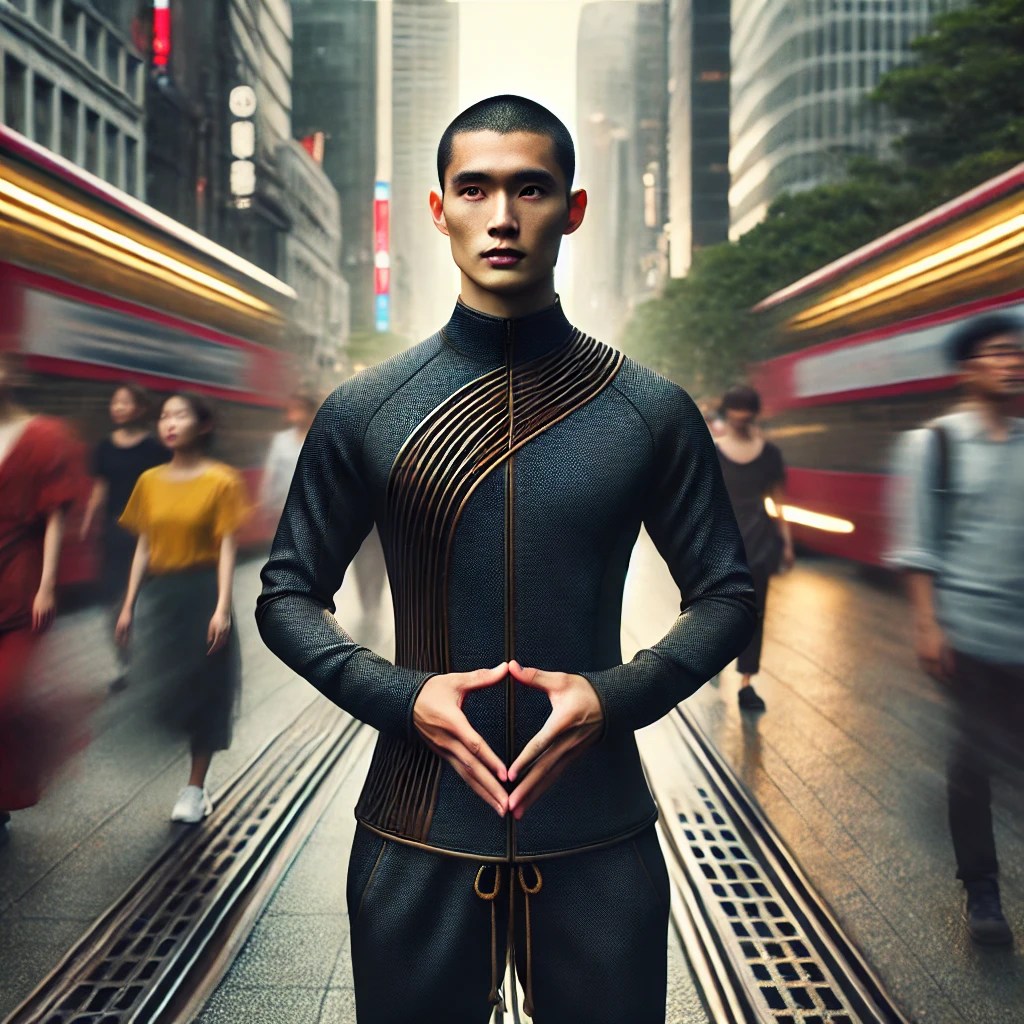
Stay centered. Pay attention. See clearly. Choose wisely.
Mindful responsiveness. Be unreactive.
As you move through life, imagine yourself at the center of an invisible sphere extending outward toward infinity.
This is your field of awareness.
Practice mindfulness—not as escape, but as paying attention. Pay attention to everything: your thoughts, your emotions, your sensations, the people around you, and the subtle changes in your environment. Observe without reacting. Maintain an eighteen inches of mental detachment.
Between stimulus and response, there is a space. In that space lies your power to choose. And in your choice lies your freedom and your growth. So said Victor Frankl, psychiatrist, neurologist, and Holocaust survivor.
Watch closely, and you will discover something profound: everything you observe is changing. Thoughts arise and disappear. Feelings arise and disappear. Sensations arise and disappear.
So if everything is changing, what are you?
You are the unchanging awareness in which all of it arises, remains for a time, and disappears.
Your awareness becomes a living radar system. You begin sensing shifts before they fully emerge. You recognize leading indicators. You perceive patterns while they are still forming.
Then you can play chess with life—anticipating its moves, adjusting your position, and acting with clarity and precision. Chess is a form of martial arts.
And you can play chess with yourself.
Through wisdom, discernment, willpower, and mindfulness, dismantle the ego piece by piece.
Every insight is a capture. Every moment of awareness is a check. Every act of surrender is a decisive move toward inner mastery.
Pay attention. Stay centered. See clearly. Choose wisely.
Most people see chess as a game of intellect, strategy, and competition. But for some, chess becomes something much deeper. It becomes meditation.
When approached with awareness, chess is not merely about defeating an opponent. It becomes a training ground for the mind itself. Every move reveals something about attention, emotion, discipline, patience, ego, and consciousness.
And yes — this absolutely transfers into life.
Learning to Pause Instead of React
One of the greatest lessons chess teaches is the power of pausing.
A careless move made in haste can change the entire game. Because of this, experienced players learn to slow down, observe carefully, and respond with awareness instead of impulse.
Life works the same way.
Most suffering comes from unconscious reactions:
anger, fear, emotional impulsiveness, pride, anxiety, and distraction. Chess trains the mind to stop reacting automatically. It conditions you to become observant and deliberate.
Over time, this calmness begins appearing off the board as well.
you must deal with the position that actually exists, not the one you wish existed.
You cannot cling emotionally to a failed plan. You cannot daydream about future victory while ignoring present danger. You must remain fully attentive to what is directly in front of you.
This is mindfulness.
The board constantly pulls you back into the present moment. Every position demands awareness now. In this way, chess becomes similar to meditation itself.
Emotional Mastery Through the Game
Chess exposes the ego quickly.
A blunder can create frustration.
A winning position can create arrogance.
A mistake can create self-doubt.
A sacrifice can create fear.
But the game also teaches recovery.
Good players learn not to collapse emotionally after errors. They regain composure, reassess the position, and continue calmly. This emotional resilience carries into everyday life.
Eventually you realize:
the mind performs best when it is centered, not emotional.
The Practice of Witnessing
When chess becomes meditative, you begin noticing something deeper than strategy.
You begin observing your own mind.
Thoughts arise.
Fear arises.
Excitement arises.
Frustration arises.
But there is also an awareness silently watching all of it.
This is the same principle found in meditation traditions: becoming the witness rather than becoming lost in every mental movement.
The board becomes a mirror.
It reflects impatience.
It reflects attachment.
It reflects overconfidence.
It reflects clarity.
And through observation, awareness grows stronger.
Chess as Spiritual Practice
Many ancient traditions taught that almost any activity can become a spiritual practice if performed with complete awareness.
Archery.
Calligraphy.
Martial arts.
Yoga.
Music.
Chess can belong in that category.
The game demands concentration, discipline, intuition, detachment, and inner stillness. Played consciously, it sharpens not only the intellect but the quality of consciousness itself.
The real question is not whether meditation transfers into chess.
The real question is whether the awareness cultivated during chess transfers into life.
Can you remain calm during conflict?
Can you stay present under pressure?
Can you observe emotions without becoming controlled by them?
Can you think clearly instead of reacting unconsciously?
If so, then the board has already begun teaching you far more than moves.
Beyond Winning and Losing
At the highest level, chess meditation is not even about victory.
It becomes about presence.
The board trains you to focus deeply.
To observe carefully.
To detach from emotional turbulence.
To remain centered in uncertainty.
And those are not merely chess skills.
They are life skills.
In the end, every game becomes practice — not only for becoming a better player, but for becoming more conscious in everyday life.
The Way of the warrior is not merely to endure life, but to master the manner in which one stands within it.
Many men believe happiness is a gift handed down by circumstance. They think it is found in favorable events, kind words, wealth, victory, or the approval of others. Thus, their peace is forever hostage to forces outside themselves. When fortune smiles, they rejoice. When it turns its face away, they collapse into agitation. Such a person is not living; he is being pulled like a chained animal by the world’s endless conditions.
This is weakness.
To be truly happy is to decide upon happiness without condition.
This is not the shallow happiness of pleasure, nor the temporary satisfaction of fulfilled desire. It is a deeper state—a quiet steadiness of being that does not rise and fall with the noise of the day. It is the calm center of the storm, untouched by the chaos that circles it.
The warrior understands that life is forever changing. Gain becomes loss. Praise becomes criticism. Health becomes sickness. Companions depart. Seasons shift. To tie one’s peace to what is unstable is to build a temple upon water.
Therefore, one must become detached.
The highest form of detachment is not merely release from circumstance, but surrender of personal will itself. The ancient prayer teaches: “let not my will be done, but God’s will be done.” This is the final severing of the chain that binds man to suffering. For so long as one insists that life unfold according to his design, he remains vulnerable to frustration, resentment, and despair. But the one who yields himself to the greater order ceases his war against reality itself. He acts with full effort, yet releases his claim upon the result. In this surrender, there is no weakness. There is supreme strength, for he no longer battles reality itself.
Detachment is often misunderstood by those who have not trained. They imagine it means coldness, indifference, or the absence of feeling.
This is false.
True detachment is not the rejection of life, but freedom within it. It is to fully engage with the world while refusing to be enslaved by its movements. To appreciate what comes without clinging to it. To face what departs without despair. To act with precision while remaining inwardly undisturbed.
When insult comes, the detached man does not immediately react. When loss arrives, he does not collapse. When praise is offered, he does not become intoxicated.
He remains centered.
This centeredness is not granted by wishing for it.
It is forged.
The untrained mind is like a wild horse, startled by every sound, pulled by every impulse, charging wherever emotion commands. Most men spend their lives in this state, believing their reactions are their nature. They mistake reflex for truth.
But the disciplined practitioner knows otherwise.
Through meditation, one enters into battle with the restless self.
To sit in stillness is to witness the ceaseless noise of the mind—the cravings, fears, resentments, fantasies, and compulsions that seek to command one’s actions. At first, the practitioner is defeated again and again, dragged into thought without awareness.
Yet through daily practice, something changes.
The mind begins to obey.
A space appears between event and response.
In that space, one finds freedom. In that freedom, one finds choice.
This is the birthplace of true happiness.
For happiness is not an emotion that descends upon the fortunate.
It is a discipline of orientation.
It is the practiced decision to remain anchored regardless of what appears.
To live this way requires effort.
One must practice releasing attachment when attachment feels natural. One must choose calm when reaction feels justified. One must return to center again and again, even after failure.
This is the labor of self-mastery.
And yet, no labor bears greater reward.
For what is the alternative?
To be ruled by every inconvenience. To have one’s mood dictated by the opinions of strangers. To rise and fall with every passing circumstance. To live as a puppet whose strings are pulled by the world.
Such an existence is unworthy.
The one who trains in meditation and detachment becomes difficult to disturb. His joy is no longer borrowed from events. His peace is not dependent on outcomes, for the outcome itself has been surrendered to God’s will. He walks through victory without arrogance and through hardship without defeat.
He has become unconquerable where it matters most.
This path requires practice, patience, and many returns after failure.
But it is a life worth living.
For to be centered is to be free. To be detached is to be strong. To be unreactive is to be sovereign over oneself. And to be happy without condition is perhaps the highest form of victory a person can attain.
This blog post is a blueprint for transcending human limits and evolving into a superhuman. Through RAT Synthesis, Mind Range™, and Mushin, it trains mastery of mind, body, and destiny.
By overcoming fear, hesitation, and ego, individuals unlock peak performance, ultimate awareness, and unshakable freedom—becoming unstoppable forces in life.
Warrior of Stillness:
No-self, No-mind.
The enemy cannot penetrate—for who is there to be penetrated?
Into a soul absolutely free From thoughts and emotion, Even the tiger finds no room To insert its fierce claws.
One and the same breeze passes Over the pines on the mountain And the oak trees in the valley; And why do they give different notes?
No thinking, no reflecting, Perfect emptiness; Yet therein something moves, Following its own course.
The eye sees it, But no hands can take hold of it – The moon in the stream.
Clouds and mists, They are midair transformations; Above them eternally shine the sun and the moon.
Victory is for the one, Even before the combat, Who has no thought of himself, Abiding in the no-mind-ness of Great Origin.
KAMON (FAMILY CREST): RAT SYNTHESIS WAY OF THE SAMURAI-YOGI
Miyamoto Musashi once said, “The way of the warrior is the resolute acceptance of death.”
Does this mean one should seek death? Should a warrior simply surrender to fate in battle?
No. The meaning runs much deeper—it is not about dying physically but about letting go of self-centeredness. It is about removing the limitations of the ego, fear, and hesitation. This teaching, mirrored in both Eastern philosophy and Christianity’s concept of “dying to self,” is the key to mastering combat and life itself.
The Power of Mushin: No Mind, No Fear
The RAT Synthesis system of Mind Range™ instills Mushin—the state of “no-mind, no-self.” This is the warrior’s ultimate edge in combat and life. When in Mushin, the fighter is free from self-conscious thought, worry, and doubt. The mind does not dwell on success or failure—it simply acts with pure clarity and precision.
Musashi also stated, “If you make your opponent flinch, you have already won.”Why is this so powerful?
Because flinching means hesitation. Hesitation comes from self-centeredness—the fear of losing, the fear of pain, the fear of failure. Remember Mike Tyson in the ring and how he would intimidate his opponents? Bruce Lee was also a master of psychological warfare.
When an enemy is preoccupied with their survival, their actions become reactive, not strategic. They are not meditating; they are panicking. Their responses become weak, erratic, and fear-driven.
A warrior trained in Mushin, however, does not react—he responds. He plays chess in the middle of battle. His counterattacks are not egoistic, fear-based, or selfish; they are efficient, devastating, and inevitable.
Mind Range™: The Key to Ultimate Awareness
Mind Range™ in RAT Synthesis is the practice of expanding one’s awareness beyond the self. It trains a practitioner to:
By mastering Mind Range™, the warrior is no longer trapped in the narrow perspective of “me vs. them.” Instead, they become one with the Moment and the opponent, intuit their intentions, and flow with the fight, becoming an unstoppable force.
This principle extends beyond combat. In life, those who are attached to their fears and doubts hesitate. They operate within limited programming. They second-guess opportunities. They remain in the prison of their own limitations.
But those who embody Mind Range™ and Mushin act decisively, embracing life with a warrior’s resolve.
Mastering the Art of No-Self
To truly win—whether in battle or in life—one must remove the distractions of self-importance. Arrogance, fear, hesitation, and overthinking are all obstacles. The path of the warrior is to transcend these limitations.
Through RAT Synthesis and Mind Range™, you can achieve Mushin and cultivate a level of awareness that grants absolute control in any situation. Whether you are fighting an opponent, navigating a business deal, or making a life-changing decision, the principles remain the same:
Meditate and Let go of self-centeredness. Dissolve into the eternal Now.
Act without fear
Master your responses
The moment is the nexus to all of reality(the matrix of Consciousness).
The moment is the lever.
By following this path, you embody the warrior’s ultimate truth: total freedom and unshakable mastery over yourself and your destiny.
Are you ready to embrace Mushin and unlock your full potential? The path is before you. Step forward without hesitation.