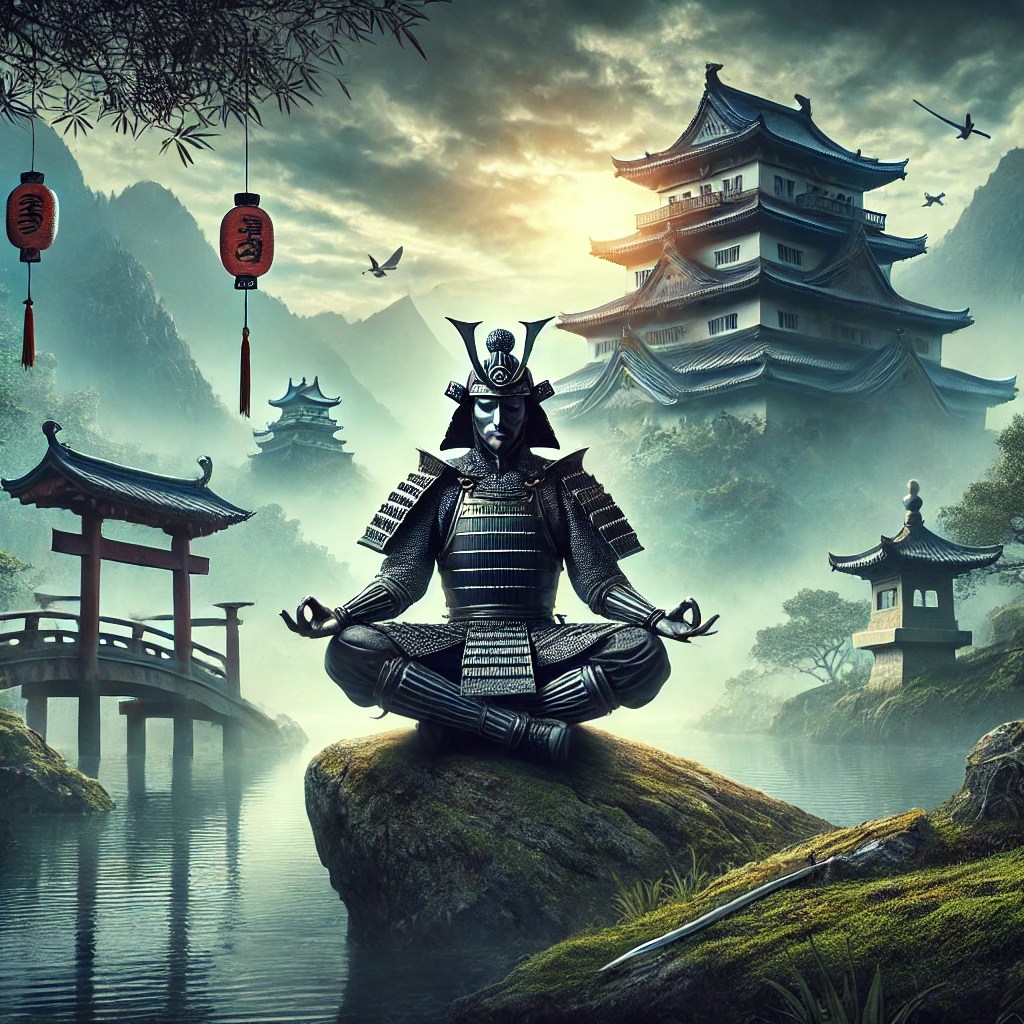
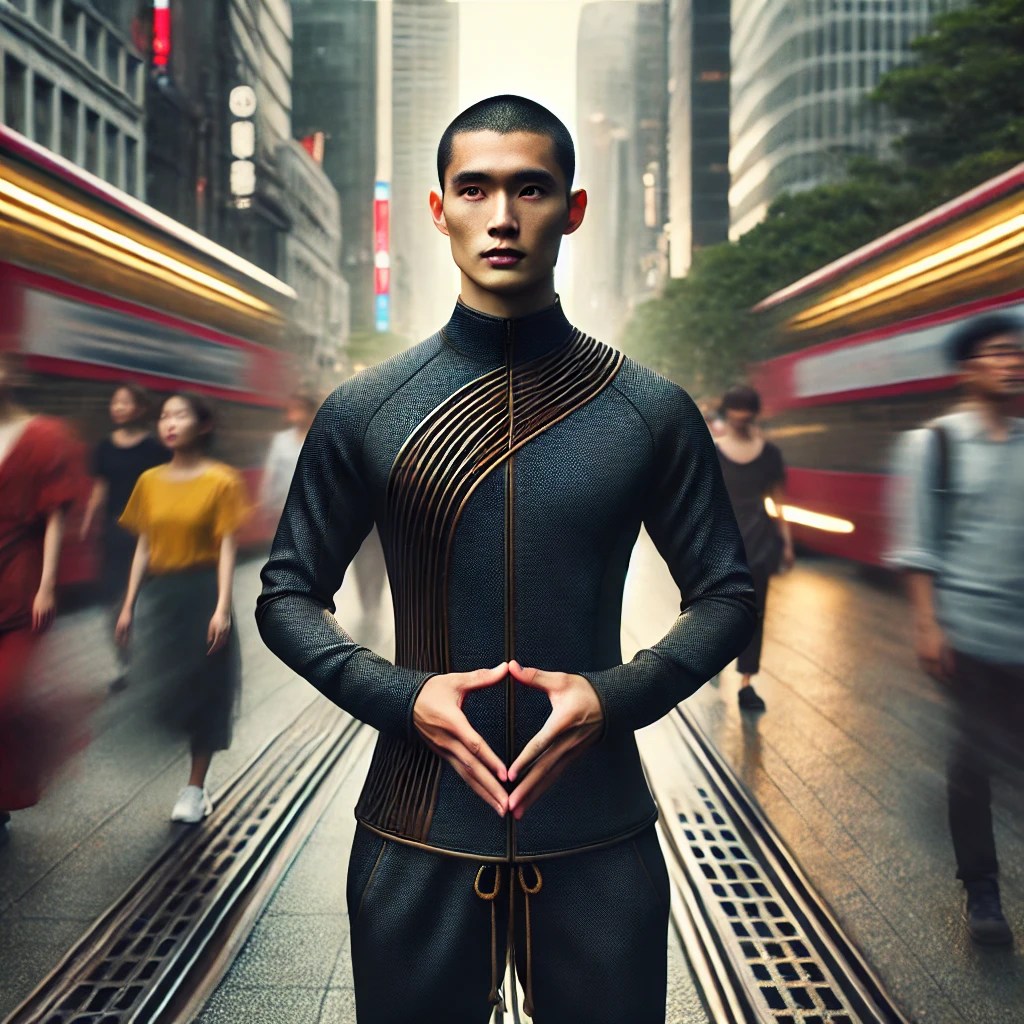
Not merely a sword of steel—but a sword of consciousness.
This one sword has two expressions.
When the situation demands destruction, it becomes the Death-Dealing Sword—satsujinken.
It cuts through fear. It cuts through anger. It cuts through attachment. It cuts through arrogance. It cuts through the illusion of the separate ego.
The Samurai-Yogi first turns this sword inward.
He uses it to slay the false self—the ego that says, “I am my fear. I am my anger. I am my desires. I am my weakness.”
But there are moments when life demands physical action.
If attacked, or if another innocent person is threatened, the Samurai-Yogi may have to use martial skill in self-defense or protection of another.
The sword does not act from hatred.
It acts according to necessity.
And because the Samurai-Yogi practices virtue, awareness, humility, and self-control, many conflicts can be prevented before the sword ever needs to act physically.
Then, when the situation calls for preservation rather than destruction, the same sword becomes the Life-Giving Sword—katsujinken.
It becomes the sword of compassion.
The sword that protects rather than intimidates. The sword that serves rather than dominates. The sword that heals rather than destroys.
It is not two swords. It is one sword with two purposes.
The situation determines how the sword behaves.
The warrior must therefore develop not only strength—but wisdom.
Through meditation, he learns stillness. Through martial arts, he learns disciplined action. Through spiritual practice, he learns when to act—and when not to act.
The Death-Dealing Sword destroys what must be destroyed.
The Life-Giving Sword preserves what must be preserved.
One sword. Two expressions. One consciousness.
Kill the ego. Give life to the soul.
Destroy what is false. Protect what is sacred.
The Samurai-Yogi does not train to become dangerous for the sake of being dangerous.
He trains so that when darkness comes, he can remain a light.
And the highest mastery is not merely knowing how to draw the sword.
It is knowing what the moment demands—and having the wisdom to let the one sword become exactly what is needed.
Stay centered. Pay attention. See clearly. Choose wisely.
Mindful responsiveness. Be unreactive.
As you move through life, imagine yourself at the center of an invisible sphere extending outward toward infinity.
This is your field of awareness.
Practice mindfulness—not as escape, but as paying attention. Pay attention to everything: your thoughts, your emotions, your sensations, the people around you, and the subtle changes in your environment. Observe without reacting. Maintain an eighteen inches of mental detachment.
Between stimulus and response, there is a space. In that space lies your power to choose. And in your choice lies your freedom and your growth. So said Victor Frankl, psychiatrist, neurologist, and Holocaust survivor.
Watch closely, and you will discover something profound: everything you observe is changing. Thoughts arise and disappear. Feelings arise and disappear. Sensations arise and disappear.
So if everything is changing, what are you?
You are the unchanging awareness in which all of it arises, remains for a time, and disappears.
Your awareness becomes a living radar system. You begin sensing shifts before they fully emerge. You recognize leading indicators. You perceive patterns while they are still forming.
Then you can play chess with life—anticipating its moves, adjusting your position, and acting with clarity and precision. Chess is a form of martial arts.
And you can play chess with yourself.
Through wisdom, discernment, willpower, and mindfulness, dismantle the ego piece by piece.
Every insight is a capture. Every moment of awareness is a check. Every act of surrender is a decisive move toward inner mastery.
Pay attention. Stay centered. See clearly. Choose wisely.
The body changes with age, but the warrior’s spirit does not. We do not quit training because we grow older—we adapt our training so we can continue the journey.
A sore shoulder? Strengthen it with resistance bands, rotator cuff exercises, and mobility work. A tweaked knee? Rehabilitate it patiently while training the rest of the body. Every obstacle becomes an opportunity to become wiser, not weaker.
The goal is not to prove how much punishment you can endure. The goal is consistency. Follow a workout schedule that fits your body, your season of life, and your recovery. Show up on the days you promised yourself you would. Small efforts, repeated for years, forge an unbreakable spirit.
Train your body. Train your mind. Train your character.
And every day, sit in meditation. In stillness, sharpen awareness. In silence, strengthen the will. A calm mind is the foundation upon which all great warriors stand.
Our mission is simple: keep moving, keep growing, keep adapting.
Train until you die—not because you fear death, but because you choose to live every day with strength, discipline, and purpose.
In my previous article, Meditation in Motion, I explained what meditation in motion is and why it matters.
Meditation should not end when you stand up from the cushion.
The goal is to carry the concentration, awareness, calmness, and equanimity developed through meditation into everything you do—walking, working, training, competing, and dealing with the unpredictable circumstances of life.
But how do you achieve this?
The answer is a progressive methodology that leads from stillness to movement, from movement to pressure, and ultimately to Mushin—the warrior’s state of no-mind, no-self.
Stillness is the foundation. Movement is the test. Life is the training hall.
STEP 1: DEVELOP CONCENTRATION
The first step is Samatha, or concentration meditation.
Sit quietly and focus your attention on the breath. When the mind wanders, notice it and gently return your attention to the breath.
The mind wanders.
You notice.
You return.
Again and again.
This simple process develops the ability to direct your attention rather than being controlled by every thought, emotion, or distraction.
This is the foundation of Meditation in Motion.
STEP 2: LEARN TO OBSERVE WITHOUT REACTING
The second step is Vipassana, or insight meditation.
Instead of focusing on one fixed object, observe whatever is most prominent in your awareness—a thought, emotion, sensation, or sound.
As the object of awareness changes, your attention changes with it.
You observe without clinging.
You observe without resisting.
This teaches you to change with change (Bagua).
The world is constantly moving. Meditation in Motion requires a mind capable of remaining present while everything around it changes.
STEP 3: DEEPEN CONCENTRATION AND INNER AWARENESS
The third step is Hong-Sau meditation, an advanced form of Samatha meditation that deepens concentration and develops inner awareness.
Through attention to the breath, the Hong-Sau mantra, and the spiritual eye, the mind gradually becomes quieter.
The purpose is not to eliminate intelligence or thought.
It is to reduce unnecessary mental interference.
As the mind becomes quieter, perception and intuition can operate more clearly.
STEP 4: ESTABLISH AN INNER CENTER
The fourth step is to develop awareness of the spiritual eye.
The spiritual eye, the point between the brows, becomes an inner anchor—a point of stillness that you can return to while the world around you continues to move.
The body moves.
Thoughts move.
Emotions move.
The world moves.
But awareness remains centered.
This is the beginning of carrying meditation beyond formal practice.
You no longer need to be sitting on a cushion to return to stillness.
STEP 5: EXPAND YOUR AWARENESS
Miyamoto Musashi, history’s greatest swordsman, used MUSHIN (Moo-shin)—the state of no-mind, no-self—as a hidden key to his invincibility. By fixing your gaze at the center while opening peripheral vision, you access this secret advantage. Thought dissolves, fear vanishes, and pure intuition takes command. This is NOT “woo woo”, this is science.
You slip into the predator’s state, where your calm presence breeds hesitation in your opponent. The eyes stay forward, yet the expanded field absorbs all, allowing the body to flow like water—fluid, instinctive, relentless.
In RAT Synthesis, mushin is not just a battlefield tactic but a total life strategy. Training it rewires your mind to stay calm, clear, and decisive under pressure. The same awareness that sharpens your sparring also amplifies focus, creativity, and success in EVERY arena of life.
The above video reveals a simple technique to help you drop into Mushin.
The fifth step is wide-angle vision.
Instead of staring intensely at one object, soften your gaze and become aware of the entire visual field.
When the eyes fixate, the mind tends to follow.
It analyzes.
It predicts.
It becomes narrow.
Wide-angle vision expands awareness and quiets excessive analysis.
You are not staring at everything.
You are perceiving everything.
This is a gateway to the predatory Mushin mind state.
The predator is relaxed, alert, and observant. It does not waste energy reacting to every movement. It remains still until action is required.
You see the whole person.
The whole environment.
The changes in distance.
The shifts in balance.
The rhythm.
The intention.
STEP 6: BRING AWARENESS INTO MOTION
The sixth step is to bring this awareness into movement.
This is where martial arts training becomes a powerful form of Meditation in Motion.
Bagua circle sparring is an excellent example.
As you move around the circle, the angle, distance, direction, and relationship to your training partner are constantly changing.
There is no time to stop and intellectually analyze every movement.
You cannot constantly think:
Should I move here?
What technique should I use?
What happens next?
If you try to consciously calculate everything, you will be too slow.
You must see.
You must feel.
You must move.
You must respond.
The pressure of the drill forces you to let go of unnecessary thought.
You drop into the moment.
You enter the Mushin mind state.
There is no time to think. Therefore, you must learn to perceive, feel, and respond.
STEP 7: PRESSURE-TEST THE MEDITATION
Circle sparring is the crucible that forges the path beyond thought. Through high stakes engagement the student enters Mushin, no-mind, no-self.
Meditation develops the mind in stillness.
Pressure testing reveals whether that stillness survives movement, uncertainty, and stress.
Bagua circle sparring constantly changes the geometry of the engagement.
The angle changes.
The distance changes.
The direction changes.
The opportunity changes.
There is no fixed script.
You must continually adapt.
This pressure strips away unnecessary intellectualization.
You cannot consciously calculate everything fast enough.
You must trust your training.
You must trust your perception.
You must remain present.
Fear, doubt, surprise, and confusion may appear.
The purpose of training is not to pretend these things do not exist.
The purpose is to train until they no longer control you.
The circle becomes a moving meditation hall.
The changing angles become your meditation object.
The pressure becomes your teacher.
STEP 8: ENTER MUSHIN
The final step is Mushin.
Mushin is not a lack of awareness.
It is freedom from unnecessary interference.
You are not lost in thought.
You are not paralyzed by fear.
You are not trapped in hesitation.
You are simply present.
You perceive.
You feel.
You respond.
This is where the boundary between meditation and action disappears.
The mind is quiet, but awareness is vast.
The body is moving, but the center remains still.
You do not need to consciously calculate every action.
You do not need to force every response.
You allow perception, training, and presence to guide your action.
This is Mushin.
FROM THE CUSHION TO THE WORLD
The goal is to make the entire day a meditation.
Walking becomes meditation.
Training becomes meditation.
Working becomes meditation.
Chess becomes meditation.
Conversation becomes meditation.
Even conflict becomes meditation.
Life becomes your training hall.
Every challenge becomes an opportunity to practice presence.
Every emotional reaction becomes an opportunity to observe.
Every moment of pressure becomes an opportunity to return to the center.
You do not escape from life to find stillness.
You discover stillness while fully participating in life.
The progression is simple:
Concentration.
Observation.
Inner awareness.
Centering.
Expanded perception.
Movement.
Pressure testing.
Mushin.
Through disciplined meditation, wide-angle vision, martial arts training, and pressure-tested movement, meditation becomes more than something you do.
It becomes something you are.
You are no longer meditating only when you sit down.
You are meditating while you move.
You are meditating while you train.
You are meditating while you work.
You are meditating while facing the unpredictable.
You have entered the state of Meditation in Motion.
Sense. Feel. Respond.
This is Mushin.
This is Meditation in Motion.
If you enjoyed this article and want to explore these ideas more deeply, consider reading my book:
Human beings spend much of their lives worrying about their place in the world. We compare ourselves to others. We wonder whether we should be leaders or followers, teachers or students, warriors or monks, rich or poor, famous or forgotten. Society tells us that our value is determined by the role we occupy. Yet from the perspective of Dharma, this obsession is misplaced.
The role you play on life’s stage doesn’t matter. No matter your role in life, the dharmic path remains the same.
Life is like a vast theater. Some are cast as kings, others as peasants. Some become business owners, laborers, soldiers, artists, parents, or spiritual teachers. The costumes differ. The responsibilities differ. The circumstances differ. But beneath the costumes stands the same eternal reality: a soul learning to walk the path of truth.
The mistake is to confuse the costume for the actor.
A king who lives selfishly and a beggar who lives virtuously are not measured by the size of their worldly position. Likewise, a famous teacher and an unknown laborer stand on equal ground before the eternal law. Dharma does not ask, “How important was your title?” Dharma asks, “Did you live with integrity? Did you act with courage? Did you serve others? Did you seek truth? Did you master yourself?”
These questions apply equally to everyone.
The warrior must practice discipline. The monk must practice discipline. The parent must practice discipline. The entrepreneur must practice discipline. The forms differ, but the principle remains unchanged. Every person faces the same inner enemies: fear, greed, anger, pride, attachment, and ignorance. Every person is called to cultivate the same virtues: wisdom, compassion, courage, patience, humility, and self-control.
This is why the dharmic path is universal.
The world may celebrate one role and ignore another, but Dharma is indifferent to social status. The universe does not award extra spiritual points for prestige. A person sweeping floors with mindfulness and devotion may advance further along the path than a celebrated leader consumed by ego. Spiritual growth depends not on what you do, but on how you do it.
The battlefield of Dharma is always within.
Many people spend years chasing a different role, believing fulfillment lies elsewhere. “If only I were successful.” “If only I were respected.” “If only I had a larger audience.” Yet when one role is exchanged for another, the same mind accompanies the traveler. The same fears, attachments, and desires remain. External change cannot solve an internal problem.
The dharmic path points in a different direction. Instead of asking, “What role should I play?” it asks, “How can I play my current role with wisdom, virtue, and detachment?”
This shift changes everything.
A person who understands Dharma becomes less concerned with outcomes and more concerned with right action. They stop measuring their worth by applause. They stop comparing their script to someone else’s. They recognize that every role is temporary and every curtain eventually falls.
What remains is character.
At the end of life, titles disappear. Wealth remains behind. Reputation fades. The costumes are returned to the wardrobe of history. The only thing carried forward is the quality of one’s consciousness and the lessons learned along the journey.
The great secret is that enlightenment is not reserved for a particular profession, social class, or station in life. The path is open to everyone. The warrior can walk it. The teacher can walk it. The mechanic can walk it. The parent can walk it. The monk can walk it. Every role contains opportunities for growth, service, sacrifice, and self-mastery.
Therefore, do not worry excessively about your place on the stage.
Play your role well. Fulfill your duties. Act honorably. Serve where you can. Practice detachment from praise and blame. Seek truth above status. Let your life become an expression of virtue.
For in the end, the role you play on life’s stage does not matter. What matters is whether, through that role, you walked the dharmic path.
“Perceive that which cannot be seen with the eye.” — Miyamoto Musashi
Why Practice Meditation in Motion?
In a chaotic world where distractions, stress, and reactive behavior dominate, Meditation in Motion (MIM) offers a path to inner and outer mastery and tactical clarity. This method trains you to stay centered, aware, and decisive—even under pressure.
By anchoring your awareness at the third eye and cultivating full-spectrum perception, you gain the power to respond strategically instead of reacting emotionally. Learn how to play chess and win in life.
Whether you’re a martial artist, entrepreneur, elite athlete, leader, or seeker on the spiritual path, this practice helps you sharpen intuition, remain calm under fire, and take impactful action in alignment with your higher purpose. It’s not just meditation—it’s transformation in motion.
PROCESS:
Anchor your awareness at the third eye center: This engenders focus and clarity and allows you to connect with the universe. Paramahansa Yoganandataught that focusing on the spiritual eye—the point between the eyebrows—is a gateway to experiencing God.
Enter your calm center: calm, clear, meditative. Visualize a sphere of energy surrounding your body—moving with you as you flow through life. Objects and circumstances can approach your sphere from any angle.
Expand into wide-angle awareness: wide-angle vision. See everything, all at once.
PAUSE TECHNIQUE — Interrupt automatic reaction: The moment you sense an impulse to react, stop immediately. Focus your awareness on the third eye and hold for a beat. You could also take a deep, slow breath—but when was the last time you were able to do that in the heat of battle? That’s why RAT Synthesis prioritizes third eye focus as the primary method. This micro-pause breaks the cycle of knee-jerk responses, opening a window to deliberate choice and clarity. This is your tactical reset.
Merge with the moment: Each moment is the entire universe. Use your intuition. This is your leverage. “Don’t think, FEEL” – Bruce Lee
Maintain inner detachment: Maintain 18 inches of inner distance. This space dissolves knee-jerk reactions. Never react—respond with mastery. “The only freedom we have is not to react” – Robert Adams“In battle, if you make your opponent flinch, you have already won.” — Musashi
Observe and choose wisely: See your options without emotion. Choose the one that creates the highest good—a win-win outcome.
Ask the right question: “What is the most impactful move I can make right now to fulfill my mission or goal?“
Always follow conscience: Always choose conscience over selfishness. At times, it may demand sacrifice—even blood. But this is the path of the spiritual warrior.
Ready to Take It Further?
Meditation in Motion is the gateway—but MUSHIN: THE WARRIOR’S SECRET TO UNSTOPPABLE POWER is the master key.
If you’re serious about transcending fear, sharpening your intuition, and mastering your mind under pressure, Mushin takes you deeper. It distills the warrior’s path into a clear, powerful system you can apply quickly—in combat, business, or life.
This isn’t just knowledge. It’s a code for living with precision, presence, and unstoppable momentum.
Unlock the secret. Own the mindset. Grab your copy of MUSHIN now—and start your rise to mastery.
The Samurai warriors practiced Zen to gain an edge in battle, and at the heart of Zen lies yoga.
Yoga Asanas
When most people think of yoga, images of contorted bodies twisted into pretzel-like poses often come to mind.
While the physical asanas (postures) of yoga have gained tremendous popularity, especially in the West, they represent only one aspect of this ancient practice.
What many overlook is the meditation and mental training that is deeply embedded within the roots of yoga, which not only offers spiritual enlightenment but also plays a pivotal role in the Art of War and the cultivation of true inner strength.
The Deeper Roots of Yoga: Meditation Over Asanas
Yoga has long been recognized as a path to spiritual awakening, but it’s crucial to understand that the physical postures are just the surface of a much deeper tradition.
At its core, yoga is about stilling the mind—calming the endless chatter that often clouds our perception and hinders our ability to act decisively.
This meditation aspect of yoga is far more powerful than just performing physical poses.
It’s about transcending the ego and achieving a state of deep awareness, where one’s true self is realized and one can access a state of inner peace that is not shaken by external circumstances.
In fact, this meditation aspect is so powerful that it became the foundation for other profound traditions, such as Chan Buddhism (which later evolved into Zen) in China.
The story of Bodhidharma, the enlightened Indian guru who traveled to China, is a testament to how meditation in the form of yoga helped shape not only spirituality but warrior philosophies too.
Bodhidharma’s Influence: Yoga’s Link to the Warrior Spirit
Bodhidharma (Dà Mó), the founder of Chan Buddhism and the key figure in elevating Shaolin Kung Fu.
Bodhidharma’s journey from India to China is legendary.
He arrived at the Shaolin Temple, where he established Chan Buddhism, a fusion of meditation and martial arts.
This blend of mindfulness, discipline, chi (pranayama), and physical training would lay the foundation for what became the Shaolin monks’ renowned martial arts expertise, later influencing countless warriors around the world.
This ancient tradition directly links yoga and meditation to the art of war, demonstrating that the true power of yoga lies not in the ability to perform physical poses but in the mental clarity, discipline, energization (chi), and fearlessness it fosters.
The meditation-based aspects of yoga create a “no-mind” state—where actions flow effortlessly, free from hesitation, and without the clutter of doubt or distraction.
This mental fortitude, honed through yoga and meditation, would become the edge in battle, just as it has in life.
Lord Krishna instructing Arjuna
The Bhagavad Gita: A Battle Between the Mind and the Self
One of the most powerful texts that blends yoga, meditation, and warriorship is the Bhagavad Gita, the epic dialogue between Lord Krishna and the warrior prince Arjuna.
The Gita isn’t just a spiritual treatise; it’s an internal battlefield where Arjuna struggles with his mind, emotions, and sense of duty.
Through Krishna’s guidance, Arjuna learns to transcend his inner conflict and reach a state of clarity, allowing him to perform his duties without attachment or hesitation.
This is the essence of the yoga of action—Karma Yoga—where the practitioner performs their duty without attachment to outcomes, free from the limitations of fear, desire, or ego.
In this state, one is not swayed by external forces but remains anchored in the present moment, ready to take decisive action when necessary.
This same mental discipline is key for warriors, athletes, and anyone who seeks to live with unwavering focus and clarity.
The Warrior Caste and the Path of Zen
Yoga’s connection to warrior philosophy is not just confined to the spiritual practices of ancient India.
Buddha himself, who was born into the warrior caste, understood the discipline and mental training that warrior culture required.
Though his journey took him away from the battlefield, the underlying principles of warrior ethos—such as fearlessness, discipline, and acting in the moment—remain closely tied to the teachings of Buddhism and the path of meditation.
The Samurai of Japan, revered for their code of honor and exceptional skills, fully embraced Zen practice.
Through Zen meditation, they cultivated a deep mental focus, allowing them to enter battle without fear or hesitation, fully present and aware of every movement.
The Samurai’s Zen practice allowed them to move beyond themselves, acting as a vessel for the art of war.
The ultimate goal was to reach a state of “no-self” or “no-mind”, where the mind does not interfere with action and one acts purely out of intuition and experience.
No Mind, No Self: The Power of Yoga in Life and Battle
The concept of “no-mind” (or “mushin”) is integral to both Zen and yoga, and it is perhaps one of the most powerful aspects of the practice.
When we let go of the ego and the constant chatter of the mind, we open up to a state of pure presence, where our actions are aligned with the flow of life.
This state of non-attachment is essential not only in meditation but also in battle, business, sports, and every area of life that demands focused action.
In yoga, this concept is cultivated through deep meditation and mindful breathing, allowing the practitioner to reach a state where actions are effortless, clear, and precise.
The “no-self” principle helps us overcome the limitations of the ego and the fear that often holds us back in life.
Whether in war or in daily struggles, this mental discipline gives you the edge—the ability to act without hesitation, free from distractions, and aligned with your highest purpose.
Yoga: More Than Just Feel-Good Poses
So, the next time you think of yoga, remember: it’s not just about tying yourself in pretzel-like shapes or doing trendy stretches.
At its core, yoga is about transcending the physical, finding inner peace, and cultivating the mental strength to face any challenge—be it on the battlefield or in the daily struggles of life.
The meditation practices of yoga, developed over millennia, are the key to unlocking the true power within you.
Just as the great warriors of history relied on the mental clarity and fearlessness gained through meditation and yoga, so too can we all benefit from its profound teachings.
Yoga, when practiced in its fullest sense, is not just a physical exercise; it is a way to elevate your warriorship, to act with precision, and to live without fear or limitation.
Final Thoughts
Yoga is not just about the body.
It is the way to train your mind, to enter a state of no-mind, and to cultivate the clarity and fearlessness necessary to face life’s battles—whether physical, mental, or spiritual.
Just as the ancient warriors did, we too can embrace the meditation aspect of yoga and unlock the deeper power that lies within us all.
Sri Paramahansa Yogananda
BE CALMLY ACTIVE
AND ACTIVELY CALM
In short, don’t think all the time of just making money. Exercise, read, meditate, love God, and act peacefully, at all times. Learn to be calmly active and actively calm, carrying into your daily activities the calmness gained in the spiritual activity of meditation.
In the Gita, Bhagwan Krishna teaches: “Remaining immersed in yoga, perform all actions, forsaking attachment (to their fruits). Remain indifferent to success and failure (while performing all actions). The mental evenness during all states of activities (resulting in success or failure) is termed yoga.
This blog post is a blueprint for transcending human limits and evolving into a superhuman. Through RAT Synthesis, Mind Range™, and Mushin, it trains mastery of mind, body, and destiny.
By overcoming fear, hesitation, and ego, individuals unlock peak performance, ultimate awareness, and unshakable freedom—becoming unstoppable forces in life.
Warrior of Stillness:
No-self, No-mind.
The enemy cannot penetrate—for who is there to be penetrated?
Into a soul absolutely free From thoughts and emotion, Even the tiger finds no room To insert its fierce claws.
One and the same breeze passes Over the pines on the mountain And the oak trees in the valley; And why do they give different notes?
No thinking, no reflecting, Perfect emptiness; Yet therein something moves, Following its own course.
The eye sees it, But no hands can take hold of it – The moon in the stream.
Clouds and mists, They are midair transformations; Above them eternally shine the sun and the moon.
Victory is for the one, Even before the combat, Who has no thought of himself, Abiding in the no-mind-ness of Great Origin.
KAMON (FAMILY CREST): RAT SYNTHESIS WAY OF THE SAMURAI-YOGI
Miyamoto Musashi once said, “The way of the warrior is the resolute acceptance of death.”
Does this mean one should seek death? Should a warrior simply surrender to fate in battle?
No. The meaning runs much deeper—it is not about dying physically but about letting go of self-centeredness. It is about removing the limitations of the ego, fear, and hesitation. This teaching, mirrored in both Eastern philosophy and Christianity’s concept of “dying to self,” is the key to mastering combat and life itself.
The Power of Mushin: No Mind, No Fear
The RAT Synthesis system of Mind Range™ instills Mushin—the state of “no-mind, no-self.” This is the warrior’s ultimate edge in combat and life. When in Mushin, the fighter is free from self-conscious thought, worry, and doubt. The mind does not dwell on success or failure—it simply acts with pure clarity and precision.
Musashi also stated, “If you make your opponent flinch, you have already won.”Why is this so powerful?
Because flinching means hesitation. Hesitation comes from self-centeredness—the fear of losing, the fear of pain, the fear of failure. Remember Mike Tyson in the ring and how he would intimidate his opponents? Bruce Lee was also a master of psychological warfare.
When an enemy is preoccupied with their survival, their actions become reactive, not strategic. They are not meditating; they are panicking. Their responses become weak, erratic, and fear-driven.
A warrior trained in Mushin, however, does not react—he responds. He plays chess in the middle of battle. His counterattacks are not egoistic, fear-based, or selfish; they are efficient, devastating, and inevitable.
Mind Range™: The Key to Ultimate Awareness
Mind Range™ in RAT Synthesis is the practice of expanding one’s awareness beyond the self. It trains a practitioner to:
By mastering Mind Range™, the warrior is no longer trapped in the narrow perspective of “me vs. them.” Instead, they become one with the Moment and the opponent, intuit their intentions, and flow with the fight, becoming an unstoppable force.
This principle extends beyond combat. In life, those who are attached to their fears and doubts hesitate. They operate within limited programming. They second-guess opportunities. They remain in the prison of their own limitations.
But those who embody Mind Range™ and Mushin act decisively, embracing life with a warrior’s resolve.
Mastering the Art of No-Self
To truly win—whether in battle or in life—one must remove the distractions of self-importance. Arrogance, fear, hesitation, and overthinking are all obstacles. The path of the warrior is to transcend these limitations.
Through RAT Synthesis and Mind Range™, you can achieve Mushin and cultivate a level of awareness that grants absolute control in any situation. Whether you are fighting an opponent, navigating a business deal, or making a life-changing decision, the principles remain the same:
Meditate and Let go of self-centeredness. Dissolve into the eternal Now.
Act without fear
Master your responses
The moment is the nexus to all of reality(the matrix of Consciousness).
The moment is the lever.
By following this path, you embody the warrior’s ultimate truth: total freedom and unshakable mastery over yourself and your destiny.
Are you ready to embrace Mushin and unlock your full potential? The path is before you. Step forward without hesitation.