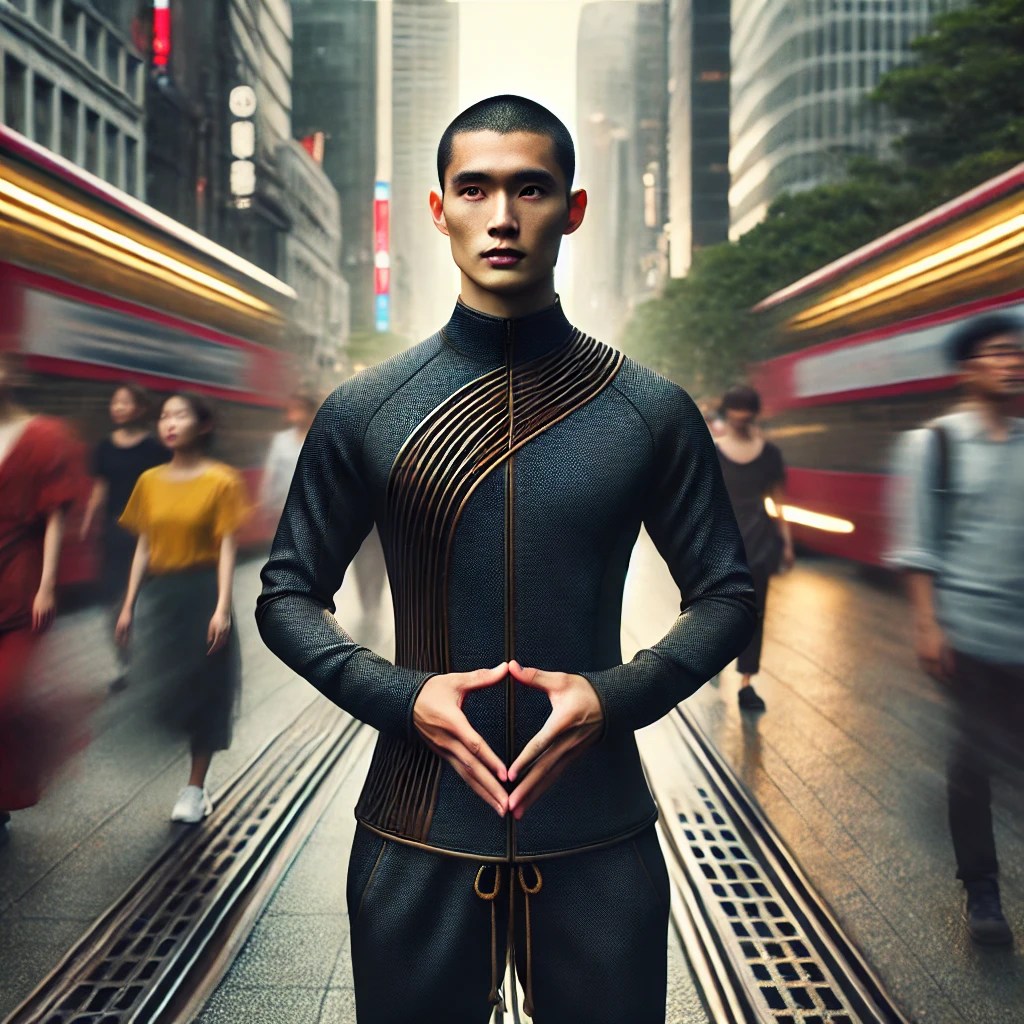
no-mind

  • THE SIXTH RANGE OF COMBAT: WHERE VICTORY IS FORGED BEFORE THE FIRST MOVEMENT

    In the stillness before dawn, when even the wind forgets its name, there is a truth that most warriors never see: battle is not fought with hands alone, but first with the mind. The blade merely follows what has already been decided in the unseen chamber of thought.

    Thus speaks the Way of Mind Range.

    Long ago, men believed combat began at the distance of weapons, then descended through kicks, punches, trapping, and grappling—each range a narrowing of space, each exchange a closer taste of danger. Yet this is incomplete sight. It is the view of those who only measure what the eyes can touch.

    There is a sixth range. Silent. Formless. Absolute.

    It is the Mind Range™ —the domain where victory is born before movement, and defeat is sealed before contact.

    The untrained man believes he acts in the world. The awakened warrior understands: the world first acts in him.

    When fear arises, it is already the first strike. When doubt creeps in, it is already a lock upon the joints of decision. When anger rises unchecked, it is already a loss of center. Thus, to master all other ranges, one must first conquer this invisible battlefield where thoughts become weapons and emotions become terrain.

    Three forces govern this inner war.

    The first is Mushin—no-mind.
    In Mushin, the self is forgotten. The river does not ask why it flows; it simply flows. In this state, hesitation dies. Thought no longer lags behind reality. Action becomes instantaneous, pure, without stain of doubt or commentary. The warrior is no longer the doer—only the act remains.

    The second is Fudoshin—immovable mind.
    When chaos roars like thunder and pressure bears down like iron mountains, the center does not move. The world may collapse into noise, but within remains a still point deeper than fear. From this stillness, even force becomes obedient. Even danger becomes clear.

    Yet stillness alone is not enough.

    Thus arises Killer Instinct—not blind rage, but sharpened inevitability. The moment must be cut without hesitation when it is time to act. Not a flicker of doubt may remain when the line is crossed. It is not emotion. It is decision made total.

    And above all this stands Strategic Mastery—the art of seeing before seeing. The warrior who understands strategy does not struggle against every wave. He reads the tide itself. He does not react to events; he arranges them inwardly before they appear outwardly. The opponent is not fought in motion, but in anticipation. Victory is shaped in silence long before the clash.

    When these forces are united, the warrior no longer lives in fragments. Mind, body, and action become one current. The five physical ranges become shadows beneath a greater sun. For what use is technique if the mind has already surrendered? And what threat is an enemy whose movement you have already seen within yourself?

    The true battlefield is not the ring, nor the street, nor the blade’s edge.

    It is the thought that arises before all of these.

    Therefore the Way teaches this:
    Master the invisible, and the visible will obey.
    Still the mind, and all motion becomes precise.
    Know yourself completely, and no opponent can appear unknown.

    Thus the warrior walks—not as one who fights battles, but as one who has already conquered the place where battles are born.

    To learn more about Mushin—the flow-like predator state where thought disappears and action moves with effortless precision, click here: https://amzn.to/4dDa66t

    To learn more about universal strategy—the hidden architecture of victory where outcomes are shaped before they appear, click here: https://amzn.to/4mpqbyZ


  • Chess as a Path of Mastery and Mindful Strategy

    The mastery you cultivate in chess — mastering openings, anticipating patterns, dismantling the opponent’s strategy, and seizing opportunities — translates directly to martial arts, where you apply the same principles of timing, positioning, and decisive action, as in RAT Synthesis™.


    Chess is more than a game; it is a mirror of the mind, a battlefield of strategy, and a training ground for intuition and self-mastery. To approach chess with the mindset of a spiritual warrior or strategist is to see beyond mere moves and pieces and recognize that the game is a study of cause and effect, patience, and the exploitation of patterns. In the pursuit of excellence, one truth stands out: mastery begins with focus.

    A strong chess player does not attempt to learn every opening or memorize every possibility. Instead, they choose one opening and commit to understanding it deeply — the ins and outs, the recurring patterns, the subtle tactics that arise from it. Personally, I favor the Four Knights Game, an opening renowned for its balance and flexibility. By mastering this opening, I gain a foundation that allows me to anticipate the flow of the game, predict likely developments, and execute attacks with confidence. From this foundation, I may weave in tactical motifs such as the Scholar’s Mate, the classic four-move checkmate, which illustrates the power of positioning and coordination between pieces.

    The beauty of chess lies in choice and flexibility. One may capture a key square with a knight and bishop, leveraging speed and surprise, or opt for a more methodical approach — advancing pawns, coordinating the rook, and slowly applying pressure. These choices exemplify the Pareto principle in action: by mastering the twenty percent of strategies and moves that produce eighty percent of results, a player can operate efficiently, confidently, and strategically. In chess, as in life, effectiveness is often rooted not in exhaustive effort but in focused mastery.

    This principle is mirrored in Sun Tzu’s insight: “Thus, what is of supreme importance in war is to attack the enemy’s strategy.” In chess, one does not fight the opponent directly but dismantles their strategy. Recognizing the enemy’s frequently employed tactics — the Wayward Queen attack, the pawn blast, the Scholar’s Mate — allows a player to counteract with precision. When the opponent’s plan is disrupted, they are often left without alternatives, and victory becomes a natural consequence of strategic superiority. The game, then, becomes a study of patterns, foresight, and the disciplined application of knowledge.

    Sun Tzu continues: “To secure ourselves against defeat lies in our own hands, but the opportunity of defeating the enemy is provided by the enemy himself.” In chess, this is the mathematical reality of the game. White is statistically favored, having the first move, yet it is the mistakes of the opponent that often determine the outcome. A single overlooked threat, a mispositioned piece, or a neglected defense opens the door to victory. Success comes not from coercion or aggression alone, but from observation, patience, and the readiness to capitalize on the openings the opponent unknowingly provides.

    Yet chess is not only a battlefield of calculation; it is also a meditation. When approached with a clear mind, the player enters a state of mushin — no-mind, no-self — where intuition and pattern recognition merge. The pieces become extensions of thought, the board a landscape of possibilities, and the mind a calm observer of both strategy and chance. This meditative state transforms chess from a contest into a practice, a journey toward mastery of self as much as mastery of the game.

    Ultimately, mastery requires repetition. One cannot learn chess through theory alone or by studying great games in isolation. True skill emerges through experience — through countless games, through victories and defeats, through reflection and adaptation. Each game refines the mind, hones strategy, and deepens the understanding of patterns, mistakes, and opportunity. The path of chess, like the path of life or spiritual practice, is one of dedication, discipline, and mindful engagement.

    Chess teaches that focus and mastery are inseparable. It teaches that strategy is more important than raw force, that patience often outmatches aggression, and that the mind is the ultimate battlefield. By mastering one opening, understanding recurring patterns, dismantling the opponent’s strategy, and cultivating intuition through meditation and practice, one transforms chess from a mere game into a profound practice of self-mastery, strategy, and mindful action.


  • When the Self Steps Aside: Mushin, Flow, and the Biology of Victory

    Victory comes not from thinking of yourself, but from dissolving the self, entering the moment, and letting flow guide your body and mind.


    In the quiet moments before a chess grandmaster makes his move, in the split second before a martial artist throws a decisive strike, or even in the silent calm before a wrestler executes a perfect takedown, there exists a hidden force that separates the ordinary from the extraordinary. It is not brute strength. It is not preparation, not raw talent, not even strategy alone. It is the absence of self.

    When we focus on ourselves—our fears, our desires, our insecurities—the ego takes the wheel. The “I” becomes the center of the universe. Neuroscience shows us exactly what happens: the prefrontal cortex, the region of the brain responsible for self-reflection, over-activates. Cortisol, the stress hormone, spikes. Our muscles tighten, our reflexes slow, our decision-making becomes clouded. In other words, thinking about yourself is biologically self-sabotaging. You are literally wiring yourself for failure.

    Chess offers a subtle but profound illustration. When a player obsesses over winning, over what others think, over the potential shame of losing, hesitation creeps in. The mind calculates but cannot see. Patterns blur, combinations slip past, and mistakes multiply. Contrast this with the player who is “in the moment,” fully immersed in the board yet detached from ego. Moves flow effortlessly. Threats are anticipated not as personal attacks but as objective patterns. The brain releases dopamine and norepinephrine, enhancing attention and pattern recognition. The body and mind are aligned. This is flow. This is mushin—the “no-mind, no-self” of Zen warriors and samurai.

    Martial arts amplifies this principle dramatically. In sparring, if the fighter worries about his record, about looking skilled, about impressing his opponent, the body stiffens. Reflexes slow. Hesitation creeps in. A punch that could have been a decisive strike glances off, a block is late, a takedown fails. Cortisol surges, anxiety spikes, and the fight becomes a battle against oneself rather than the opponent.

    But the practitioner who has cultivated mushin—the mind of no-mind—experiences something extraordinary. Awareness is heightened, yet the ego has dissolved. The self disappears; only movement exists. Every strike, block, and feint becomes natural, uncontrived. Heart rate stabilizes, alpha brain waves rise, and the body releases endorphins and dopamine in a balanced cascade. This is the predator flow state: focused, fearless, fluid, and almost preternaturally intuitive. The fighter moves not as an “I” but as the moment itself, and in this way, the odds of success dramatically increase.

    This is not mysticism alone. Science confirms it. Studies of elite athletes, musicians, and meditators show that the “selfless” state—often called flow—reduces cortisol, enhances motor coordination, improves reaction time, and sharpens perception. Neural networks synchronize; the conscious mind steps aside, and the brain enters a pattern-recognition superstate. You are no longer “thinking”—you are responding, adapting, thriving.

    Consider the duality: ego-driven striving versus selfless presence. Ego says: I must win. I must not fail. I must be the best. The body tenses; the brain is hyper-aware of its own actions; performance suffers. Selfless presence says: The moment is what it is. My role is to act appropriately, fully, without attachment. The body relaxes, the mind expands, and the outcome—whether in chess, combat, or life itself—is far more likely to be victorious.

    Martial artists know this intuitively. Samurai trained for years not just in strikes and counters, but in zen meditation and discipline to dissolve the self. Chess masters study openings and endgames not to boast, but to internalize them, letting intuition guide the next move without ego interference. Even modern athletes employ mindfulness to enter flow, a state of effortless, high-performance presence.

    Victory, therefore, is rarely about thinking about yourself. It is about forgetting yourself entirely. It is about dissolving the “I” and becoming the moment, the move, the strike, the thought, and the feeling simultaneously. Mushin is no-mind. No-self. Pure presence. In this state, your biology, your consciousness, and your environment align. You spike the chemicals that enhance performance, creativity, and precision. You quiet the stress responses that sabotage you. You step into a zone where time dilates, perception sharpens, and the impossible becomes natural.

    So next time you step onto the mat, face an opponent, or sit before a chessboard, remember this: thinking of yourself is a trap. It binds you to cortisol, hesitation, and fear. Let go of the self. Dissolve ego. Enter the flow of the moment. Become the strike, the move, the play. Biology, psychology, and ancient wisdom all converge here: the selfless warrior is the victorious one.

    In the end, it is not “you” who wins. It is the universe flowing through you.


  • Why SPORT MMA FAILS—and how RAT SYNTHESIS™ STREET MMA WINS.

    “You can only fight the way you train.” Miyamoto Musashi, A Book of Five Rings


    Let’s get real.

    The UFC and modern MMA are a spectacle. Entertaining? Absolutely. Effective? To a point. But if you think what happens in the cage reflects the savage, unpredictable, and dirty nature of real violence—you’ve bought into the modern classical mess Bruce Lee warned us about.

    Let’s break it down:

    Weight Classes. Rules. Referees.

    You don’t get those on the street.

    In the octagon, you’ve got timed rounds, doctors, tap-outs, padded gloves, and strict rules that ban the very tools that end real fights in seconds: groin strikes, eye jabs, throat shots, ear slaps, bites, claws, leg fractures, and stomps. That’s not a knock on the athletes—some are phenomenal. But it is a knock on the idea that MMA as a sport is the end-all-be-all of combat training.

    Street fighting is no-holds-barred.
    And if you’re not training for that reality, you’re not ready.

    Horrendous EYE POKES That Lead to Fight Stoppages

    RAT Synthesis™: MMA for the Street, Not the Cage

    (Inspired by Rapid Assault Tactics™ R.A.T.)

    RAT Synthesis™ was born from battle and built for victory.
    This isn’t theory. This isn’t art for art’s sake. This is a combat and mindset system forged from the raw truth of street altercations, military encounters, and years of refining what actually works under real pressure.

    👉 Rapid-fire low-line kicks to shatter knees.
    👉 Eye jabs that disorient or disable.
    👉 Ear slaps that rupture eardrums and shut down balance.
    👉 Carotid stuns that drop attackers like a sack of bricks.
    👉 Groin destruction that ends the fight before it starts.

    This is not “tough guy talk.” These are surgical, ballistic tools you deploy when your life, your loved ones, or your mission is on the line.


    “If You Can’t Beat a Trained Fighter With Rules, How Can You Without Rules?”

    This is a common misunderstanding.

    In reality, removing the rules changes everything. It doesn’t level the playing field—it flips it entirely. The sport-trained fighter operates inside a framework. That framework conditions the fighter’s nervous system, instincts, and tactics. When those rules are stripped away, so is their operating system.

    RAT Synthesis™ was built outside that system.

    This is chess, not checkers.

    While some train to score points or win on the judge’s card, we train to cause pain, break structure, and end the encounter instantly.

    💥 Eye jab before they even know the fight started.
    💥 Elbow spike into a punch to fracture the attacking limb.
    💥 Lead sidekick into the knee as they step forward—fight over before it began.
    💥 Intercept, destroy, terminate.

    In RAT Synthesis™, defense isn’t passive. We don’t block—we break.
    We don’t wait—we intercept.
    We don’t counter—we destroy and finish.

    Our method relies on the pain–pressure–termination sequence:

    • Pain (via destructions, nerve shocks, or sensory disruption like eye jabs), This steals the initiative
    • Pressure (overwhelming, nonstop forward barrage using a STRAIGHT BLAST that turns them into a pedestrian—backpedaling, panicked, and off-balance),
    • Termination (decisive, brutal end using headbutts, knees, elbows). If this doesn’t seal the deal, we have more.

    This is not theory. It’s not for points. It’s not sparring. It’s survival.

    So yes, a highly trained MMA fighter may dominate inside a controlled ruleset—but when the rules are gone, so is their edge.

    The way you train is the way you fight.

    Another example: when two fighters are tangled on the ground, each scrambling for position with endless counters—why play that game? Instead of trading move for move, a direct attack to a vital target—like seizing the groin—ends the fight immediately. Why memorize a hundred counters when a few ruthless, well-placed moves let you dominate?

    RAT Synthesis™ turns chaos into strategy. We operate in the shadows of the rulebook—where speed, ruthlessness, and targeting vital structures matter more than endurance, points, or submission games.

    What’s even more dangerous than technique?
    Mindset.

    The modern martial arts world is missing its heart—the warrior spirit. What gave the Zen Samurai their edge wasn’t just their sword. It was their mind. Calm under chaos. Focused. Fierce. Fully present. Stillness in motion. And killer instinct.

    At RAT Synthesis™, we train that.
    Through warrior meditation and strategic mental conditioning, we forge fighters who are as mentally sharp as they are physically deadly. Because when fear hits, when adrenaline spikes, when the chaos surges—you fall back on your training.

    And if your training was built for sport, you lose.

    UFC = Entertainment.

    RAT Synthesis™ = Survival.

    The modern MMA world may laugh now—but in a real violent encounter, they’ll wish they trained for what we train for.

    This isn’t a game.
    This isn’t about belts or titles.
    This is about walking away alive—every time.

    Lastly, as you get older, you don’t have time to play and roll around. You need to end it quickly.


    Learn the system that cuts through the noise.
    Train in the art that ends fights in seconds, not rounds.
    Forge the mindset that wins before the battle begins.

    ➡️ Discover RAT Synthesis™ now


    The Bruce Lee Secret

    Bruce Lee wasn’t just a movie icon — he was a nearly unbeatable street fighter in both the U.S. and Hong Kong, the heart of Chinese Kung Fu.

    Legends like Chuck Norris, Joe Lewis, Bolo Yeung, Jim Kelly, and Mike Stone (91 straight wins in full-contact karate) all recognized one thing: Bruce had a deadly edge that conventional martial arts never captured.
    But the complete, real-world system of domination?
    It was never released. Almost lost forever.
    Until now.

    After decades of relentless study, brutal training, and real-world testing, Sifu Matt Russo has cracked the Bruce Lee code— and now it’s yours.
    Forget flashy kicks and cage rules.
    This isn’t for sport. Not for show.
    This is raw, brutal street fighting — built for one thing:
    Dominate. Survive. Walk away alive.

    Inside this book, you’ll discover:

    • The hidden blueprint of Bruce Lee’s street-fighting genius — decoded and made battle-ready
    • Why traditional martial arts and conventional MMA fall short in real-life violence — and what actually works when your life depends on it
    • The radical simplicity of Jeet Kune Do.  
    • Master the art of striking first and applying offensive defense — with battle-tested tactics to control the fight and end it fast
    • How Bruce’s vision inspired elite fighters to break from tradition and master the true art of survival

    This isn’t a history lesson — it’s a revolution in real-world self-defense.

    “Life is really simple, but we insist on making it complicated.” — Confucius
    The pieces were scattered— but I’ve assembled the puzzle for you.
    This is your street fighting blueprint: distilled from Rapid Assault Tactics™ (R.A.T.) and the Joe Lewis Fighting System™ — both rooted in Jeet Kune Do — and sharpened through 44 years of training and deep study of Bruce Lee. While Joe Lewis’s system was designed for sport, what I share here is forged specifically to dominate on the street.  This recipe gives you clear, decisive advantages in real-world combat, even against larger experienced fighters.

    You could study every JKD style, concept, and system, read every JKD book, watch every JKD video, train in multiple arts, and even learn from JKD legends like I did — and still miss the mark.
    That was me. Lost in the trees. Couldn’t see the forest.
    Until I found this recipe  — and now you can too.

    Avoid years of confusion, frustration, or worse—believing you know it all when you don’t.
    Get this book.
    Because in the end, truth is simple:
    “Jeet Kune Do is simply to simplify.” — Bruce Lee

    About the Author:
    Sifu Matt Russo is a warrior, teacher, and seeker with 44+ years of martial arts mastery across Kung Fu, Kickboxing, Kali, and Jeet Kune Do — including years of study with a Bruce Lee lineage instructor, multiple seminars with JKD legends, and training in Chi Ling Pai® under Grandmaster Denis Decker.  A spiritual mentor grounded in Raja Yoga and the teachings of Paramahansa Yogananda, Matt blends physical mastery with mental clarity — plus 35 years of corporate strategy experience — to decode Bruce Lee’s ultimate system for survival and success.

    When chaos erupts, you won’t rise to the occasion — you’ll fall to your training.
    If you’re done with illusions…
    If you want power, precision, and survival skills that work in the real world…
    Click the link below and unleash Bruce Lee’s complete street-fighting system — finally decoded and battle-ready.
    The street doesn’t wait. Neither should you.

    TABLE OF CONTENTS

    • INTRODUCTION
    • UNLEASHING THE STRATEGIC GENIUS OF BRUCE LEE
    • CONCLUSION: THE RETURN OF THE DRAGON’S CODE
    • PROGRESSIVE TRAINING SYSTEM
    • APPENDIX / RESOURCES
    • ABOUT THE AUTHOR

    If you’re done playing games—and ready to unlock real-world fighting power—click HERE


    UNLOCK THE SECRET TO UNSTOPPABLE POWER
    Transcend Fear, Doubt, and Confusion. Awaken the Warrior Within.

    What if you could move through life with laser precision, unwavering clarity, and unstoppable effectiveness?
    What if every decision, every action, every moment was infused with calm power and strategic mastery?

    This isn’t a fantasy. This is Mushin.

    MUSHIN: THE WARRIOR’S SECRET TO UNSTOPPABLE POWER isn’t just a book—it’s a breakthrough.
    A battlefield-tested guide forged from ancient Eastern wisdom, elite martial arts, and modern performance science.
    This is the manual for those who refuse to live an average life.

    Mushin means “no-mind, no-self”—a state where fear disappears, doubt vanishes, and action flows effortlessly from a place of higher awareness. It’s how the samurai dominated the battlefield.
    It’s how world-class CEOs and Hollywood icons stay centered, sharp, and powerful under pressure.
    And now, it’s how you will rise.

    Through this transformational guide, you’ll learn how to:

    • Eliminate fear and inner resistance
    • Cultivate unshakable equanimity and calm under chaos
    • Develop killer instinct—the ability to act decisively and without hesitation under pressure
    • Develop razor-sharp intuition and lightning-fast clarity
    • Master perfect timing, distance, and strategic precision
    • Move with speed, grace, and explosive power
    • Enhance every aspect of your life—from combat to career
    • Achieve success faster—and with purpose

    This is more than self-help. This is self-mastery.

    If you’re ready to break limits, silence the noise, and embody the mindset of warriors and masters—this is your moment.

    Don’t just read about greatness. Become it.
    Get your copy of MUSHIN: THE WARRIOR’S SECRET TO UNSTOPPABLE POWER now—and begin the journey to supreme mastery. Click HERE to rise!


  • Yoga is Not Just About Tying Yourself in a Pretzel: The Forgotten Meditation Aspect and Its Power in Warriorship

    The Samurai warriors practiced Zen to gain an edge in battle, and at the heart of Zen lies yoga.


    Yoga Asanas

    When most people think of yoga, images of contorted bodies twisted into pretzel-like poses often come to mind.

    While the physical asanas (postures) of yoga have gained tremendous popularity, especially in the West, they represent only one aspect of this ancient practice.

    What many overlook is the meditation and mental training that is deeply embedded within the roots of yoga, which not only offers spiritual enlightenment but also plays a pivotal role in the Art of War and the cultivation of true inner strength.

    The Deeper Roots of Yoga: Meditation Over Asanas

    Yoga has long been recognized as a path to spiritual awakening, but it’s crucial to understand that the physical postures are just the surface of a much deeper tradition.

    At its core, yoga is about stilling the mind—calming the endless chatter that often clouds our perception and hinders our ability to act decisively.

    This meditation aspect of yoga is far more powerful than just performing physical poses.

    It’s about transcending the ego and achieving a state of deep awareness, where one’s true self is realized and one can access a state of inner peace that is not shaken by external circumstances.

    In fact, this meditation aspect is so powerful that it became the foundation for other profound traditions, such as Chan Buddhism (which later evolved into Zen) in China.

    The story of Bodhidharma, the enlightened Indian guru who traveled to China, is a testament to how meditation in the form of yoga helped shape not only spirituality but warrior philosophies too.

    Bodhidharma (Dà Mó), the founder of Chan Buddhism and the key figure in elevating Shaolin Kung Fu.

    Bodhidharma’s journey from India to China is legendary.

    He arrived at the Shaolin Temple, where he established Chan Buddhism, a fusion of meditation and martial arts.

    This blend of mindfulness, discipline, chi (pranayama), and physical training would lay the foundation for what became the Shaolin monks’ renowned martial arts expertise, later influencing countless warriors around the world.

    This ancient tradition directly links yoga and meditation to the art of war, demonstrating that the true power of yoga lies not in the ability to perform physical poses but in the mental clarity, discipline, energization (chi), and fearlessness it fosters.

    The meditation-based aspects of yoga create a “no-mind” state—where actions flow effortlessly, free from hesitation, and without the clutter of doubt or distraction.

    This mental fortitude, honed through yoga and meditation, would become the edge in battle, just as it has in life.

    Lord Krishna instructing Arjuna

    The Bhagavad Gita: A Battle Between the Mind and the Self

    One of the most powerful texts that blends yoga, meditation, and warriorship is the Bhagavad Gita, the epic dialogue between Lord Krishna and the warrior prince Arjuna.

    The Gita isn’t just a spiritual treatise; it’s an internal battlefield where Arjuna struggles with his mind, emotions, and sense of duty.

    Through Krishna’s guidance, Arjuna learns to transcend his inner conflict and reach a state of clarity, allowing him to perform his duties without attachment or hesitation.

    This is the essence of the yoga of action—Karma Yoga—where the practitioner performs their duty without attachment to outcomes, free from the limitations of fear, desire, or ego.

    In this state, one is not swayed by external forces but remains anchored in the present moment, ready to take decisive action when necessary.

    This same mental discipline is key for warriors, athletes, and anyone who seeks to live with unwavering focus and clarity.

    The Warrior Caste and the Path of Zen

    Yoga’s connection to warrior philosophy is not just confined to the spiritual practices of ancient India.

    Buddha himself, who was born into the warrior caste, understood the discipline and mental training that warrior culture required.

    Though his journey took him away from the battlefield, the underlying principles of warrior ethos—such as fearlessness, discipline, and acting in the moment—remain closely tied to the teachings of Buddhism and the path of meditation.

    The Samurai of Japan, revered for their code of honor and exceptional skills, fully embraced Zen practice.

    Through Zen meditation, they cultivated a deep mental focus, allowing them to enter battle without fear or hesitation, fully present and aware of every movement.

    The Samurai’s Zen practice allowed them to move beyond themselves, acting as a vessel for the art of war.

    The ultimate goal was to reach a state of “no-self” or “no-mind”, where the mind does not interfere with action and one acts purely out of intuition and experience.

    No Mind, No Self: The Power of Yoga in Life and Battle

    The concept of “no-mind” (or “mushin”) is integral to both Zen and yoga, and it is perhaps one of the most powerful aspects of the practice.

    When we let go of the ego and the constant chatter of the mind, we open up to a state of pure presence, where our actions are aligned with the flow of life.

    This state of non-attachment is essential not only in meditation but also in battle, business, sports, and every area of life that demands focused action.

    In yoga, this concept is cultivated through deep meditation and mindful breathing, allowing the practitioner to reach a state where actions are effortless, clear, and precise.

    The “no-self” principle helps us overcome the limitations of the ego and the fear that often holds us back in life.

    Whether in war or in daily struggles, this mental discipline gives you the edge—the ability to act without hesitation, free from distractions, and aligned with your highest purpose.

    Yoga: More Than Just Feel-Good Poses

    So, the next time you think of yoga, remember: it’s not just about tying yourself in pretzel-like shapes or doing trendy stretches.

    At its core, yoga is about transcending the physical, finding inner peace, and cultivating the mental strength to face any challenge—be it on the battlefield or in the daily struggles of life.

    The meditation practices of yoga, developed over millennia, are the key to unlocking the true power within you.

    Just as the great warriors of history relied on the mental clarity and fearlessness gained through meditation and yoga, so too can we all benefit from its profound teachings.

    Yoga, when practiced in its fullest sense, is not just a physical exercise; it is a way to elevate your warriorship, to act with precision, and to live without fear or limitation.

    Final Thoughts

    Yoga is not just about the body.

    It is the way to train your mind, to enter a state of no-mind, and to cultivate the clarity and fearlessness necessary to face life’s battles—whether physical, mental, or spiritual.

    Just as the ancient warriors did, we too can embrace the meditation aspect of yoga and unlock the deeper power that lies within us all.

    Sri Paramahansa Yogananda

    BE CALMLY ACTIVE

    AND ACTIVELY CALM

    In short, don’t think all the time of just making money. Exercise, read, meditate, love God, and act peacefully, at all times. Learn to be calmly active and actively calm, carrying into your daily activities the calmness gained in the spiritual activity of meditation.

    In the Gita, Bhagwan Krishna teaches: “Remaining immersed in yoga, perform all actions, forsaking attachment (to their fruits). Remain indifferent to success and failure (while performing all actions). The mental evenness during all states of activities (resulting in success or failure) is termed yoga.

    – Sri Sri Paramahansa Yogananda

    MANS ETERNAL QUEST

    Chapter 47 page 402


  • Unyielding Life Mastery with Mind Range™: The Warrior’s Path to Mushin

    This blog post is a blueprint for transcending human limits and evolving into a superhuman. Through RAT Synthesis, Mind Range™, and Mushin, it trains mastery of mind, body, and destiny.

    By overcoming fear, hesitation, and ego, individuals unlock peak performance, ultimate awareness, and unshakable freedom—becoming unstoppable forces in life.


    Warrior of Stillness:

    No-self, No-mind.

    The enemy cannot penetrate—for who is there to be penetrated?

    Into a soul absolutely free
    From thoughts and emotion,
    Even the tiger finds no room
    To insert its fierce claws.

    One and the same breeze passes
    Over the pines on the mountain
    And the oak trees in the valley;
    And why do they give different notes?

    No thinking, no reflecting,
    Perfect emptiness;
    Yet therein something moves,
    Following its own course.

    The eye sees it,
    But no hands can take hold of it –
    The moon in the stream.

    Clouds and mists,
    They are midair transformations;
    Above them eternally shine the sun and the moon.

    Victory is for the one,
    Even before the combat,
    Who has no thought of himself,
    Abiding in the no-mind-ness of Great Origin.

    SOURCE: Bruce Lee The Tao of Gung Fu: A Study in the Way of Chinese Martial Art

    KAMON (FAMILY CREST): RAT SYNTHESIS WAY OF THE SAMURAI-YOGI


    Miyamoto Musashi once said, “The way of the warrior is the resolute acceptance of death.”

    Does this mean one should seek death? Should a warrior simply surrender to fate in battle?

    No. The meaning runs much deeper—it is not about dying physically but about letting go of self-centeredness. It is about removing the limitations of the ego, fear, and hesitation. This teaching, mirrored in both Eastern philosophy and Christianity’s concept of “dying to self,” is the key to mastering combat and life itself.

    The Power of Mushin: No Mind, No Fear

    The RAT Synthesis system of Mind Range™ instills Mushin—the state of “no-mind, no-self.” This is the warrior’s ultimate edge in combat and life. When in Mushin, the fighter is free from self-conscious thought, worry, and doubt. The mind does not dwell on success or failure—it simply acts with pure clarity and precision.

    Musashi also stated, “If you make your opponent flinch, you have already won.” Why is this so powerful?

    Because flinching means hesitation. Hesitation comes from self-centeredness—the fear of losing, the fear of pain, the fear of failure. Remember Mike Tyson in the ring and how he would intimidate his opponents? Bruce Lee was also a master of psychological warfare.

    When an enemy is preoccupied with their survival, their actions become reactive, not strategic. They are not meditating; they are panicking. Their responses become weak, erratic, and fear-driven.

    A warrior trained in Mushin, however, does not react—he responds. He plays chess in the middle of battle. His counterattacks are not egoistic, fear-based, or selfish; they are efficient, devastating, and inevitable.

    Mind Range™: The Key to Ultimate Awareness

    Mind Range™ in RAT Synthesis is the practice of expanding one’s awareness beyond the self. It trains a practitioner to:

    By mastering Mind Range™, the warrior is no longer trapped in the narrow perspective of “me vs. them.” Instead, they become one with the Moment and the opponent, intuit their intentions, and flow with the fight, becoming an unstoppable force.

    This principle extends beyond combat. In life, those who are attached to their fears and doubts hesitate. They operate within limited programming. They second-guess opportunities. They remain in the prison of their own limitations.

    But those who embody Mind Range™ and Mushin act decisively, embracing life with a warrior’s resolve.

    Mastering the Art of No-Self

    To truly win—whether in battle or in life—one must remove the distractions of self-importance. Arrogance, fear, hesitation, and overthinking are all obstacles. The path of the warrior is to transcend these limitations.

    Through RAT Synthesis and Mind Range™, you can achieve Mushin and cultivate a level of awareness that grants absolute control in any situation. Whether you are fighting an opponent, navigating a business deal, or making a life-changing decision, the principles remain the same:

    • Meditate and Let go of self-centeredness. Dissolve into the eternal Now.
    • Act without fear
    • Master your responses

    The moment is the nexus to all of reality (the matrix of Consciousness).

    The moment is the lever.

    By following this path, you embody the warrior’s ultimate truth: total freedom and unshakable mastery over yourself and your destiny.

    Are you ready to embrace Mushin and unlock your full potential? The path is before you. Step forward without hesitation.

    19 books FREE on Kindle Unlimited:  https://amzn.to/3FwuJ5h


  • The Samurai’s Secret: Harnessing Unstoppable Determination and the Law of Attraction

    Generally speaking, the Way of the warrior is resolute acceptance of death – Miyamoto Musashi

    Face insurmountable odds with unwavering purpose—like a samurai throwing away their scabbard.

    Act with force, focus, and absolute confidence in the outcome, harnessing the Law of Attraction.

    Set your intent, draw in the energy, step aside, and let God provide the tools.

    Your task? Accept and act.

    Rose Cross, symbol of the enlightenment
    Aligning with the structure of Yin/Yang/Tao brings harmony with reality and avoids partial outcomes.
    The Way Of The Samurai-Yogi: RAT Synthesis Transformational Leadership Coaching

  • Unleashing the Mind of No-Mind: A Martial Arts Odyssey

    In the martial arts world, the concept of the “mind of no-mind” has long been revered by legends like Sun Tzu, Bruce Lee, and Miyamoto Musashi. This state, known as “Mushin,” is a mental zone where actions become intuitive and precise, unburdened by overthinking.

    Sparring, meditation, and RAT Synthesis – a transformative martial arts program – form the crucible for cultivating the mind of no-mind. These practices emphasize spontaneity, adaptability, and the harnessing of the subconscious mind’s intuitive wisdom.

    Sun Tzu, the ancient Chinese military strategist, highlighted the significance of knowing both oneself and one’s adversary. In the mind of no-mind, this understanding is not intellectual but intuitive, allowing for a deeper connection with the opponent’s intentions and movements.

    Bruce Lee, the iconic martial artist and philosopher, advocated for the cultivation of a spontaneous and instinctive approach to combat. He believed that the conscious mind was too slow for effective action, and true mastery came from tapping into the innate wisdom of the subconscious.

    Miyamoto Musashi, the legendary samurai, wrote about the importance of being in a constant state of readiness and adapting to the ever-changing flow of battle. The mind of no-mind is, in essence, a state of heightened awareness and preparedness without fixation on a particular outcome.

    Sun Tzu’s strategic insights, Bruce Lee’s emphasis on spontaneity, and Musashi’s readiness all find resonance in the mind of no-mind philosophy. The RAT Synthesis Mind Range, incorporating visualization, autosuggestion, and the law of attraction, acts as a catalyst for quickening mental processes and enhancing combat instincts.

    In RAT Synthesis, practitioners not only engage in dynamic physical training but also delve into the transformative power of thought. The aim is to seamlessly blend mind and body, transcending the limitations of conscious thinking in combat situations.

    In essence, the mind of no-mind is not just a concept but a practical approach to martial arts. By embracing this state, practitioners unlock their full potential, allowing intuition to guide them on the path to self-mastery. In the arena of RAT Synthesis, it’s not just about physical skills – it’s about unleashing the power of the mind for victory and self-transformation.

    For additional details on the RAT Synthesis Mind Range and its role in enhancing your skills, kindly click HERE