fight strategy

  • THE RAT SYNTHESIS™ BATTLE PLAN: HOW REAL VIOLENCE UNFOLDS AND HOW TO END IT.

    “The general who wins a battle makes many calculations in his temple before the battle is fought. The general who loses makes but few calculations beforehand.” – Sun Tzu

    Violent encounters can be analyzed many ways depending on context, environment, and intent. For tactical decision-making, however, the most useful approach is to observe behavioral patterns that appear at the moment violence becomes possible.

    When a confrontation becomes mutual and visible, individuals consistently fall into three primary engagement behaviors:

    Jammer. Blocker. Runner.

    What follows are statistically reasonable ranges drawn from law-enforcement observations, self-defense case studies, and combat analysis. These numbers are not predictions, but training priorities—guidelines for how often each problem appears in the real world.


    1. The Jammer — Sudden Forward Pressure

    The Jammer attempts to overwhelm immediately.

    This includes:

    • Explosive forward rushes
    • Tackle or clinch attempts
    • Wild or committed forward strikes
    • Sucker punches followed by rapid closure

    Observed frequency

    Across street assault reviews, police reports, and self-defense case analysis, sudden forward-driving aggression accounts for approximately:

    20–35% of real-world violent encounters

    Context matters:

    • This behavior is more common in criminal assault and robbery scenarios
    • It appears less often in socially mediated or ego-driven confrontations
    • Many jammer-style assaults end the encounter quickly and never develop into prolonged exchanges

    Success depends on immediate interception, angulation, and structural disruption.


    2. The Blocker — Positional Control, Trapping, and Destruction

    The Blocker maintains position and structure.

    This opponent:

    • Squares up and holds ground
    • Maintains posture, guard, or framing
    • Controls range and waits for commitment
    • Attempts to shut down forward pressure through structure rather than speed

    Blockers are common in mutual confrontations where both parties recognize escalation and test each other before committing.

    Observed frequency

    In incidents involving mutual awareness, posturing, and gradual escalation—such as bar fights, road rage encounters, and one-on-one altercations—blocker behavior appears in approximately:

    40–55% of mutual encounters


    Tactical approach against the Blocker

    Against a blocker, the objective is not force-on-force collision.

    It is systematic breakdown.

    You maintain:

    • Trapping to occupy and clear the hands
    • Destruction (gunting and limb damage) to degrade structure
    • Eye jabs to disrupt vision, posture, and intent
    • Low-line kicks to the groin, knees, and base to erode balance

    3. The Runner — Distance, Evasion, and Opportunism

    The Runner avoids direct commitment.

    This individual may:

    • Circle or retreat
    • Use footwork and space
    • Bait reactions
    • Counter selectively or disengage entirely

    Observed frequency

    Runner behavior appears in approximately:

    15–30% of violent confrontations

    Contextual factors:

    • More common when confidence is uneven
    • More frequent with fear, intoxication, or uncertainty
    • Less common in highly trained or dominance-driven attackers

    Runners are not passive. They rely on timing and opponent error. Uncontrolled pursuit often creates openings for counters, weapons, or environmental hazards.

    Against a Runner, the goal is to remove mobility.
    Pursue them attacking the legs with low-line kicks, and force imbalance. When retreat turns into loss of structure, enter, grab, strike, and sweep, placing the attacker in a position where escape and continued fighting are no longer possible.

    NOTE: one type of fighter can morph into another type of fighter as the fight continues. Their footwork is what determines the type of fighter.


    From Recognition to Resolution: Pressure, Termination, Escape

    Regardless of the opponent type—Jammer, Blocker, or Runner—the objective remains the same:

    Create pain. Create imbalance. End the threat. Leave.

    Once the appropriate tactics for each behavior have landed and pain or disruption has been established, the encounter transitions into its final phases.

    Pressure

    You move forward with a straight blast—not as a flurry, but as forward pressure. This drives the attacker backward, collapses their base, and denies them the ability to reset or re-engage strategically.
    The boxing combination—hooks, crosses, uppercuts, inevitability.
    The kung fu sequence—angles, whips, spirals, and snapping power.

    Termination

    As balance and structure deteriorate, pressure is converted into termination tools:

    • Headbutts
    • Knees
    • Elbows

    These strikes exploit the attacker’s compromised posture and force them into retreating positions they cannot easily fight their way out of. As they move backward, they are being hit continuously, overwhelmed both physically and neurologically.

    The goal here is not exchange—it is decisive shutdown.

    Finish (If Required)

    If the attacker remains a threat, additional strikes may be applied, followed by a finishing technique appropriate to the moment, environment, and legal context.

    Escape

    Once the threat is neutralized, disengage immediately.

    Create distance.
    Scan for additional attackers.
    Watch for buddies, weapons, or environmental dangers.

    Survival does not end with dominance—it ends with safe withdrawal.


    Why This Model Works

    This framework focuses on observable human behavior under stress and a clear progression from recognition to resolution.

    People under threat tend to:

    • Crash forward
    • Hold ground
    • Or disengage and bait

    Once disrupted, they retreat.

    And retreat, when pressured correctly, becomes collapse.


    Closing Insight

    Violence does not begin with strikes.

    It begins with movement choices.

    Those choices reveal intent.
    Pressure reveals weakness.
    Termination ends resistance.

    And escape—done with awareness—ensures you go home.

    • This model draws from long-standing combat observations shared across multiple self-defense systems and instructors.

    Now watch the video below, where I break down how to handle each of the three fighter types:

  • 🔑 THE MASTER KEY TO WINNING IT ALL

    STRATEGIC CONSCIOUSNESS: UNLOCK THE SCIENCE OF VICTORY


    Most people don’t realize they’re in a game.
    And that’s exactly why they keep losing.

    They get checkmated in relationships.
    Outmaneuvered at work.
    Trapped in emotional loops, crisis cycles, and spiritual stagnation.
    And they never understand why.

    They’re trying to win at life with no strategy. No training. No inner game.

    They’re trying to fight a Grandmaster—called Reality—without even knowing how to move the pieces.


    ⚔️ THE PROBLEM: YOU’RE IN A STRATEGIC BATTLEFIELD… AND YOU’RE UNARMED

    Whether you’re dealing with a heated argument, a business setback, a health collapse, or a spiritual crisis—the problem isn’t just what you’re facing.

    The problem is how you’re thinking about it.

    You react instead of respond.
    You clash when you should flow.
    You freeze when you should strike.
    You chase when you should anchor.

    You’re living like it’s checkers
    But life is chess.

    And chess requires something far more than hustle, strength, or good intentions.

    It requires Strategic Consciousness.


    🧠 WHAT IS STRATEGIC CONSCIOUSNESS?

    Strategic Consciousness is the awakened capacity to perceive, plan, and act with higher awareness.

    It’s:

    • Seeing the full board of life—not just the next move.
    • Understanding patterns, not just reacting to events.
    • Responding from centered clarity, not emotional chaos.
    • Aligning every move with your highest mission, not just chasing wins.

    In other words, it’s martial arts for the mind and soul.
    It’s life mastery—played like a Grandmaster.


    ⚠️ WHY MOST PEOPLE NEVER ATTAIN IT

    Because they’ve been trained to think in fragments.

    • Spirituality in one box.
    • Business in another.
    • Relationships over here.
    • Crisis over there.
    • Martial arts… maybe never.

    But life doesn’t play by categories.
    Life attacks wherever you’re weak.

    And without a unified system—a strategy that bridges the physical, mental, emotional, and spiritual—you remain vulnerable.


    📕 THE SOLUTION: THE WAY OF THE WARRIOR-SAGE

    This is not just a book.
    It’s not just about martial arts or mindset.

    It is the Field Manual for Strategic Consciousness.

    It fuses ancient martial wisdom, real-world tactical mastery, spiritual discipline, and modern psychological warfare into one living system.

    🔺Inside, you’ll learn to:

    Live by the Elemental Triad of Supreme Strategy™ — your energetic chessboard for reality.

    Diagnose any opponent or challenge as:

    • Fire (Jammer)
    • Earth (Blocker)
    • Water (Runner)

    Respond with:

    • Power
    • Finesse
    • Centering
      to restore harmony and regain control.

    Activate the Master’s Code:

    • Enter the Void(空)-Spirit(ॐ) (divine stillness, intuition)
    • Flow into Mushin (no-mind, no-self, instant action)
    • Anchor in Fudoshin (unshakable calm)
    • Apply Strategy (tactical clarity)
    • Unleash Killer Instinct (decisive strike)
    • Maintain Zanshin (constant awareness)

    Master the inner battlefield before you ever enter the outer one.

    Incorporating the wisdom of masterminds Musashi, Sun Tzu, Clausewitz, Bruce Lee, Tyson, Yogananda, and the Samurai-Yogi.

    Includes: the Art of War, the Art of Yoga, the Art of Manifestation, and the Art of Wu Wei.

    It’s the system the world never gave you.
    But your soul always craved.


    ♟️ LIFE IS CHESS. YOU’RE THE PIECE… OR THE PLAYER.

    If you don’t choose your moves, life will choose them for you.

    If you don’t awaken your inner general, your inner child will keep reacting.

    If you don’t develop strategic consciousness, you will be ruled by unconscious programs, emotional reactions, and karmic patterns.

    This is the Age of Energy—Dwapara Yuga.
    The battlefield is everywhere.
    So must your awareness be.

    Successful warriors and teams address the problem before the meeting even begins, while struggling warriors and teams dive in unprepared and scramble to fix it afterward.


    🔓 READ THE BOOK. UNLOCK THE CODE. BECOME THE MASTER.

    The Way of the Warrior-Sage isn’t theory. It’s action.
    It’s transformation.
    It’s your ascension playbook for dominating every arena with soul.

    Master yourself.
    Master the moment.
    Master the world.

    VICTORY FAVORS THE PREPARED.

    FREE on Kindle Unlimited.

    🎯 GET THE BOOK ON AMAZON
    🎓 TRAIN THE SYSTEM AT RATSYNTHESIS.COM


    BONUS: Strategic Triad Quick Reference

    Situation TypePatternYour Response
    Jammer – Aggressive, fiery, overwhelmingFire/YangUse Water – Redirect, disarm, finesse
    Blocker – Rigid, resistant, unyieldingEarthUse Fire – Penetrate, disrupt, take bold action
    Runner – Evasive, avoidant, scatteredWater/YinUse Fire & Earth – Anchor, center, apply pressure

    Final Thought:

    “You don’t need more motivation.
    You need strategy.
    Because strategy… is the soul’s chessboard.”


  • 🔥WHY DOES RAT SYNTHESIS™ STAND OUT? COMPARE IT TO KRAV MAGA, SPORT MMA & MORE — SEE THE FULL BREAKDOWN 🔥

    VICTORY BEFORE THE BATTLE!


    🔥FULL SYSTEM BREAKDOWN AND PHILOSOPHY🔥

    AMATEURS RELY ON INTENSITY.

    MASTERS RELY ON INTELLIGENT ADAPTIVE STRATEGY.

    THE RAT SYNTHESIS™ FIGHTING & LIFE MASTERY SYSTEM.

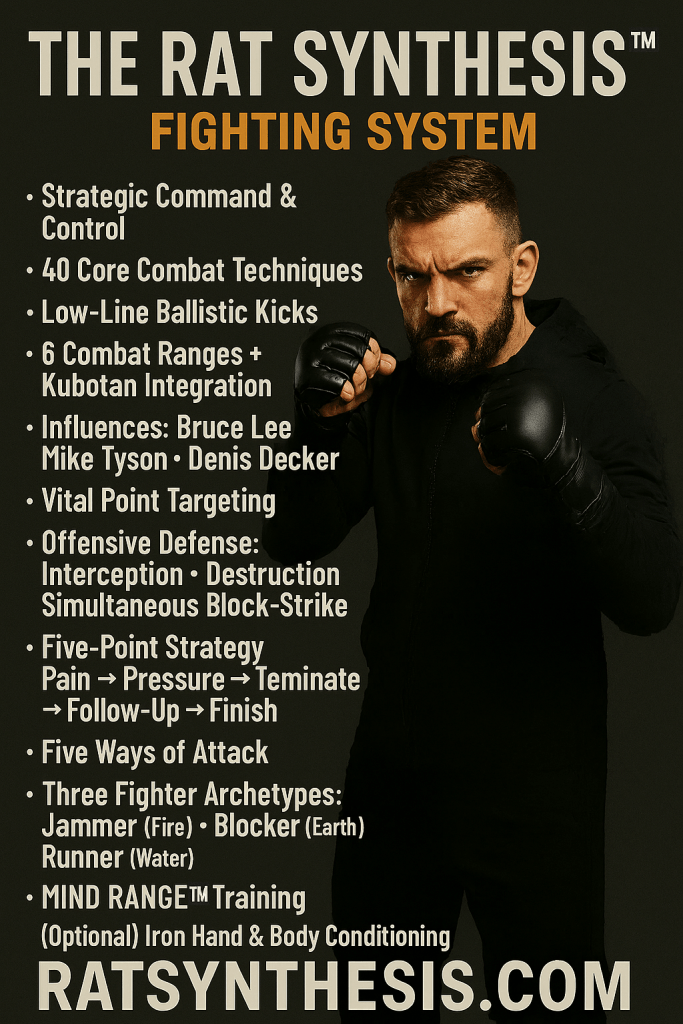
    Sifu Matt Russo’s RAT SYNTHESIS™ — inspired by Rapid Assault Tactics™ (R.A.T.) — is an independent, evolutionary version of JKD. It combines Bruce Lee’s method, Tyson-style power boxing, Denis Decker’s Chi Ling Pai®/Baguazhang, and Kubotan fighting, forged through real-world combat experience.


    • Vital Point Targeting with Only 40 techniques—stripped down to what actually ends fights. Focus is power. Focus saves time—so you can live your life. Complex martial arts techniques FAIL under real stress. Why waste energy memorizing hundreds of counters in a rule-bound system when one brutal strike to a vital point can end it instantly—or give you the edge to finish it fast?
    • No pointless forms, kata, or drills like hubud, sombrada, or chi sao. Drills build drill skill, not necessarily fight skill.
    • No flashy high kicks. We use devastating ballistic low line kicks.

    🧬 SCIENTIFIC STREET FIGHTING

    THE COMPLETE SYSTEM OF STREET DOMINATION.

    COMMAND AND CONTROL STRATEGY.

    R.A.T. IS BATTLE-TESTED BY GOVERNMENT AGENCIES AND NAVY SEALS.

    Bruce Lee Inspired
    Street Fighting System of Domination
    TIER 1
    Mike Tyson Inspired
    Explosive Power Street Boxing
    TIER 1
    Denis Decker
    Kung Fu Mastery
    TIER 3
    Kubotan
    Weapons Range for Any Scenario
    ALL TIERS

    THE FOUR TIERS: PATH OF ASCENDANCY

    1967: Bruce Lee chose Interception over blocking. 1970s: Inosanto added Destructions. Blocking is OBSOLETE.

    • We don’t trade punches. We don’t block. Block-counter is passive and a last resort.
      Instead, we use Offensive Defense—intercept, destroy, and simultaneous block-strike.
      Master the Five Ways of Attack, command the Five-Point Strategy of domination, and outsmart all Three Fighter Types.
      Total control—on the street or in life.
    • SIX RANGE SYSTEM: Mind, Weapon (Kubotan), Kicking, Striking, Trapping, Counter-Grappling. Our Mind training makes the other ranges work.
    • Bruce Lee Foundation: Five-Point Strategy of domination. First: vital point strikes and joint destructions (PAIN). Then: a straight blast (PRESSURE) that crushes all styles—finished with headbutts, knees, and elbows (TERMINATE) that end it brutally and fast. Then FOLLOW UP AND FINISH (e.g., rear strangle or takedown with ground-and-pound) (60%).
    • Mike Tyson‑level shock power street kickboxing without gloves (20%).
    • Denis Decker Kung Fu domination of balance disruption, structural breaks, and devastating flank attacks (20%).
    • OPTIONAL: Iron Hand & Body training available—toughen your tools, resist pain, and finish the fight without hesitation.

    • Real-World Personal Development. If Sifu Russo could transcend the system and win from within, so can you—using RAT Synthesis™ .
    • The Sixth Range of Combat and Life — Beyond weapons, striking, and grappling, the mind governs all ranges.
    • Transform in Just 15 Minutes — Each class concludes with a focused meditation and strategy training session to build clarity, calm, power, and strategic dominance in combat and life.
    • The Secrets of Mastery. The system’s four secret weapons are Mushin (no-mind, no-self flow state for effortless action), Fudoshin (immovable mind) combined with controlled killer instinct to stay calm and strike decisively, and Strategic Mastery to apply timeless strategy for total control.
    • Benefits of Mind Range™ Training:
      • Laser-sharp focus and tactical awareness
      • Emotional resilience under pressure
      • Fast, fearless decision-making
      • Spiritual awareness and intuition
      • Confidence that empowers every area of life
    • The Master’s Formula: Meditation → Strategy → Mushin → Fudoshin → Killer Instinct → Mastery
    • Join a Warrior Brotherhood committed to strength of body, mind, and spirit.

    🏋️‍♂️ COMBAT‑SPECIFIC FITNESS

    BEYOND SURVIVAL: WHY SPRINT-LEVEL FITNESS IS ENOUGH FOR A FIGHT—BUT RAT SYNTHESIS BUILDS MORE.

    Most street fights are shockingly short—usually just 10 to 30 seconds, rarely more than a minute. They erupt with sudden aggression, burn through adrenaline fast, and often end quickly from exhaustion, a decisive strike, or bystander intervention. Because of this, you don’t need the stamina of an Olympic athlete—you just need the athleticism for a short sprint, and being able to go all-out for 30–60 seconds is more than enough to cover the bases.

    What truly makes the difference is strategy. With smart tactics, you can conserve energy, control the chaos, and end things swiftly. That’s why RAT Synthesis Martial Arts is so effective—it’s built on superior strategy, not brute force. At the same time, RAT Synthesis goes far beyond the demands of a short sprint, building greater overall fitness while also improving your health and confidence.

    • Pad and shield work builds Muay Thai-level and beyond striking power and combat-ready fitness.
    • Kettlebells. Calisthenics. Rubberized resistance training.
    • Short‑range internal knockout power that ages as well as you do.

    🛡️ WEAPONS DEFENSE. COUNTER‑GRAPPLING. MASS ATTACK DEFENSE.

    • Kubotan mastery—legal, concealable, brutal.
    • Escape clinches and ground fighting with pain, not wrestling matches. Break structure, create exits.
    • Train vs weapon attacks (knife, baseball bat)
    • Trains vs. multiple attackers at Tier 2 (~6 months into the program)

    🧠 EXPOSING THE BLIND SPOTS: WHY RAT SYNTHESIS™ STANDS ALONE

    To grasp the power of RAT Synthesis™, you must first see where others fall short.

    WHY COMPARE AT ALL?


    1️⃣ KRAV MAGA — WHERE IT FALLS SHORT

    WeaknessReal‑World Cost
    Limited Ground GameA skilled grappler can dominate once contact is made.
    Minimal SparringDrills without resistance inflate confidence, not skill.
    Brute‑Force BiasMuggers, rapists, and home invaders are usually bigger. Larger, more aggressive attackers erase any advantage.
    Rigid, Scripted CountersChaos shatters pre‑set moves.
    No Internal DevelopmentMeditation, Chi, awareness, and short‑range power never mature. In RAT Synthesis Tier 3, Internal Power delivers short-range knockout force. As you age, non-muscular strength and energy-driven endurance become essential weapons in your arsenal.

    FORCE VS. FORCE IS NOT SCIENCE; IT’S GAMBLING WITH YOUR LIFE.


    2️⃣ GRACIE JIU‑JITSU — CHOKED BY CONTEXT

    WeaknessReal‑World Cost
    Vulnerable to StrikesPulling guard on concrete = broken face or worse.
    Poor Stand‑Up GameNo tools until you clinch—if you clinch.
    One‑on‑One FocusThe second attacker ends the match—on your head.
    Ground‑First MindsetAsphalt, glass, friends with boots: all bad.
    Energy DrainPositional warfare exhausts smaller or older fighters.

    GREAT ON MATS, DANGEROUS ON PAVEMENT.


    3️⃣ SPORT MMA — A CAGE ISN’T A STREET

    WeaknessReal‑World Cost
    Rules‑Based ConditioningEye gouges, groin kicks, head‑butts = blind spots. No referees or weight classes in real fights.
    Ground LiabilityGravity + concrete + buddies with boots. Enough said.
    Glove DependenceBare‑knuckle breaks hands; wraps are dreams. RAT Synthesis includes optional iron hand and body conditioning.
    Weapon IgnoranceKnife beats rear‑naked choke every time.
    Single‑Opponent Tunnel VisionChaos, ambush, and terrain rewrite the script.

    A RULEBOOK IS A LUXURY YOU WON’T HAVE IN A PARKING LOT.

    4️⃣ TAEKWONDO — TRADITIONAL SPORT, LIMITED STREET APPLICATION

    WeaknessReal-World Cost
    Sport‑Focused RulesPoint scoring and competition mindset don’t prepare you for chaotic street fights with no referees or rules.
    Telegraphed, High KicksLarge spinning and jumping kicks are slow and predictable, making you vulnerable in close quarters. If a grappler shoots in, you could be taken down and crack the back of your head on the pavement.
    Underdeveloped Hand StrikesOveremphasis on kicks means punches, elbows, and close-range strikes are weak or missing.
    No Grappling or Ground GameLack of clinch work or ground fighting leaves you exposed when contact is made.
    Rigid Forms and PatternsTraditional poomsae don’t translate to real fight adaptability or unpredictability.
    No Internal Power TrainingRelies on brute strength and stamina, which fade under pressure or with age. Knee joints wear out. Works for kids. Bad for longevity.

    STREET FIGHTS DEMAND BRUTAL EFFICIENCY, NOT FANCY KICKS OR FLASHY ROUTINES.


    💬 What Warriors Are Saying:

    Sifu Matt is a highly skilled martial artist as well as a profound thinker. I am very grateful to have trained with him.” — Robert Q.

    “Thanks to Sifu Matt for 20+ years of friendship. Sifu gave the best teaching/training/fitness ever. Sifu understands the most effective and efficient self-defense moves. Sifu also understands each students’ assets and abilities. Sifu Matt has lived the journey learning more each day and willing to impart it to all.” – Robert Shaughnessy


    STOP WASTING TIME.

    RAT SYNTHESISIS SIMPLE, POWERFUL, AND INNOVATIVE—NOT AN IMITATION.

    REAL SYSTEM. FAST RESULTS.


    SAMPLE VIDEOS

    🎥 WATCH: RAT SYNTHESIS™ COMBAT IN ACTION – 4-MONTH STUDENT DEMO.

    This is primarily offense. For offensive defense—interception, destruction, and block-strike combos—visit our videos page.


    🌌 OUR MISSION:

    To awaken greatness within.
    To forge Spartans—warriors of body, mind, and spirit.
    To create leaders who master themselves and each moment through meditation, energy, and strategy.


    🥋 JOIN THE LIVE WARRIOR TRAINING.
    COMBAT-FITNESS-MINDSET-STRATEGY.
    FIRST CLASS FREE!

    Cash or Venmo accepted after your first free class.

    All training is conducted in a respectful, supportive, and safety-first environment.

    START YOUR WARRIOR JOURNEY NOW!

    LOCATION:

    Water Street Wellness

    15 Water Street
    Englishtown, NJ 07726

    Monday: 7:15 pm-8:15 pm ET

    Wednesday: 7 pm – 8 pm ET

    Saturday: 9 am – 10 am ET

    Attire:

    No uniforms. Gym clothes or track suit. Please bring a separate pair of sneakers just for class use to avoid tracking snow or gravel into the yoga studio floor. Also a liquid refreshment like Gatorade. Thank You.

    Discover a new era of combat, fitness, and mindset transformation with RAT Synthesis.

    📞 Call 732-682-4213 to inquire or ✉️ email mrusso572000@yahoo.com. Get ready to redefine combat fitness and life excellence!

    START YOUR WARRIOR JOURNEY NOW!

    🔥 Claim Your First Warrior Session


    ⚔️ Ready to Go Deeper?

    🎯 YOUR PATH TO MASTERY STARTS HERE 🎯

    With over 44 years in martial arts, 35 in corporate strategy, and 20 in deep spiritual training, Sifu Matt Russo forged RAT Synthesis™—a powerful fusion of warrior discipline, spiritual wisdom, and modern success.
    If he could transcend the system and win from within, so can you.


    This is the insider know-how  you won’t find in classrooms, sport systems or mainstream dojos. Most have never seen this. Fewer have mastered it.


    📚 AMAZON POWERFUL READS
    Unlock hidden power, laser focus, and unstoppable spiritual fire.
    These aren’t just books — they’re mental weapons forged for transformation.

    Browse Books

    🎧 SILENT SUBLIMINAL MIND PROGRAMMING

    Reprogram your subconscious.

    ⚡️Achieve goals faster. Transform inside-out.

    🧠 Change Your Mind. Change Your Destiny.

    Try the Subliminals

    🎥 ONLINE WARRIOR COURSES

    (Coming Soon)

    Train anytime. Anywhere. Master elite tactics, mindsets, and inner power — from your living room to the battlefield of life. No excuses. No limits.

    ⚔️ Rise. Train. Dominate.

    Courses Coming Soon


    RAT SYNTHESIS: THE ART OF STRATEGIC DOMINATION

  • CHESS, NOT CHECKERS.

    Winning isn’t everything; it’s the only thing

    When your life—and the lives of those you love—are on the line.


    The Sumbrada Flow Drill

    All respect to Sifu Singh. I used to train Sumbrada often back in the day—it definitely helped. But it doesn’t teach you how to fight strategically to dominate and win. It’s like trying to win the Super Bowl by only running tires, hitting tackling dummies, and running football drills—without a real game plan.

    I understand it may be a teaching tool and for beginners, but, in my opinion, drills have become the new “kata,” and too many people are overemphasizing them while neglecting real fight strategy—how to actually win. Don’t get me wrong, drills have their place, but they can easily turn into flashy routines disconnected from reality.

    Too many drills or too much kata can also become unnecessary overhead. There’s only so much time in the day, and overtraining leaves no room for your body to recuperate and come back stronger. At RAT Synthesis we drop the unnecessary overhead (kata, drills).

    MMA tends to avoid this trap because they constantly test their skills in the ring. However, their strategies are sport-oriented, not combat-oriented. The focus isn’t on the streets—where targeting vital points and ending a confrontation quickly is crucial.

    And it’s not just about vital points; whole sections of their techniques break down the moment you break the rules—like grabbing the groin when mounted. So all that time spent focusing on sections of sport technique is out the window because it no longer applies.

    In RAT Synthesis, we approach it differently.

    Our drills are fight drills that revolve around applying the core fight strategy: pain, pressure, terminate, follow-up, finish—whether initiating from defense or attack. We also work counters to the blast, and counters to those counters. No hubud. No chi sao.

    Instead, we integrate everything within the fight drills, always focusing on the end goal: winning. We’ll also isolate specific areas—like Immobilization Attack or Trapping—to sharpen and refine them.

    We incorporate the RAT Drill, where the attacker wears a motorcycle helmet to safely absorb the straight blast, while the defender works the main strategy under realistic pressure.

    From there, we move to sparring. One student plays the “bad guy,” mimicking specific fighter types. The other plays the “good guy,” tasked with neutralizing and defeating them. This method sharpens strategy and helps keep egos in check—the bad guy is meant to lose. Of course, ego never disappears entirely, but this structure helps manage it.

    Eventually, we remove the limitations and let things flow freely—though always keeping it at a level of play.

    There’s a recent movement against sparring, highlighted in some popular YouTube videos. But the pushback is really against hard, knockdown-drag-out sparring. The solution, as Jesse Enkamp wisely says? Play with it.

    Bruce Lee knew this too—hence his quote:

    “A good fight should be like a small play, but played seriously.”

    Check out Jesse’s informative breakdown here:

    Why Everyone Stopped Sparring

    Conclusion:

    In this post, we examine the limitations of traditional martial arts drills like Sumbrada, hubud, and chi sao, emphasizing that while they can build coordination, they often lack strategic depth for real combat situations.

    RAT Synthesis takes a different approach—cutting unnecessary overhead and focusing on practical fight strategies designed for real-world self-defense. We prioritize drills that revolve around pain, pressure, termination, follow up, and finishing, integrated with sparring methods that sharpen both strategy and ego management.

    Inspired by Bruce Lee’s philosophy and modern perspectives, our goal is clear: train to win, not just perform.

  • RAT SYNTHESIS MARTIAL STRATEGY GUIDE: MASTERING COMBAT WITH SPEED, POWER, AND DECEPTION

    “Be like water making its way through cracks. Do not be assertive, but adjust to the object, and you shall find a way round or through it.” – Bruce Lee

    Introduction:
    In the realm of fighting, the RAT Synthesis Strategy Guide stands out as a comprehensive playbook that combines science, precision and power to protect oneself effectively. Focusing on vital points, this strategy is a versatile approach designed for both finesse and power. Let’s delve into the key aspects of the RAT Synthesis Strategy and explore the two main approaches: Finesse (Little Pagua) and Power (Big Pagua).

    Finesse Strategy (Little Pagua):
    The finesse strategy is tailored for smaller opponents who prefer not to engage in direct punches and kicks. Instead, they strategically move around at a distance, weakening their adversaries. Once the opponent is in pain, the finesse practitioner moves in with precision, executing well-timed strikes before retreating again. This strategy revolves around creating openings and capitalizing on the opponent’s vulnerabilities.

    Power Strategy (Big Pagua):
    On the other end of the spectrum, the power strategy is usually employed by larger opponents. This approach involves overwhelming the adversary with forceful strikes and kicks. The goal is to move in with power, striking decisively to gain control of the situation.

    The Rapid Assault Tactics (R.A.T.) Approach:
    The RAT approach is firmly rooted in the finesse strategy, emphasizing moving back and circling side to side to elusively intercept the opponent or destroy their limbs while creating pain. Once pain is established, the RAT practitioner moves in with a blast, followed by headbutts, knees, and elbow strikes. The mantra is PAIN-PRESSURE-TERMINATE, focusing on defanging the snake before executing decisive attacks. In close encounters, one might instead initiate with headbutts, knees, and elbows.

    Five Ways of Attack:
    To overcome strong defenses, RAT Synthesis employs Bruce Lee’s five ways of attack: single direct attack, attack by combination, attack by drawing, trapping, and broken rhythm. These methods provide a nuanced and dynamic approach to self-defense, using speed, power, and deceptiveness to gain the upper hand.

    Pattern Recognition:

    The key to successful self-defense lies in intuiting your opponent’s movements. RAT Synthesis offers a framework for categorizing fighters based on behaviors, facilitating tailored responses and effective countermeasures grounded in the five ways of attack.

    Adaptability and Overcoming Challenges:
    Recognizing that real-world scenarios rarely unfold as planned, RAT Synthesis emphasizes adaptability and improvisation. The guide equips practitioners with the tools to overcome unforeseen challenges and adjust their strategies on the fly.

    Conclusion:
    The RAT Synthesis Strategy Guide offers a comprehensive roadmap for navigating the complexities of combat. By mastering the principles of movement, understanding patterns, and wielding the five ways of attack, individuals can acquire the confidence, skills, and intuition to protect themselves effectively, adapting to any situation with speed, deception, and power.