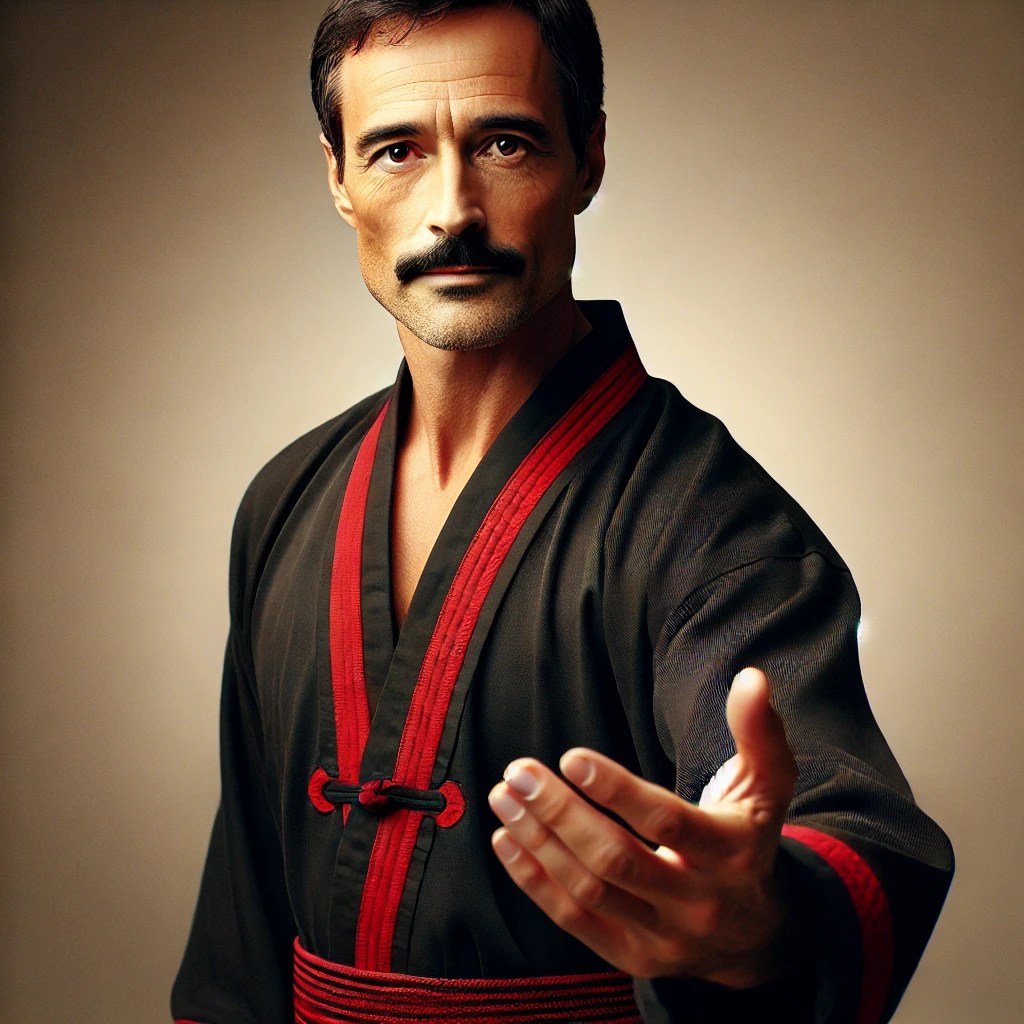
Mystic Valor is a powerful, uplifting soundtrack and epic discourse of the soul’s journey—where soaring riffs meet sacred echoes, and every rhythm calls you to rise above life’s battles.
Epic motivational and inspiring speeches by Brother Long Tran and Sifu Matt Russo, designed to empower your mind, body, and spirit. Let freedom ring.
Brother Long Tran & Sifu Matt Russo – Warriors of Mind and Spirit
Brother Long Tran, a Vietnam-born kung fu fighter, U.S. Army veteran, and one of Sifu Matt Russo’s martial arts teachers, brings a lifetime of discipline, courage, and relentless drive. His journey through combat, martial arts, and spiritual practice has shaped him into a thinker-warrior who challenges conventional ideas and inspires others to rise above limits.
Sifu Matt Russo, martial artist, spiritual teacher, and founder of RAT Synthesis, has dedicated decades to mastering real-world combat, inner power, and strategic living. Guided by mentors like Brother Tran, and blending Kriya Yoga, the teachings of Paramahansa Yogananda, and martial strategy from legends such as Clausewitz, Denis Decker, Bruce Lee, Musashi, Mike Tyson, and Sun Tzu, he teaches mastery of both the physical and spiritual dimensions of life.
Together, they fuse martial mastery with mindfulness, creating a path that sharpens the body, empowers the mind, and awakens the spirit—a story of transformation, strategy, and the pursuit of true freedom.
Trump compared his upcoming Alaska summit with Putin to a “chess game”, saying there’s a 25% chance it could fail to advance peace talks on Ukraine. He hopes it will lead to a second meeting with Putin and Zelenskyy to negotiate a deal, possibly involving give-and-take on land and boundaries—something Ukraine and its allies oppose.
There is an invisible war between Godless Marxism and the free world—most people don’t even see it. The end game? Total control, worship of the state—not Jesus, not Adonai, not Buddha, not Krishna—while stripping away free will and human rights.
And here’s the thing: God exists… so what dark force do you think is pulling the strings behind Marxism? Think about that.
Capitalism: “The worst economic system—except for all the others.” – Churchill
Like it or not, Trump knows what he’s doing, and he’s fighting this war. Yes, it’s a chess game—and so is most of life. I know this because of martial arts.
What? You thought martial arts was just mindless kick, punch, grapple like the UFC? No—when practiced with intelligence, it’s far deeper. You study masters like Sun Tzu, Clausewitz, Musashi—names the average Westerner may not recognize or care about—to their own detriment.
Countless martial artists—perhaps even hundreds of thousands—have met and trained with the legendary “Superfoot” Bill Wallace. But how many truly learned the essence of what he teaches?
Though I haven’t had the honor of meeting him in person, I’ve studied his system and spoken with those who trained under him. From a distance, one truth stands out—and I believe many may have overlooked it:
✅ Turn weakness into strength. After a judo injury damaged his right leg, Wallace didn’t quit—he adapted. His left leg became his primary weapon, and what began as a limitation became legendary. It was clocked at 60 mph.
✅ Simplicity + Focus = Power. Instead of chasing complexity, he refined a few tools to surgical precision. This kind of discipline and clarity is rare.
✅ Deception is key. Like Sun Tzu taught, the art of war is the art of deception. Wallace embodied this with his set ups—using one leg to dominate most of his opponents.
His genius wasn’t just physical—it was strategic. Like Bruce Lee’s Jeet Kune Do, Wallace’s method focused on simplicity.
And with boxing fundamentals added to his arsenal, he became a true hybrid—fast, efficient, and dangerous.
The lesson? Mastery isn’t about having more. It’s about doing more with LESS.
At RATsynthesis.com, we live by that same principle: Less is MORE.
We don’t overwhelm you with hundreds of techniques. We help you master the 40 that matter—deeply, decisively, and strategically.
Visit RATsynthesis.com and learn how to become a strategic warrior—on the streets, and in life. It’s time to train smart. Move with clarity. Strike with purpose.
“In battle, do not think that you have to win. Think rather that you do not have to lose.”
– Gichin Funakoshi
Why the Water‑Mind Strategy Outclasses Ego Warfare
At first glance Funakoshi’s quote sounds like timid advice—until you realize it is the ancient martial cheat‑code hiding in plain sight. This single shift from “I must win” to “I must not lose” dissolves ego, unlocks impeccable timing, and hands you the keys to psychological domination.
Below is your Warrior‑Sage field manual for turning that maxim into real‑world power—on the mat, in the boardroom, and anywhere resistance appears.
1 ⚔️ EGO IS A HAND GRENADE—PULL THE PIN, LOSE THE LIMB
Obsessing over victory shackles you to one outcome. The moment you need to win, you telegraph desperation:
Tension creeps into shoulders and stance.
Vision narrows; options disappear.
You lunge, overextend, or bite on feints.
Drop the ego: “I must not lose.” Suddenly you’re calm, unreadable, immune to bait. Clarity replaces compulsion; adaptability replaces anxiety.
2 🧠 PATIENCE TURNS MOMENTS INTO OPENINGS
Not losing is not passivity—it’s waiting with purpose. Miyamoto Musashi wrote of seated zeal, the coiled spring that strikes only when the adversary cuts his own armor.
Rushing to win = gifting your timing to the enemy.
Refusing to lose = forcing them to create the opportunity you exploit.
Victory becomes an inevitable by‑product of conserved energy and precise release.
3 🎯 EARTH CENTER VS. FIRE FLAIL
Think of the elements:
Element
Energy
Typical Error
Water‑Mind Counter
Fire
Overreach, blitz
Burns fuel, exposes flanks
Cool flow, lure into vacuum
Earth
Rigid guard
Roots in one spot
Slip, redirect, erode
Water
Adaptive calm
None—Water studies, then floods
You
Staying in the center (Earth) while holding a Water mindset means you never need to chase. You occupy ground, breathe, and let volatility orbit your stillness.
4 🧘 DETACHMENT + DOMINANCE = WARRIOR‑SAGE
Zen archers loose the arrow after the bow has already loosed them. Taoist generals win before marching. Spiritual sages remind disciples: “The soul doesn’t need to win; it only needs to remain awake.”
Hold the outcome lightly, own the moment completely. The world sees serenity—then wonders how serenity keeps beating it.
5 🧩 MAKE THE ENEMY SOLVE YOUR RIDDLE
When you no longer broadcast an urgent need to triumph:
Impatience gnaws at the adversary.
They probe; their pattern reveals.
You counter once—clean, final, effortless.
The Water strategist never outmuscles; he outlasts, outwits, out‑centers.
WHY THIS IS PURE WATER
Non‑contention: Flow around stone, not through it.
Strategic patience: Erode defenses grain by grain.
Detachment: Formless until form is advantageous.
Preservation: Win with minimum force, minimum cost.
“The clever combatant imposes his will on the enemy but does not allow the enemy’s will to be imposed on him.” — Sun Tzu
Water neither boasts nor breaks, yet mountains bear its signature.
REAL‑WORLD RIPPLE EFFECTS
Arena
“I Must Win” Mind
“I Must Not Lose” Water Strategy
Negotiation
Over‑concession or hard‑line rigidity
Listen, mirror, let them reveal true ceiling
Startup Warfare
Burn cash for market share
Conserve runway, pivot until gap appears
Relationships
Point‑scoring arguments
Hold space, defuse, invite truth
Fitness
Crash diets, injury
Sustainable habits, incremental load
Investing
Chasing highs, panic sell
Capital protection, asymmetric bets
ACTION DRILL—30‑SECOND WATER RESET
Exhale slowly—empty the lungs, empty attachment.
Ask: “What do I actually lose if I pause?”
Feel feet and spine—Earth center.
Wait three heartbeats; watch the field realign.
Do this before every crucial exchange. You’ll feel the current shift in your favor.
THE SAMURAI‑YOGI CREED
“Do not think you must win. Think only that you must not lose.”
Win by outlasting. Win by out‑centering. Win by letting Water sculpt the battlefield to your design.
Flow. Endure. Redirect. Emerge victorious—without the fight.
⚔️ Ready to Master Strategy in Every Arena?
AVAILABLE WITHIN DAYS:The Way of the Warrior‑Sage isn’t just a book—it’s a battle-tested system to help you decode conflict in seconds, strike with precision, and dominate in any arena—from business and relationships to combat and inner mastery.
🔥 Learn the art of strategic domination. 🌊 Command the elements. 🌍 Win without wasting energy.
🕉️ Also includes the arts of yoga, manifestation, and living the way of the warrior-saint (Kensei).
Have you ever caught yourself thinking, “I already know this—it’s all been said and done”? If so, be careful. That thought is more dangerous than ignorance—it’s the death of growth.
That mindset, while seemingly harmless or even confident, is the surest sign that you’ve become unteachable. And once you’re unteachable, you’ve stopped evolving. You’ve stopped learning. You’ve shut the door to mastery.
The Parable of the Overflowing Teacup
There’s a Zen story that illustrates this perfectly.
A learned man once came to visit a Zen master, boasting about all he had studied. He wanted to discuss Zen, but his words were filled with opinions and theories. The master simply listened—and then offered the man some tea.
He began to pour.
The cup filled. Then overflowed. And the master kept pouring.
The visitor exclaimed, “Stop! The cup is full—no more will go in!”
The master replied,
“Exactly. Like this cup, you are full of your own opinions and preconceptions. How can I show you Zen unless you first empty your cup?”
That man, like so many of us, believed he already knew. But the fullness of ego is the emptiness of learning.
This is where the ancient principle of Shoshin comes in.
Enter Shoshin — The Beginner’s Mind
In Zen Buddhism, Shoshin means beginner’s mind. It’s the attitude of openness, curiosity, and humility, no matter how advanced or experienced you become.
Shunryu Suzuki, a revered Zen teacher, once said:
“In the beginner’s mind there are many possibilities, in the expert’s mind there are few.”
This isn’t just poetic philosophy. It’s a practical mindset that separates masters from mediocrities.
The true master revisits the basics again and again—not out of necessity, but from reverence. The unteachable person rolls their eyes and says, “I already know this.”
Why “I Already Know This” is a Lie
Let’s break down this subtle yet toxic belief.
When you say “I already know this,” what you’re really saying is:
“There’s nothing more for me to see here.”
“I don’t need to listen deeply.”
“My cup is full. I don’t need to drink.”
But reality constantly changes. Your perception changes. You change. The same teaching, revisited with fresh eyes, can offer brand-new insight.
Bruce Lee echoed this spirit when he said:
“Empty your cup so that it may be filled; become devoid to gain totality.”
That’s Shoshin. That’s the essence of continual growth.
The Hidden Arrogance of Certainty
Knowledge can become a trap. The more we think we know, the more we close ourselves off. Ego creeps in. We become armored by our own opinions.
And ego is the enemy of mastery.
The most dangerous words a martial artist, spiritual seeker, entrepreneur, or truth-seeker can utter are:
“I’ve heard this before.”
Because hearing is not knowing, and knowing is not living.
You don’t truly know something until it becomes part of your nature—until it shapes how you breathe, speak, decide, and move.
Real Talk: Martial Artists, Ego, and the Dunning-Kruger Effect
I’ve had numerous online conversations with martial artists who think they already understand what I teach in my book: RESURRECTING THE BRUCE LEE STREET FIGHTING SYSTEM OF DOMINATION!: Learn How to End Street Fights in Seconds, Not Rounds.
They confidently throw out lines like:
“It’s just interception. You can teach it in 10 minutes.” “Vital points don’t matter—trained fighters can target them too.” “Just get the Rapid Assault Tactics™ (R.A.T.) book cheap.” “You’re just lazy or inexperienced.”
Let’s clear a few things up:
Yes, interception is part of offensive defense—but it’s not the whole system.
Yes, trained fighters can target vital points—but they usually don’t. Why? Because they’ve trained within rules. And under pressure, you default to how you train. For example, on the ground they might cycle through 75 moves and counters—while you can short-circuit the entire game with simple immobilizations combined with a groin grab, an eye jab, or a throat strike. These aren’t complex moves. They’re simple, direct, and devastating—and they don’t take years to master.
Yes, a good part of it is inspired by R.A.T.—but it also draws from the Joe Lewis Fighting System™ and has much more. Like discussions on technology and how to train the system. While Mr. Lewis’ system was built for sport, Bruce’s was forged for street survival. The power isn’t in endless techniques—it’s in the strategy and the clear, decisive advantages it gives you in real-world combat, even against larger experienced fighters. Without the recipe, you’ll likely mistake the trees for the forest. I know—I was there, frustrated, before I finally saw the vision that put the simple puzzle together.
No, I’m not inexperienced. I don’t sit around eating chips on a couch watching fights and spouting theory. At nearly 60 I still train hard several times a week and bring over 44 years of martial arts experience to the table—including real sparring with serious, highly skilled fighters. For context:
A Golden Gloves-level boxer
A high school wrestling champ (also my Vietnamese Gung Fu teacher and a ferocious street fighter)
A 6’5″, 300-pound black belt in both Okinawan Karate and Taekwondo
Multiple Chinese Kung Fu practitioners, including another 6’5″, 300-pound fighter with real-world experience
More
I’ve trained across numerous disciplines, including Jeet Kune Do with JKD legends, and I’ve got the injuries and insights to show for it.
This kind of dismissive attitude could be a case of theDunning-Kruger Effect—where those with limited experience overestimate their understanding and reject deeper, hard-earned knowledge.
If this challenges you, good. I’m not here to coddle comfort zones—I’m here to awaken warriors.
What they don’t grasp is this: It’s not about multitudes of techniques, arts, or training methods. It’s about a complete, simple strategic system designed for real-world application—built on command, control, shock, and finish.
This isn’t dojo fighting. This isn’t the octagon.
This is survival.
But because they think they “already know,” they never even begin to understand. They’ve become unteachable—full cups that spill over the moment you try to pour something new in.
Jesus and the Teachable Heart
Jesus encountered this same attitude among the self-righteous and self-satisfied. When asked why He spent time with sinners instead of the “wise,” He replied:
“It is not the healthy who need a doctor, but the sick. I have not come to call the righteous, but sinners to repentance.” (Luke 5:31–32)
In other words: those who think they already have all the answers can’t receive truth. It’s the humble, the hungry, the ones who know they still have something to learn—they’re the ones who transform.
How to Practice Shoshin
Here’s how to cultivate the beginner’s mind every day:
Approach every lesson like it’s your first. Even if you’ve “done it a thousand times.” The master always finds new depths in repetition.
Catch the “I know this” voice. When it arises, take a breath and soften. Be curious. Ask: What’s here for me now?
Study with childlike wonder. Children don’t pretend to know—they explore, absorb, and play.
Relearn your foundations often. Go back to the basics. Mastery lives in simplicity.
Surround yourself with those who challenge your assumptions. Stay humble. Stay open.
Final Thought: Stay Teachable, Stay Alive
The moment you stop learning is the moment you start dying—spiritually, creatively, mentally.
Don’t let the illusion of “knowing” rob you of growth. Don’t let your ego lock the gates to new insight.
Instead, bow to the wisdom of Shoshin—and rediscover the world, moment by moment.
Because the real master isn’t the one who knows it all… It’s the one who never stops learning.
🔱 Awaken the Samurai-Yogi.
🔱 Live by Dharma, not drama.
🔱 Train like a Warrior. Think like a Sage. Move like a King.
Discipline equals freedom. Now rise.
🥋 JOIN THELIVE WARRIOR TRAINING. COMBAT-FITNESS-MINDSET-STRATEGY. Learn how to End street fights in seconds — and master life beyond combat. Start Your Warrior Journey Now
“Appear weak when you are strong, and strong when you are weak.” – Sun Tzu
WIN BEFORE THE BATTLE STARTS– Epic Rap Ballad | Spiritual Warrior ✝ ॐ
Core Combat Principles:
Victory comes from preparation, not chance
Know yourself and know your enemy
Win without fighting
All warfare is based on deception
Attack where the enemy is unprepared
Use speed and flexibility
Appear weak when you are strong, and strong when you are weak
Adapt to changing circumstances
Strategy over brute force
Control the battlefield before the battle begins
Sun Tzu’s The Art of War offers timeless strategies emphasizing preparation, adaptability, and understanding one’s adversary—principles central to RAT Synthesis. His insights seamlessly integrate into physical combat and life’s challenges, empowering practitioners to achieve victory.
Rooted in Lao Tzu’s Yin/Yang/Tao philosophy, Sun Tzu reveals a five-factor codethat decodes reality, providing tools to command life and resolve conflicts with precision. Echoing the Tao Te Ching, he warns against partiality—failing to consider both sides. By embracing balance and harmony, you can generate vitality (chi) and master life’s internal and external challenges.
SPIRIT OF THE DRAGON – Spiritual Warrior ✝ ॐ Hip Hop
Bruce Lee: The Philosopher of Flow and Jeet Kune Do Far more than just a movie star, Bruce Lee was a smaller, lighter, and highly skilled street fighter whose methods consistently proved effective, even against larger opponents.
His exceptional abilities earned the respect of martial arts legends such as Ed Parker, Chuck Norris, and Joe Lewis. He revolutionized martial arts with Jeet Kune Do, a mixed martial art focusing on adaptability, efficiency, and the flow state.
Using No Way as Way, Having No Limitation as Limitation
Flow Like Water
Interception
Longest weapon to nearest target
Five Ways of Attack
Four Ranges
Keep your Strong Side Forward
Straight Blast
Psychological Warfare
Bruce Lee wasn’t just a movie icon — he was a nearly unbeatable street fighter in both the U.S. and Hong Kong, the heart of Chinese Kung Fu.
Legends like Chuck Norris, Joe Lewis, Bolo Yeung, Jim Kelly, and Mike Stone (91 straight wins in full-contact karate) all recognized one thing: Bruce had a deadly edge that conventional martial arts never captured. But the complete, real-world system of domination? It was never released. Almost lost forever. Until now.
After decades of relentless study, brutal training, and real-world testing, Sifu Matt Russo has cracked the Bruce Lee code— and now it’s yours. Forget flashy kicks and cage rules. This isn’t for sport. Not for show. This is raw, brutal street fighting — built for one thing: Dominate. Survive. Walk away alive.
Inside this book, you’ll discover:
The hidden blueprint of Bruce Lee’s street-fighting genius — decoded and made battle-ready
Why traditional martial arts and conventional MMA fall short in real-life violence — and what actually works when your life depends on it
The radical simplicity of Jeet Kune Do.
Master the art of striking first and applying offensive defense — with battle-tested tactics to control the fight and end it fast
How Bruce’s vision inspired elite fighters to break from tradition and master the true art of survival
This isn’t a history lesson — it’s a revolution in real-world self-defense.
“Life is really simple, but we insist on making it complicated.” — Confucius The pieces were scattered— but I’ve assembled the puzzle for you. This is your street fighting blueprint: distilled from Rapid Assault Tactics™ (R.A.T.) and the Joe Lewis Fighting System™ — both rooted in Jeet Kune Do — and sharpened through 44 years of training and deep study of Bruce Lee. While Joe Lewis’s system was designed for sport, what I share here is forged specifically to dominate on the street. This recipe gives you clear, decisive advantages in real-world combat, even against larger experienced fighters.
You could study every JKD style, concept, and system, read every JKD book, watch every JKD video, train in multiple arts, and even learn from JKD legends like I did — and still miss the mark. That was me. Lost in the trees. Couldn’t see the forest. Until I found this recipe — and now you can too.
Avoid years of confusion, frustration, or worse—believing you know it all when you don’t. Get this book. Because in the end, truth is simple: “Jeet Kune Do is simply to simplify.” — Bruce Lee
About the Author: Sifu Matt Russo is a warrior, teacher, and seeker with 44+ years of martial arts mastery across Kung Fu, Kickboxing, Kali, and Jeet Kune Do — including years of study with a Bruce Lee lineage instructor, multiple seminars with JKD legends, and training in Chi Ling Pai® under Grandmaster Denis Decker. A spiritual mentor grounded in Raja Yoga and the teachings of Paramahansa Yogananda, Matt blends physical mastery with mental clarity — plus 35 years of corporate strategy experience — to decode Bruce Lee’s ultimate system for survival and success.
When chaos erupts, you won’t rise to the occasion — you’ll fall to your training. If you’re done with illusions… If you want power, precision, and survival skills that work in the real world… Click the link below and unleash Bruce Lee’s complete street-fighting system — finally decoded and battle-ready. The street doesn’t wait. Neither should you.
TABLE OF CONTENTS
INTRODUCTION
UNLEASHING THE STRATEGIC GENIUS OF BRUCE LEE
CONCLUSION: THE RETURN OF THE DRAGON’S CODE
PROGRESSIVE TRAINING SYSTEM
APPENDIX / RESOURCES
ABOUT THE AUTHOR
If you’re done playing games—and ready to unlock real-world fighting power—click HERE
UNLOCK THE SECRET TO UNSTOPPABLE POWER Transcend Fear, Doubt, and Confusion. Awaken the Warrior Within.
What if you could move through life with laser precision, unwavering clarity, and unstoppable effectiveness? What if every decision, every action, every moment was infused with calm power and strategic mastery?
This isn’t a fantasy. This is Mushin.
MUSHIN: THE WARRIOR’S SECRET TO UNSTOPPABLE POWER isn’t just a book—it’s a breakthrough. A battlefield-tested guide forged from ancient Eastern wisdom, elite martial arts, and modern performance science. This is the manual for those who refuse to live an average life.
Mushin means “no-mind, no-self”—a state where fear disappears, doubt vanishes, and action flows effortlessly from a place of higher awareness. It’s how the samurai dominated the battlefield. It’s how world-class CEOs and Hollywood icons stay centered, sharp, and powerful under pressure. And now, it’s how you will rise.
Learn to tap into a higher intelligence—beyond the conditioned mind and faster than thought.
Through this transformational guide, you’ll learn how to:
Eliminate fear and inner resistance
Cultivate unshakable equanimity and calm under chaos
Develop razor-sharp intuition and lightning-fast clarity
Master perfect timing, distance, and strategic precision
Move with speed, grace, and explosive power
Enhance every aspect of your life—from combat to career
Achieve success faster—and with purpose
This is more than self-help. This is self-mastery.
If you’re ready to break limits, silence the noise, and embody the mindset of warriors and masters—this is your moment.
Don’t just read about greatness. Become it. Get your copy of MUSHIN: THE WARRIOR’S SECRET TO UNSTOPPABLE POWERnow—and begin the journey to supreme mastery. Click HERE to rise!
This is the RAT Synthesis expression of Grandmaster Denis Decker’s Gung Fu and Pagua (Bagua).
Grandmaster Decker was both feared and loved by many martial artists he encountered. His skill was undeniable—he could end fights with advanced practitioners in seconds. But as he aged and evolved, a deeper gentleness emerged. He became more generous, more compassionate—and in the end, he was loved even more than he was feared.
Overview
Tier 3of RAT Synthesis focuses on the combat-tested teachings of Grandmaster Denis Decker. Many can perform flowery forms, but few can scientifically fight and end a confrontation in seconds. Grandmaster Denis Decker mastered both.
Simply mastering the forms and some drills does not teach how Grandmaster Decker actually fought.
While we do not include the traditional components of Decker’s system—such as horse training, forms, or other classical practices (many of which were truly poetry in motion)—we have fully integrated his functional, street-proven Gung Fu and Bagua methods.
This streamlines the Gung Fu component of RAT Synthesis, eliminating unnecessary complexity and overhead.
An efficient system minimizes its impact on the rest of your life, giving you the freedom to focus on other priorities.
Jeet Kune Do is simply to simplify– Bruce Lee
How Do We Train and get Results Without Forms and other Classical drills?
Zhan Zhuang
Instead of relying on forms (kata) or traditional drills, our training focuses on principle-based internal development through Decker’s proven fighting methods:
Zhan Zhuang (Standing Meditation that develops strong internal power and proper body structure)
“Empty your mind, be formless, shapeless – like water.” – Bruce Lee
Our approach aligns with Yi Quan (意拳) – “Mind Boxing”, a modern internal art that also discards forms in favor of:
Internal principles
Intention (Yi)
Standing meditation (Zhan Zhuang)
Spontaneous movement
Tactical Adjustment and Awareness
Training is hands-on and refined in real-time by the Sifu (teacher) correcting during attack/defense drills and sparring. This is our version of Chi Sao or Push Hands, but more streamlined and complete—similar to how Bruce Lee trained the formidable karate champion Joe Lewis using fight drills.
It’s like playing chess by mastering a few strong strategies—without needing to memorize every move. Chess isn’t about knowing everything; it’s about consistently knowing how to win. The same applies to martial arts. Martial arts is chess with muscles. The Sifu guides the student through sparring and drills, correcting them like a coach in a chess game. This also lets the Sifu create specific learning experiences to help the student grow.
Each adjustment sharpens:
Structure
Internals
Timing
Spatial awareness
You learn to dominate with strategy—not brute strength.
Core Combat Principles
Take Command and Control from the Start.
Internal Power over Brute Force
Circular, Flowing Motion
Fight Centers and disrupt their balance
Use Triangles and the Pyramid
Feet in parallel lines
The Octagon
Employ Four-Sided Fighting (Pagua)
Keep Your Strong Side Forward (Decker was left handed and many copy this)
Be Deceptive (Possum)
Never give a sucker an even break
Additional Combat Concepts
Attack from flanks and blind sides (Tier 1 of RAT Synthesis emphasized the middle or straight blast. Tier 3 also adds the sides. This is similar to the role of Filipino Kali in Jeet Kune Do).
Apply Fajingfor explosive short-range power. We develop this by training power strikes on mitts and shields.
THE GUNG FU CHESSBOARD.
The gates diagram is a chessboard or map that teaches warriors how to analyze, protect, and exploit the vulnerable areas of an opponent’s body. The body is divided by thirds, vertically and horizontally, revealing the vertical lanes of engagement: the left outer lane, the middle line (which holds the legendary Wing Chun centerline), and the right outer lane. Add angles (triangles) and circles for attack and defense. Master this, and you master the geometry of battle.
Bagua Integration
Eight Palms
Eight Chi Gungs (Zhan Zhuang)
Circle Walking
Inside Change / Outside Change
Side Step and step with Hook Stance to take the sides
Bagua Videos
Additional Techniques
Black Feather
Chinese Hook Punch
Golden Peacock
Rising Fist
Upset Punch
Ridge Hand
Bear Palm
Chop (Shuto)
Reverse Fajing (similar to Lop Sao)
Adaptable Battle Plan: RAT Synthesis 5-Point Attack Strategy (Bagua Style)
Pain – palm strike. Eye jab is ‘number 2’ palm.
Pressure – Use ABC (Attack by Combination) to keep the heat on. E.g. multiple palm strikes executed using fajing.
Terminate – Power strikes: headbutts, elbows, knees, forearms.
Follow-Up (optional) – Continue pressure at close range. Power shots.
Finish – End the fight with one of five options:
Rear strangle
Push
Push-and-kick
Takedown variations
Ground control & strikes
On the ground, ground and pound using palm strikes, headbutts, knees, and elbows. Stay to the side or crouched—avoid mounting, as it limits mobility and exposes you to reversal. Then you are prepared for multiple opponents.
Defensive Strategy: The Six Responses
Accept – Receive their energy and absorb it into the ground, or redirect it to use against them.
Pass – Turn your waist and shift your position so their attack moves past you harmlessly.
Destroy – Attack the opponent’s attacking limb with precision strikes. Here we add the “Bagua Hammer“.
Cancel – Target their structural alignment to break the power behind their attack.
Neutralize – Nullify the incoming force with balance and timing (50/50 approach).
Stop– Use shoulder, bicep, forearm, or fist stops to interrupt their movement.
Offensive Strategy: The Five Ways of Attack
Single Direct Attack/Angular Attack, Attack by Combination, Immobilization Attack, Attack By Drawing, Broken Rhythm.
Attack by Drawing (Possum)
One of Master Decker’s signature tactics, Attack by Drawing—known as “Possum”—uses calculated deception to bait an attack.
The advantage? When the opponent takes the bait and commits to an attack, they walk directly into your counter. Their forward momentum amplifies the force of your strike, effectively doubling the impact.
Like Muhammad Ali but without the dancing, Decker would lure opponents into false confidence—then counter with devastating precision.
How to Set the Trap
Expose a Targetusing the“W” Guard: Example, lead palm held high to the side, rear palm low and centered—exposing a tempting middle or side lane. Decker would also crane his head forward to present a tempting target—a bold tactic that can be highly effective but is extremely dangerous without advanced timing, precision, and refined attributes.
Bait and Counter: Block the first shot, then Stop-Hit the second shot. You could also stop hit on their first shot if you prefer or are able to do so.
Reposition and Repeat: Reset the trap and draw again.
Power Strike: Land a decisive blow (e.g., rear-hand punch to solar plexus) when the moment opens.
ABC (Attack by Combination): Chain strikes to overwhelm and confuse—forcing the opponent further into what Bruce Lee called “the wounded crane” as they retreat under pressure or collapse from the impact.
Disclaimer: RAT Synthesis™ is an independent system created by Sifu Matt Russo. While Sifu Russo is certified in Rapid Assault Tactics, RAT Synthesis™ is a modified and expanded system that is not affiliated with, authorized by, or endorsed by Paul Vunak or the original RAT organization. The information contained in my videos, webpages, programs, forms, and documents is provided for entertainment and informational purposes only and does not constitute legal, financial, or professional advice.
If you choke someone out, they might never wake up. Then you’re facing a lifetime in a solitary cell. No black belt can save you from that. So what’s the real solution when you’re forced into a self-defense situation?
Martial arts skills are one thing—but strategy, judgment, and restraint are what determine whether you’ll walk free or end up in a cell.
Here’s the solution, step-by-step:
✅ 1. Avoidance Is Victory
The best fight is the one that never happens. Use:
Situational awareness
Verbal de-escalation
Positioning (stay near exits, avoid being cornered)
Body language to defuse threats
✅ 2. Control, Don’t Destroy
If conflict is unavoidable, your goal is to neutralize, not to brutalize.
Use pain compliance, positional control, and escapes rather than lethal or crippling techniques.
Chokes (especially rear naked chokes) are dangerous—use only if you’re being killed and must stop the threat.
Strive to use non-lethal force and stop once the threat is over.
Consider low line kicks to break their legs, eye jabs, ear slaps, and carotid stuns.
✅ 3. Understand the Law
Study self-defense laws in your region:
You must usually prove imminent danger, reasonable force, and no ability to retreat.
Know that excessive force, even if you were attacked first, can lead to prison.
✅ 4. Train for Realistic Scenarios
Practice verbal skills, control tactics, team de-escalation, and legal aftermath.
Pressure-test with stress drills and realistic roleplays (not just sparring).
✅ 5. Have a Post-Fight Plan
Get legal counsel. Prepare in advance if you’re trained in self-defense.
Martial arts should be about protection, not punishment. The solution is to fight with skill, compassion, and legal intelligence.
Sifu Russo’s works are a collaboration between AI tools such as ChatGPT and himself.
Disclaimer:The information contained in my videos, webpages, programs, forms, and documents is provided for entertainment and informational purposes only and does not constitute legal, financial, or professional advice.
When your life—and the lives of those you love—are on the line.
The Sumbrada Flow Drill
All respect to Sifu Singh. I used to train Sumbrada often back in the day—it definitely helped. But it doesn’t teach you how to fight strategically to dominate and win. It’s like trying to win the Super Bowl by only running tires, hitting tackling dummies, and running football drills—without a real game plan.
I understand it may be a teaching tool and for beginners, but, in my opinion, drills have become the new “kata,” and too many people are overemphasizing them while neglecting real fight strategy—how to actually win. Don’t get me wrong, drills have their place, but they can easily turn into flashy routines disconnected from reality.
Too many drills or too much kata can also become unnecessary overhead. There’s only so much time in the day, and overtraining leaves no room for your body to recuperate and come back stronger. At RAT Synthesis we drop the unnecessary overhead (kata, drills).
MMA tends to avoid this trap because they constantly test their skills in the ring. However, their strategies are sport-oriented, not combat-oriented. The focus isn’t on the streets—where targeting vital points and ending a confrontation quickly is crucial.
And it’s not just about vital points; whole sections of their techniques break down the moment you break the rules—like grabbing the groin when mounted. So all that time spent focusing on sections of sport technique is out the window because it no longer applies.
In RAT Synthesis, we approach it differently.
Our drills are fight drills that revolve around applying the core fight strategy: pain, pressure, terminate, follow-up, finish—whether initiating from defense or attack. We also work counters to the blast, and counters to those counters. No hubud. No chi sao.
Instead, we integrate everything within the fight drills, always focusing on the end goal: winning. We’ll also isolate specific areas—like Immobilization Attack or Trapping—to sharpen and refine them.
We incorporate the RAT Drill, where the attacker wears a motorcycle helmet to safely absorb the straight blast, while the defender works the main strategy under realistic pressure.
From there, we move to sparring. One student plays the “bad guy,” mimicking specific fighter types. The other plays the “good guy,” tasked with neutralizing and defeating them. This method sharpens strategy and helps keep egos in check—the bad guy is meant to lose. Of course, ego never disappears entirely, but this structure helps manage it.
Eventually, we remove the limitations and let things flow freely—though always keeping it at a level of play.
There’s a recent movement against sparring, highlighted in some popular YouTube videos. But the pushback is really against hard, knockdown-drag-out sparring. The solution, as Jesse Enkamp wisely says? Play with it.
Bruce Lee knew this too—hence his quote:
“A good fight should be like a small play, but played seriously.”
Check out Jesse’s informative breakdown here:
Why Everyone Stopped Sparring
Conclusion:
In this post, we examine the limitations of traditional martial arts drills like Sumbrada, hubud, and chi sao, emphasizing that while they can build coordination, they often lack strategic depth for real combat situations.
RAT Synthesis takes a different approach—cutting unnecessary overhead and focusing on practical fight strategies designed for real-world self-defense. We prioritize drills that revolve around pain, pressure, termination, follow up, and finishing, integrated with sparring methods that sharpen both strategy and ego management.
Inspired by Bruce Lee’s philosophy and modern perspectives, our goal is clear: train to win, not just perform.


 🎥 ONLINE WARRIOR COURSES