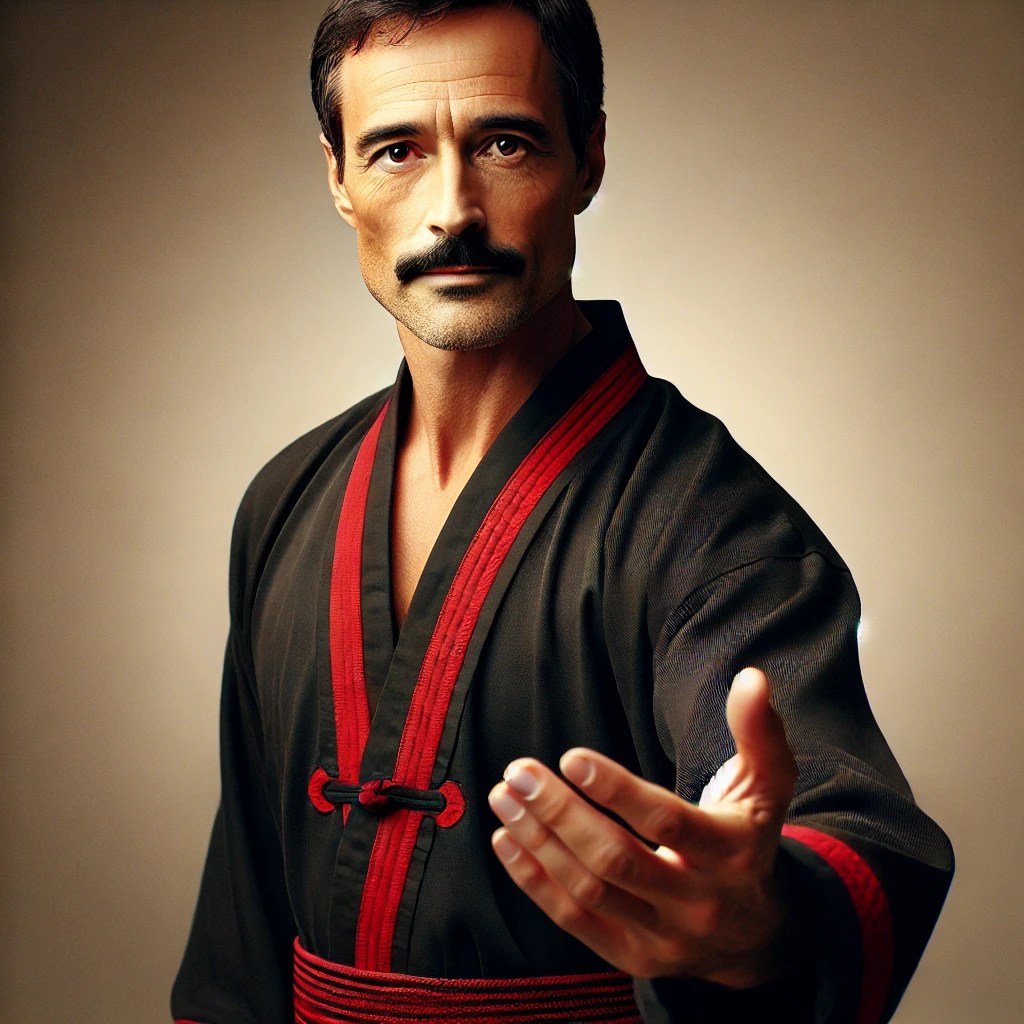
Had an interesting phone conversation tonight with someone curious about Mushin, my books, and the RAT Synthesis™ system. He asked me, “What is the path?”—referencing a Google review that said, “Stay on the path.”
The path is the way of the warrior—rooted in the tradition of the Japanese samurai, who blended Zen Buddhism and meditation to gain a decisive edge in both battle and life. I’ve studied Zen and Theravāda Buddhism myself, and later embraced the teachings of Paramahansa Yogananda.
Yogananda’s teaching helped me decode the deeper spiritual essence of martial arts. The path also contains Dharma or the Truth in life which leads to the discovery of your Higher Self also known as self-realization.
That’s what my book on Mushin is all about—cultivating stillness within motion and becoming the ultimate warrior, both in the dojo and in everyday life. Life becomes a form of living Vipassanā, a meditative awareness that sharpens your edge. This is where the path of the samurai ultimately leads.
At RAT Synthesis, we train both meditation and warriorship—fusing internal mastery with practical combat skills to give you the edge in every area of life. We also teach strategic domination—how to outthink, outmaneuver, and overcome. I also discussed the RAT Synthesis simple, adaptable and complete game plan that allows you to end street fights in seconds, not rounds.
The caller also asked about my physical stats—I’m 5’8″ and weigh around 175 lbs. He was concerned I might be overweight. So here I share a photo of myself at 57—living proof that the system works.
I train just 2.5 times a week and maintain peak performance across my entire strategic system.
No gym memberships. No machines. No ellipticals. No jogging. No steroids needed.
Just scientific street fighting, fused with a proven, science-based training methodology.
Honestly, I could be in even better shape—but nearing 60, my focus isn’t on obsessing over appearance. It’s about maintaining peak functionality and real-world performance.
Want to learn more?
Visit: https://ratsynthesis.com — there’s a blog with over 190+ free posts packed with insights and more.
All the best,
Sifu Matt Russo
Founder of THE RAT SYNTHESIS™ Fighting & Life Mastery System
Sifu Russo’s works are a collaboration between AI tools such as ChatGPT and himself—fusing ancient wisdom with cutting-edge intelligence.
Disclaimer: RAT Synthesis™ is an independent system by Sifu Matt Russo and is not affiliated with or endorsed by the original Rapid Assault Tactics™ organization.The information contained in my videos, webpages, programs, forms, and documents is provided for entertainment and informational purposes only and does not constitute legal, financial, or professional advice.
This is the RAT Synthesis expression of Grandmaster Denis Decker’s Gung Fu and Pagua (Bagua).
Grandmaster Decker was both feared and loved by many martial artists he encountered. His skill was undeniable—he could end fights with advanced practitioners in seconds. But as he aged and evolved, a deeper gentleness emerged. He became more generous, more compassionate—and in the end, he was loved even more than he was feared.
Overview
Tier 3of RAT Synthesis focuses on the combat-tested teachings of Grandmaster Denis Decker. Many can perform flowery forms, but few can scientifically fight and end a confrontation in seconds. Grandmaster Denis Decker mastered both.
Simply mastering the forms and some drills does not teach how Grandmaster Decker actually fought.
While we do not include the traditional components of Decker’s system—such as horse training, forms, or other classical practices (many of which were truly poetry in motion)—we have fully integrated his functional, street-proven Gung Fu and Bagua methods.
This streamlines the Gung Fu component of RAT Synthesis, eliminating unnecessary complexity and overhead.
An efficient system minimizes its impact on the rest of your life, giving you the freedom to focus on other priorities.
Jeet Kune Do is simply to simplify– Bruce Lee
How Do We Train and get Results Without Forms and other Classical drills?
Zhan Zhuang
Instead of relying on forms (kata) or traditional drills, our training focuses on principle-based internal development through Decker’s proven fighting methods:
Zhan Zhuang (Standing Meditation that develops strong internal power and proper body structure)
“Empty your mind, be formless, shapeless – like water.” – Bruce Lee
Our approach aligns with Yi Quan (意拳) – “Mind Boxing”, a modern internal art that also discards forms in favor of:
Internal principles
Intention (Yi)
Standing meditation (Zhan Zhuang)
Spontaneous movement
Tactical Adjustment and Awareness
Training is hands-on and refined in real-time by the Sifu (teacher) correcting during attack/defense drills and sparring. This is our version of Chi Sao or Push Hands, but more streamlined and complete—similar to how Bruce Lee trained the formidable karate champion Joe Lewis using fight drills.
It’s like playing chess by mastering a few strong strategies—without needing to memorize every move. Chess isn’t about knowing everything; it’s about consistently knowing how to win. The same applies to martial arts. Martial arts is chess with muscles. The Sifu guides the student through sparring and drills, correcting them like a coach in a chess game. This also lets the Sifu create specific learning experiences to help the student grow.
Each adjustment sharpens:
Structure
Internals
Timing
Spatial awareness
You learn to dominate with strategy—not brute strength.
Core Combat Principles
Take Command and Control from the Start.
Internal Power over Brute Force
Circular, Flowing Motion
Fight Centers and disrupt their balance
Use Triangles and the Pyramid
Feet in parallel lines
The Octagon
Employ Four-Sided Fighting (Pagua)
Keep Your Strong Side Forward (Decker was left handed and many copy this)
Be Deceptive (Possum)
Never give a sucker an even break
Additional Combat Concepts
Attack from flanks and blind sides (Tier 1 of RAT Synthesis emphasized the middle or straight blast. Tier 3 also adds the sides. This is similar to the role of Filipino Kali in Jeet Kune Do).
Apply Fajingfor explosive short-range power. We develop this by training power strikes on mitts and shields.
THE GUNG FU CHESSBOARD.
The gates diagram is a chessboard or map that teaches warriors how to analyze, protect, and exploit the vulnerable areas of an opponent’s body. The body is divided by thirds, vertically and horizontally, revealing the vertical lanes of engagement: the left outer lane, the middle line (which holds the legendary Wing Chun centerline), and the right outer lane. Add angles (triangles) and circles for attack and defense. Master this, and you master the geometry of battle.
Bagua Integration
Eight Palms
Eight Chi Gungs (Zhan Zhuang)
Circle Walking
Inside Change / Outside Change
Side Step and step with Hook Stance to take the sides
Additional Techniques
Black Feather
Chinese Hook Punch
Golden Peacock
Rising Fist
Upset Punch
Ridge Hand
Bear Palm
Chop (Shuto)
Reverse Fajing (similar to Lop Sao)
Adaptable Battle Plan: RAT Synthesis 5-Point Attack Strategy (Bagua Style)
Pain – palm strike. Eye jab is ‘number 2’ palm.
Pressure – Use ABC (Attack by Combination) to keep the heat on. E.g. multiple palm strikes executed using fajing.
Terminate – Power strikes: headbutts, elbows, knees, forearms.
Follow-Up (optional) – Continue pressure at close range. Power shots.
Finish – End the fight with one of five options:
Rear strangle
Push
Push-and-kick
Takedown variations
Ground control & strikes
On the ground, ground and pound using palm strikes, headbutts, knees, and elbows. Stay to the side or crouched—avoid mounting, as it limits mobility and exposes you to reversal. Then you are prepared for multiple opponents.
Defensive Strategy: The Six Responses
Accept – Receive their energy and absorb it into the ground, or redirect it to use against them.
Pass – Turn your waist and shift your position so their attack moves past you harmlessly.
Destroy – Attack the opponent’s attacking limb with precision strikes. Here we add the “Bagua Hammer“.
Cancel – Target their structural alignment to break the power behind their attack.
Neutralize – Nullify the incoming force with balance and timing (50/50 approach).
Stop– Use shoulder, bicep, forearm, or fist stops to interrupt their movement.
Offensive Strategy: The Five Ways of Attack
Single Direct Attack/Angular Attack, Attack by Combination, Immobilization Attack, Attack By Drawing, Broken Rhythm.
Attack by Drawing (Possum)
One of Master Decker’s signature tactics, Attack by Drawing—known as “Possum”—uses calculated deception to bait an attack.
The advantage? When the opponent takes the bait and commits to an attack, they walk directly into your counter. Their forward momentum amplifies the force of your strike, effectively doubling the impact.
Like Muhammad Ali but without the dancing, Decker would lure opponents into false confidence—then counter with devastating precision.
How to Set the Trap
Expose a Targetusing the“W” Guard: Example, lead palm held high to the side, rear palm low and centered—exposing a tempting middle or side lane. Decker would also crane his head forward to present a tempting target—a bold tactic that can be highly effective but is extremely dangerous without advanced timing, precision, and refined attributes.
Bait and Counter: Block the first shot, then Stop-Hit the second shot. You could also stop hit on their first shot if you prefer or are able to do so.
Reposition and Repeat: Reset the trap and draw again.
Power Strike: Land a decisive blow (e.g., rear-hand punch to solar plexus) when the moment opens.
ABC (Attack by Combination): Chain strikes to overwhelm and confuse—forcing the opponent further into what Bruce Lee called “the wounded crane” as they retreat under pressure or collapse from the impact.
Disclaimer: RAT Synthesis™ is an independent system created by Sifu Matt Russo. While Sifu Russo is certified in Rapid Assault Tactics, RAT Synthesis™ is a modified and expanded system that is not affiliated with, authorized by, or endorsed by Paul Vunak or the original RAT organization. The information contained in my videos, webpages, programs, forms, and documents is provided for entertainment and informational purposes only and does not constitute legal, financial, or professional advice.