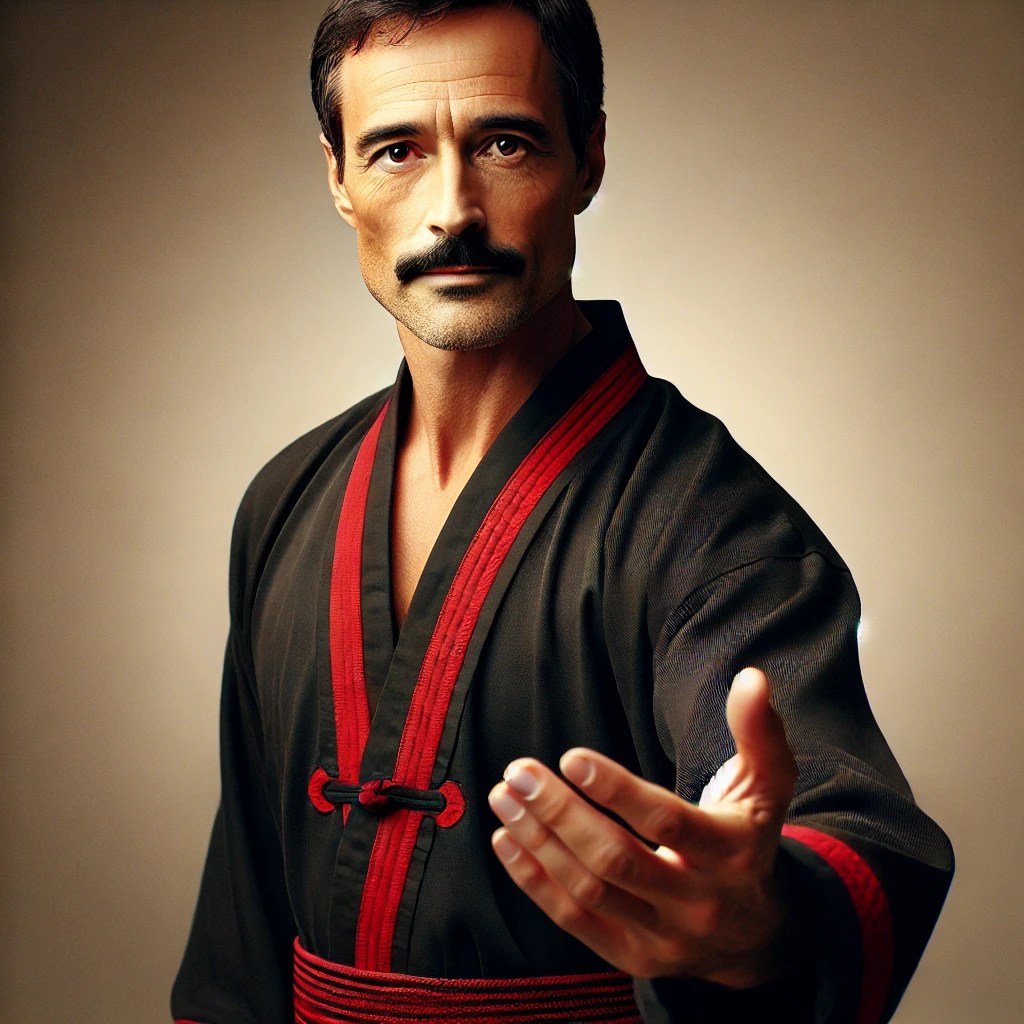
This is how I spar on my device — on chess.com, not with fists, but with thought.
Every move on the digital chessboard becomes a reflection of life itself.
Just as a fighter shadowboxes in the mirror, I train my mind through the game.
Each piece, each move, each calculated risk — it’s all a microcosm of existence.
When I play chess, I’m not just playing a game.
I’m training my brain — to anticipate, to strategize, to flow.
Likewise, I can visualize my martial arts moves in my mind like a computer simulation — each strike, each counter, each transition unfolding with precision.
It’s like a warrior replaying every motion of combat in his mind’s eye — forging reflexes not just in the body, but in the soul.
Eventually, the thinking fades.
You stop calculating. You stop planning.
During actual sparring or combat you forget calculation and enter the no-mind state — Mushin.
Pure awareness. Pure presence.
This is the moment when strategy dissolves into intuition.
You no longer “think” your next move — you feel it.
You respond like lightning, without hesitation or doubt.
This is the rhythm of mastery — the sacred balance of yin and yang.
🌓 Yin is visualization — the silent, internal rehearsal. ☀️ Yang is execution — the fierce and fearless act.
Together, they form the full cycle of true training — the mind and body united in one effortless flow.
Whether in chess, combat, or life itself — the secret is not to choose between thinking and not-thinking… but to merge them, to walk the razor’s edge between intention and instinct.
I watched the above video on Jack Dempsey’s training regimen — and it blew my mind. The “Manassa Mauler” didn’t just train; he lived inside a furnace of discipline and pain.
His daily grind wasn’t for the faint of heart:
Morning roadwork – 3–5 miles, hill sprints, shadowboxing, jump rope.
That’s 4 to 6 hours of full-intensity work every single day — the kind of workload that breaks ordinary men.
But here’s the truth: Most men trying to “train like Dempsey” are setting themselves up for failure. Not because they lack courage… but because they’re fighting the wrong battle.
I’ve said it before: YouTube is mostly noise. It’s full of flashy routines and empty hype, not a rigorous, scientific system. RAT Synthesis is different — it’s engineered for elite street fighting and real-world fitness, not clicks.
⚖️ The Mathematics of Modern Man
Let’s be scientific for a moment.
According to U.S. time-use studies, the average man has 5–6 hours of free time per day. But most of that gets burned away:
TV and streaming: ~2.8 hours/day
Socializing or relaxing: ~40 minutes
Sports or exercise: ~25 minutes
Hobbies or computers: ~30 minutes
Reading: ~15 minutes
When the smoke clears, he’s got about 25 minutes a day for actual training.
Even if he doubles it — an hour — he’s still nowhere near Dempsey’s 4–6 hour gauntlet. And if he tries to imitate it, he’ll crash and burn.
🕐 The Hidden Science: Recovery Rules the Game
Here’s another truth champions live by — recovery is training. You grow when you rest, not when you grind yourself into the dirt.
Light workout: 12–24 hours recovery
Moderate resistance training: 24–48 hours
Heavy sparring or lifting: 48–72 hours
Full fight-level intensity: 3–4 days
So when modern men go all out, day after day, they’re not becoming warriors — they’re destroying the very machinery that makes a warrior possible.
🧠 The 80/20 Principle of Combat Mastery
To be scientific is to be strategic. In RAT Synthesis, we apply the 80/20 Rule: Focus on the 20% of techniques that deliver 80% of the results.
We don’t chase every style or movement — we refine the essentials. About 40 core techniques across the five ranges of combat:
Kicking
Punching
Trapping
Grappling
Kubotan (Weapon)
That’s the formula of domination — not volume, but precision. Not thousands of motions, but a handful of techniques mastered under pressure.
⚙️ The Warrior’s Routine for the Modern Age
Here’s a structure that works for real men — men with jobs, families, and missions:
Day 1:
Heavy bag and elastic band shadow fighting
Calisthenics and kettlebell work (under 30 minutes)
Day 2–3:
Rest, recover, reflect.
(Optional: Iron body and hand training in split routine)
Then repeat. 1 day on, 2 days off — simple, sustainable, and powerful.
This rhythm prevents burnout, optimizes recovery, and allows progressive growth — the scientific way to build your body, sharpen your technique, and evolve your spirit.
💡 The Truth About “Champion Imitation”
Trying to copy a legend like Jack Dempsey is like trying to live someone else’s karma. It’s not the routine that made him great — it was his relentless adaptation to his own conditions.
Dempsey trained like a warrior because his entire life was a war. You must train like a warrior because your mission demands it. But your path must fit your battlefield.
⚔️ The Warrior’s Math of Mastery
Let’s sum it up:
You have 25–60 minutes a day — make it count.
Use the 80/20 principle — refine, don’t scatter.
Honor recovery as sacred.
Build power through consistency, not exhaustion.
Train your mind as much as your muscles.
When you align these elements, you’re no longer imitating champions — you’re forging your own legend.
And that, my friend, is the Dempsey lesson hidden in plain sight: It’s not about training harder than everyone else. It’s about training smarter than time itself.
This is the RAT Synthesis expression of Grandmaster Denis Decker’s Gung Fu and Pagua (Bagua).
Grandmaster Decker was both feared and loved by many martial artists he encountered. His skill was undeniable—he could end fights with advanced practitioners in seconds. But as he aged and evolved, a deeper gentleness emerged. He became more generous, more compassionate—and in the end, he was loved even more than he was feared.
Overview
Tier 3of RAT Synthesis focuses on the combat-tested teachings of Grandmaster Denis Decker. Many can perform flowery forms, but few can scientifically fight and end a confrontation in seconds. Grandmaster Denis Decker mastered both.
Simply mastering the forms and some drills does not teach how Grandmaster Decker actually fought.
While we do not include the traditional components of Decker’s system—such as horse training, forms, or other classical practices (many of which were truly poetry in motion)—we have fully integrated his functional, street-proven Gung Fu and Bagua methods.
This streamlines the Gung Fu component of RAT Synthesis, eliminating unnecessary complexity and overhead.
An efficient system minimizes its impact on the rest of your life, giving you the freedom to focus on other priorities.
Jeet Kune Do is simply to simplify– Bruce Lee
How Do We Train and get Results Without Forms and other Classical drills?
Zhan Zhuang
Instead of relying on forms (kata) or traditional drills, our training focuses on principle-based internal development through Decker’s proven fighting methods:
Zhan Zhuang (Standing Meditation that develops strong internal power and proper body structure)
“Empty your mind, be formless, shapeless – like water.” – Bruce Lee
Our approach aligns with Yi Quan (意拳) – “Mind Boxing”, a modern internal art that also discards forms in favor of:
Internal principles
Intention (Yi)
Standing meditation (Zhan Zhuang)
Spontaneous movement
Tactical Adjustment and Awareness
Training is hands-on and refined in real-time by the Sifu (teacher) correcting during attack/defense drills and sparring. This is our version of Chi Sao or Push Hands, but more streamlined and complete—similar to how Bruce Lee trained the formidable karate champion Joe Lewis using fight drills.
It’s like playing chess by mastering a few strong strategies—without needing to memorize every move. Chess isn’t about knowing everything; it’s about consistently knowing how to win. The same applies to martial arts. Martial arts is chess with muscles. The Sifu guides the student through sparring and drills, correcting them like a coach in a chess game. This also lets the Sifu create specific learning experiences to help the student grow.
Each adjustment sharpens:
Structure
Internals
Timing
Spatial awareness
You learn to dominate with strategy—not brute strength.
Core Combat Principles
Take Command and Control from the Start.
Internal Power over Brute Force
Circular, Flowing Motion
Fight Centers and disrupt their balance
Use Triangles and the Pyramid
Feet in parallel lines
The Octagon
Employ Four-Sided Fighting (Pagua)
Keep Your Strong Side Forward (Decker was left handed and many copy this)
Be Deceptive (Possum)
Never give a sucker an even break
Additional Combat Concepts
Attack from flanks and blind sides (Tier 1 of RAT Synthesis emphasized the middle or straight blast. Tier 3 also adds the sides. This is similar to the role of Filipino Kali in Jeet Kune Do).
Apply Fajingfor explosive short-range power. We develop this by training power strikes on mitts and shields.
THE GUNG FU CHESSBOARD.
The gates diagram is a chessboard or map that teaches warriors how to analyze, protect, and exploit the vulnerable areas of an opponent’s body. The body is divided by thirds, vertically and horizontally, revealing the vertical lanes of engagement: the left outer lane, the middle line (which holds the legendary Wing Chun centerline), and the right outer lane. Add angles (triangles) and circles for attack and defense. Master this, and you master the geometry of battle.
Bagua Integration
Eight Palms
Eight Chi Gungs (Zhan Zhuang)
Circle Walking
Inside Change / Outside Change
Side Step and step with Hook Stance to take the sides
Bagua Videos
Additional Techniques
Black Feather
Chinese Hook Punch
Golden Peacock
Rising Fist
Upset Punch
Ridge Hand
Bear Palm
Chop (Shuto)
Reverse Fajing (similar to Lop Sao)
Adaptable Battle Plan: RAT Synthesis 5-Point Attack Strategy (Bagua Style)
Pain – palm strike. Eye jab is ‘number 2’ palm.
Pressure – Use ABC (Attack by Combination) to keep the heat on. E.g. multiple palm strikes executed using fajing.
Terminate – Power strikes: headbutts, elbows, knees, forearms.
Follow-Up (optional) – Continue pressure at close range. Power shots.
Finish – End the fight with one of five options:
Rear strangle
Push
Push-and-kick
Takedown variations
Ground control & strikes
On the ground, ground and pound using palm strikes, headbutts, knees, and elbows. Stay to the side or crouched—avoid mounting, as it limits mobility and exposes you to reversal. Then you are prepared for multiple opponents.
Defensive Strategy: The Six Responses
Accept – Receive their energy and absorb it into the ground, or redirect it to use against them.
Pass – Turn your waist and shift your position so their attack moves past you harmlessly.
Destroy – Attack the opponent’s attacking limb with precision strikes. Here we add the “Bagua Hammer“.
Cancel – Target their structural alignment to break the power behind their attack.
Neutralize – Nullify the incoming force with balance and timing (50/50 approach).
Stop– Use shoulder, bicep, forearm, or fist stops to interrupt their movement.
Offensive Strategy: The Five Ways of Attack
Single Direct Attack/Angular Attack, Attack by Combination, Immobilization Attack, Attack By Drawing, Broken Rhythm.
Attack by Drawing (Possum)
One of Master Decker’s signature tactics, Attack by Drawing—known as “Possum”—uses calculated deception to bait an attack.
The advantage? When the opponent takes the bait and commits to an attack, they walk directly into your counter. Their forward momentum amplifies the force of your strike, effectively doubling the impact.
Like Muhammad Ali but without the dancing, Decker would lure opponents into false confidence—then counter with devastating precision.
How to Set the Trap
Expose a Targetusing the“W” Guard: Example, lead palm held high to the side, rear palm low and centered—exposing a tempting middle or side lane. Decker would also crane his head forward to present a tempting target—a bold tactic that can be highly effective but is extremely dangerous without advanced timing, precision, and refined attributes.
Bait and Counter: Block the first shot, then Stop-Hit the second shot. You could also stop hit on their first shot if you prefer or are able to do so.
Reposition and Repeat: Reset the trap and draw again.
Power Strike: Land a decisive blow (e.g., rear-hand punch to solar plexus) when the moment opens.
ABC (Attack by Combination): Chain strikes to overwhelm and confuse—forcing the opponent further into what Bruce Lee called “the wounded crane” as they retreat under pressure or collapse from the impact.
Disclaimer: RAT Synthesis™ is an independent system created by Sifu Matt Russo. While Sifu Russo is certified in Rapid Assault Tactics, RAT Synthesis™ is a modified and expanded system that is not affiliated with, authorized by, or endorsed by Paul Vunak or the original RAT organization. The information contained in my videos, webpages, programs, forms, and documents is provided for entertainment and informational purposes only and does not constitute legal, financial, or professional advice.
🎥 WATCH: Tier 1 Training — Just 4 Months In. RAT Synthesis trains you fast, real, and ready for the streets.
🎥 WATCH: STREET MMA. NO RULES. NO NONSENSE. SAVE YOUR LIFE & LOVED ONES.
Sport MMA has rules. Rules dictate how you fight. And the way you train is the way you fight. You can’t rewire your nervous system in the heat of the moment. Under pressure, you’ll react exactly how you’ve trained. RAT Synthesis is STREET MMA. It’s scientific street fighting—beyond traditional styles and modern trends.
🥋Master the Art of Counter-Grappling. We don’t play by their rules. We don’t out-wrestle wrestlers—we unleash sudden pain, disrupt their game, and escape with ruthless precision.
What Will You Do When There’s No Referee—Just Life or Death?
Live For Something Or Die For Nothing
Forget Rules. Forget Tradition. Forget Sport. This Is Real.
RAT Synthesis was forged by Sifu Matt Russo, a master martial artist, Raja yogi, and life strategist. After studying dozens of systems and teaching for years, he saw the fatal flaws in most martial arts:
❌ Too Many Rules – Real fights don’t follow a rulebook. There are no weight classes and referees. ❌ Too Defensive – Waiting to react gives the attacker the upper hand. ❌ Too Many Arts, Drills, and Fancy Moves – If you spread yourself thin you lose power. Complicated techniques collapse under real pressure. Kata and drills don’t guarantee real-world readiness. High kicks get you tackled in the street—not the dojo. ❌ No Mental Preparation – Most systems ignore the psychological warfare of real violence.
So he built a new way—a synthesis of only what works when life is on the line.
THE RAT SYNTHESIS™ FIGHTING SYSTEM.
Sifu (Teacher) Matt Russo’s evolutionary approach includes:
Bruce Lee perhaps the greatest martial artist of the current era.
Mike Tyson needs no introduction.
Denis Decker is known as a Kung Fu prodigy in traditional martial arts circles.
Weapons Mastery: Kubotan. Legal in New Jersey, USA. Compact. Non-lethal by design— but fully capable of delivering deadly force when the moment demands it.
Mind Range™. Warrior Mind. Strategic Power. Spiritual Force. The missing link in most martial, personal and professional development training today.
STRATEGIC DOMINANCE: The Art of Controlling and Conquering Any Opponent
STRATEGY IS A CRITICAL FACTOR—THIS IS MUSCLE CHESS.
Become a tactical genius in the chaos of combat. Sun Tzu is strategy. Clausewitz is strategy. Chess is strategy. Bruce Lee, Mike Tyson, and Denis Decker were all strategic geniuses. Yes, efficient techniques and attributes matter—but strategy matters more.
RAT SYNTHESIS™ Core Combat Principles:
Street-Ready MMA, Not Sport: Brutal low-line kicks, eye jabs, ear slaps, groin shots—designed for survival, not points.
No Forms. No Fluff: Forget katas, chi sao, and patterned drills. Drills like Hubud build drill skill but not necessarily fight skill. We build real fight skills through adaptive, live-pressure training.
Relentless Domination: Offense is your best defense. Command and Control the fight before it starts.
Minimalist, Maximum Impact: Master just 40 lethal techniques across 4 combat ranges—no fluff, no wasted motion. Why get lost in hundreds of moves and endless counters… when a precision arsenal, scientific street-fight strategy, and ruthless vital point targeting can end the chaos and own the fight in seconds—not rounds?
Mindset Meets Strategy: Integrated training for the body, mind, and battlefield.
A simple system wastes nothing. You train smarter, faster, and still have energy for life.
“I fear not the man who has practiced 10,000 kicks once, but the man who has practiced one kick 10,000 times.” – Bruce Lee
Our system is efficient. You get results with less time and less fluff. A lower maintenance system gives you freedom through mastery.
🔒 Our Defense Is Offense:
We intercept, destroy, and simultaneous block-strike rather than block and then counter, combining defense and counterattack in one seamless motion
⚔️ Our Offense = Relentless Attack:
Direct Attack: Fast and straight.
Combinations: Rapid-fire hits.
Drawing: Bait and counter.
Immobilization: Trap and shut them down.
Broken Rhythm: Disrupt their timing.
On the street, 80% of offense is ABC (Attack by Combination) and trapping—because ranges collapse fast. There’s no time for feints or setups like in dojo or sport fighting.
But when distance is kept and bombs are exchanged, RAT Synthesis still has you covered. RAT Synthesis gives you all the tools and prepares you for any scenario.
🧠 Our Formula:
PAIN → PRESSURE → TERMINATE → FOLLOW-UP → FINISH
We break down all fighters:
Jammers (aggressive)
Blockers (defensive)
Runners (evasive)
We take the lead, break their structure, and finish the fight fast.
🚀 4-Tier Training System:
Tier 1 (Initiate): Core street tactics—learnable in 6 months. Includes the Bruce Lee Fighting System and street kickboxing. Also basic ground defense and kubotan fighting.
Tier 4 (Master): Self-Mastery and Freedom of Expression (non-physical training).
Training is real-time, hands-on, and strategic. Like chess, you don’t need to know every move—just how to win.
HOW WE SPAR.
Your Sifu coaches you through fight drills and sparring, correcting timing, structure, and awareness. You’ll face a variety of live-action scenarios and evolving challenges designed to sharpen your adaptability and response under pressure.
Our “muscle chess” drills build true combat ability in dynamic, high-stakes situations—just like Bruce Lee used to train champion Joe Lewis.
When ready, students engage in tactical sparring—good guy vs. bad guy, not ego vs. ego—focusing on strategy, timing, and mission-based intent.
Motorcycle helmet fight drills from Rapid Assault Tactics™ for realistic chaos.
Weapons defense sparring to prepare for armed threats under pressure. Also kubotan sparring.
Counter-groundfighting drills, highly realistic and designed to simulate live ground combat with an emphasis on survival, escape, and rapid neutralization.
Mass attack sparringto train awareness, movement, and dominance against multiple attackers.
You don’t overpower—you outthink, outmove, and outstrike.
For a deep dive into our Four Tier System, please click HERE.
FITNESS DEVELOPMENT.
Kicking Shield Training Our methods develop explosive power—matching or surpassing even Muay Thai.
Each class is split into two parts:
Technical Training: Learn and refine real-world combat techniques. Attack/defense drills, especially our Five Point Formula – and sparring, when the student is ready.
High-Intensity Conditioning: Strike mitts, punch and kick shields, lift kettlebells, perform calisthenics, and build explosive power with resistance tubing. You’ll build serious cardio and functional strength.
Straight Blast
Shadow fighting using rubber resistance tubing
RAT Synthesis™ delivers real results.
Here’s a photo of me at 57—living proof of the system.
I train just 2.5 times a week and maintain peak performance across my entire strategic system.
I don’t hit the gym, use weight machines, jog, or ride ellipticals.
It’s scientific street fighting paired with a proven, science-based training approach.
MINDSET & STRATEGIC MASTERY: REAL WORLD PERSONAL DEVELOPMENT.
“I’ve always believed that the mind is the best weapon.” – John Rambo
This is where RAT Synthesis stands alone. It’s not just training—it’s transformation.
Every class ends with 15 minutes of life mastery:
Inner Stillness & Emotional Control
Warrior Meditation
Law of Attraction & Energy
Tactical Visualization
Combat & Life Strategy
The path of the tactician. The yogi-sage. The spiritual warrior.
Master this—and life becomes your game.
To take a deep dive into our 15-minute Mind Range™ sessions—click HERE.
Why RAT Synthesis Is for You:
You don’t have time for gimmicks—you want what works.
You don’t care about belts—you care about survival.
You’re not looking to compete—you’re training to win when it counts.
You want to be stronger, smarter, faster, and spiritually grounded.
Whether you’re a beginner, martial artist, or everyday citizen—if you want to dominate the moment instead of be dominated, this system is for you.
Live for Something. Or Die for Nothing.
Don’t wait for violence to find you. Train today. Win tomorrow.
RAT SYNTHESIS: Combat. Fitness. Mindset. This is the way of the warrior.
“The shortest distance between two points is a circle“
THE GRANDMASTER – Spiritual Warrior ✝ ॐ Hip Hop
Dedicated in honor and loving memory to
Great Grandmaster Denis R. Decker
NOTE: Many may dismiss the movements in the below videos as impractical, but they are classical forms designed to build foundational principles—not how Grandmaster Decker truly fought. I share them to honor and preserve his legacy. Simply learning the forms and some drills does not teach how he actually fought.
Decker’s fighting method was fast, powerful, brutal, and decisive. Sometimes deceptive (attack by drawing which he termed ‘possum’). Elements of Decker’s fighting method are reflected in Kosho Ryu Kempo, Hanshi Bruce Juchnik’s system, particularly in their focus on fighting centers and related principles such as the octagon. However, Decker’s method stands out as notably more aggressive.
I had the privilege of learning Grandmaster Decker’s fighting method firsthand. While RAT Synthesis does not include the traditional aspects of his system—such as horse training, forms, and other classical practices, many of which were poetry in motion—we fully integrate his practical fighting Gung Fu and Pagua (Bagua) into Tier 3 of the RAT Synthesis system.
Grandmaster Decker was both feared and loved by many martial artists he encountered. His skill was undeniable—he could end fights with advanced practitioners in seconds. But as he aged and evolved, a deeper gentleness emerged. He became more generous, more compassionate—and in the end, he was loved even more than he was feared.
Hanshi Bruce Juchnik—renowned martial artist, head of the Kosho Ryu Kempo system, and close friend of Grandmaster Decker—offers his reflections on their relationship and Decker’s legacy.
Cynthia Rothrock is an acclaimed American martial artist and actress, widely celebrated for her groundbreaking work in martial arts cinema and for paving the way as a female action star.
Cynthia was taught by Grandmaster Denis Decker in the late 1960s or 1970s. Below is a Facebook post she shared, featuring a photo of the two together when she was a young martial artist.
From what I understand, Grandmaster Decker and Cynthia were both training in Eagle Claw Kung Fu with Leung Shum in Pennsylvania during the 1970s. That was quintessential Denis—he thrived on connecting with other masters like Leung and exchanging knowledge. In this way, he remained unrestricted by any single martial arts style, yet he developed his own unique system known as Chi Ling Pai®.
Keep Your Strong Side Forward (Decker was left handed and many copy this)
Be Deceptive (Possum)
Never give a sucker an even break
Grandmaster Denis Decker was not merely a martial artist; he was a visionary whose approach to martial arts became a revolutionary force within the discipline. His unique Gung Fu was an extraordinary fusion of profound internal power, adaptable combat strategies, and deep philosophical insight, blending the body, mind, and spirit into one cohesive system.
Decker’s genius lay in his ability to integrate real-world application with explosive technique and mental agility, creating a martial art that was as strategic as it was powerful. His mindset was built on these cornerstones, each reinforcing the other to form a system that transcended conventional martial arts.
Key Points in Denis Decker’s Mindset and Strategy
Real-World Application: Denis Decker didn’t just create a martial art for the sake of tradition; he forged a system for survival. His approach was founded on the belief that martial arts must be tested in real combat. He emphasized practical techniques that could be utilized in the most challenging, high-stress environments. Unlike many traditional schools that were bogged down by rigid forms and theory, Decker’s Gung Fu was designed for adaptability. Every technique was a tool for survival, tested under pressure, shaped by the chaos of real-world application.
Adaptability and Fluidity: In Decker’s system, rigidity was the enemy. His students were not taught to memorize patterns; instead, they were trained to feel the flow of combat, to adjust and adapt seamlessly to the ever-changing dynamics of a fight. Decker’s gung fu emphasizes fluidity and natural body mechanics, ensuring that practitioners can respond to any situation, any opponent, and any environment. By cultivating fluid movements and intuitive responses, Decker’s system made practitioners unpredictable and virtually impossible to counter. Denis Decker exemplified creativity in martial arts by spontaneously creating new forms, showcasing his genius and innovative approach to Gung Fu.
Internal Strength and Energy: Where many martial artists focused on brute strength, Decker took the opposite approach. He tapped into the ancient art of internal energy, or chi, which became a central theme of Decker’s gung fu. Through controlled breathing and specific exercises, Decker’s system taught practitioners how to harness their internal power, using this energy to enhance their movements and strikes. The result? A martial artist whose strength was not limited to physical muscle but was magnified by the profound energy of chi, enabling them to strike with immense power while remaining grounded and centered.
Explosive Power with Minimal Effort: Decker understood the value of efficiency in combat. His teachings prioritized using minimal force to generate maximum effect, a concept that is crucial for overcoming opponents who may be larger, faster, or more aggressive. Instead of relying on brute force, Decker Gung Fu practitioners learn to deliver devastating strikes that are quick, powerful, and direct, allowing them to neutralize threats without wasting energy. This principle aligns with the internal energy philosophy, where strength isn’t solely about muscle but also about the seamless application of focused power.
Mental Agility and Focus: The mind is as important as the body in Decker’s Gung Fu. Denis Decker’s teachings stressed the importance of mental clarity and focus under pressure. He believed that mental agility—staying calm, sharp, and aware—was essential not only in combat but in life. Practitioners of his gung fu are trained to remain strategic and composed, able to adjust on the fly and adapt to opponents who may be faster, stronger, or more aggressive. This mental focus gives practitioners an extraordinary edge, as they can read their opponents and respond with pinpoint accuracy.
Self-Examination and Continuous Growth: One of Decker’s most profound beliefs was that martial arts, like life, is a journey of constant growth. He emphasized self-examination as a path to mastery, urging his students to reflect on their performance, learn from their mistakes, and continuously improve. This commitment to growth extended far beyond the dojo, creating individuals who were not just skilled martial artists, but individuals deeply committed to personal development. The philosophy of Decker’s gung fu, then, is not merely about fighting—it’s about becoming a better person every day.
Emphasis on Deception: The strategic mind of Denis Decker understood the power of deception. In combat, being predictable is a fatal flaw, and Decker’s system emphasized the use of feints, baits, misdirection, and unexpected angles. Decker called this Possum. Practitioners learned not only to strike but to outwit their opponents, making their movements unpredictable and disorienting. This mastery of deception was a crucial part of Decker’s gung fu, elevating the combatant from mere fighter to a true strategist, capable of turning the tide of battle with a single well-placed move.
The Importance of Teaching: Beyond his personal skill, Denis Decker was deeply committed to the art of teaching. He didn’t just want to create skilled fighters—he wanted to create well-rounded individuals, capable of mastering both combat and life. His philosophy was rooted in empowering others, sharing his knowledge, and building a community of like-minded individuals. The Denis Decker gung fu method wasn’t just about combat techniques; it was a school for life, shaping individuals into leaders, warriors, and thinkers.
Conclusion
Denis Decker’s Gung Fu represents a legacy of genius that goes far beyond the realm of martial arts. His system is a fusion of body, mind, and spirit, designed to unlock the potential of every individual. Through its emphasis on adaptability, internal strength, mental agility, and strategic deception, Decker’s gung fu offers a blueprint for personal and martial mastery.
Decker’s philosophy teaches us that true strength is not just about physical might but about the power of adaptability, strategy, and inner calm. His contributions to martial arts have inspired countless students to live, fight, and grow with strength, purpose, and clarity.
Through his gung fu, Decker gave the world not just a martial art, but a way of life.
Denis Decker once said, “Martial arts is about love.” At first, I misunderstood. But over time, I realized it was profound. Love is why we teach. Love is why we fight. Love is why we endure. One family.
MORE INFORMATION:
THE CHI LING PAI GUNG FU® ASSOCIATION – Led by Master Scott Felsen, the website of my good friend, Brother, and heir to Denis Decker’s Gung Fu system. There are also demonstrations by my Kung Fu Brothers on this website.
Aum is the cosmic vibration of creation and divine consciousness.
Disclaimer: RAT Synthesis™ is an independent system created by Sifu Matt Russo. While Sifu Russo is certified in Rapid Assault Tactics, RAT Synthesis™ is a modified and expanded system that is not affiliated with, authorized by, or endorsed by Paul Vunak or the original RAT organization. The information contained in my videos, webpages, programs, forms, and documents is provided for entertainment and informational purposes only and does not constitute legal, financial, or professional advice.
Chris Kent was a friend of Marty Gross, my Jeet Kune Do (JKD) teacher in the late 1980s and early 1990s. Marty was a student of Dan Inosanto during the 1970s and spent five years training at the Marina Del Rey Academy in California. He primarily taught me Kickboxing and Filipino Kali, introducing me to Doce Pares stylists such as Arnulfo “Dong” Cuesta in Jersey City, NJ, Dr. Tabo Tabo, and Grandmaster Dionisio Cañete. Marty was a street fighter who won his battles with fists and knives and carried the scars to prove it. He was an intense, fearless individual. Those were wild times.
My honest expression of martial arts evolution is RAT Synthesis—a system curated from solving real-world combat challenges and overcoming the limitations I faced in sparring, even after years of training in various styles. In real life, playing by the rules can mean losing—and on the street, that loss could cost your life or the lives of others. Explore our strategic blueprint here: https://ratsynthesis.com/what-is-rat-synthesis/
The Way of StrategyRose Cross, symbol of the enlightenmentAligning with the structure of Yin/Yang/Tao brings harmony with reality and avoids partial outcomes.