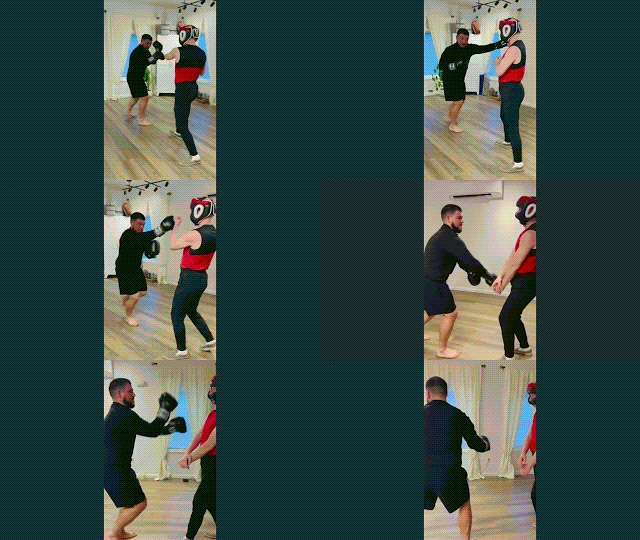
When I was younger, I sparred—and I usually got beaten.
In my kwoon, I often lost.
Against friends who studied other styles, I lost.
And that was a gift.
Because every time I lost, I was standing across from someone better than me.
Someone who exposed my weaknesses.
Someone who forced me to adapt.
So I kept challenging myself.
I got better.
But I was still frustrated—until I discovered Baguazhang.
Bagua taught me how to fight—and more importantly, how to build the integrity of an art that can eventually fight for you through a reprogrammed nervous system and the Mind of No Mind—Mushin.
Then came Rapid Assault Tactics, combined with Joe Lewis’s Five Ways of Attack and the three types of fighters.
Piece by piece, the Bruce Lee fighting system became clear.
This is the difference with Jeet Kune Do:
Don’t simply wait to block.
Intercept. Destroy. Stop the attack as it comes.
It is active self-defense.
Then came RAT Synthesis—built from decades of martial arts experience and the Bruce Lee fighting system, with arts like Bagua placed at the highest tier.
And the lesson is simple:
If you are never challenged where you train, you are in the wrong place.
Find people better than you.
Get humbled.
Discard the ego.
Because you have to lose to discover how to win.
Don’t train until you get it right.
Train until you can’t get it wrong.
Get out of the comfort zone.
Seek the fighter who exposes your weakness.
Because your greatest defeat may be your greatest teacher.
The spiritual warrior understands a powerful truth: you don’t need to use maximum effort to achieve maximum results.
In Taoism, Wu Wei means “effortless action”—not doing nothing, but acting without unnecessary struggle. You learn to move with circumstances rather than constantly fighting against them. This is like sand paper and rubbing with the grain instead of against the grain.
The Pareto Principle, or 80/20 rule, teaches something similar: roughly 80% of our results often come from 20% of our efforts. So instead of trying to do everything, the warrior identifies what matters most and puts energy there.
And then there is the principle of conservation of energy. In life and in martial arts, our energy is limited. Every wasted movement, every unnecessary argument, every emotional reaction, and every technique that uses more force than necessary drains the warrior.
In martial arts, this means efficiency over brute force. Don’t meet strength with strength when you can redirect it. Don’t throw ten techniques when one precise technique will do. Relax, observe, position yourself, and strike only when the opportunity presents itself.
In life, it means asking: Where is my energy actually producing results?
Stop fighting battles that don’t matter. Stop forcing what cannot be forced. Focus your energy on what is important, act intelligently, and let go of unnecessary struggle.
That is Wu Wei. That is the 80/20 principle. That is conservation of energy.
The warrior doesn’t waste energy fighting everything. The warrior learns where to place it—and makes every movement count.
Because it retrains the nervous system to move with internal power, proper alignment, and integrity. Circle sparring, along with the palm-on-the-chest drill, further imprints that integrity into the nervous system. This is what makes Bagua such a profound martial art.
Once these principles become embodied within the nervous system, you no longer have to consciously think about them. You simply continue practicing the peculiar methods of Bagua to maintain, refine, and deepen that near-perfect integration.
Bagua is not a collection of techniques—it is a training method into which you place your techniques. As an example, you can use Wing Chun techniques. Bagua operates at trapping range.
At that distance, there is no time to think. You are dropped into Mushin—“no mind.” The conscious mind gets out of the way, allowing your training and programming to take over.
Meditation combined with the Bagua training methods and wide angle vision makes a devastating combination.
The program, built through thousands of repetitions and refined through Bagua training, responds with near-perfect integrity. You don’t have to think about what to do.
You simply engage—and the training fights for you.
The body changes with age, but the warrior’s spirit does not. We do not quit training because we grow older—we adapt our training so we can continue the journey.
A sore shoulder? Strengthen it with resistance bands, rotator cuff exercises, and mobility work. A tweaked knee? Rehabilitate it patiently while training the rest of the body. Every obstacle becomes an opportunity to become wiser, not weaker.
The goal is not to prove how much punishment you can endure. The goal is consistency. Follow a workout schedule that fits your body, your season of life, and your recovery. Show up on the days you promised yourself you would. Small efforts, repeated for years, forge an unbreakable spirit.
Train your body. Train your mind. Train your character.
And every day, sit in meditation. In stillness, sharpen awareness. In silence, strengthen the will. A calm mind is the foundation upon which all great warriors stand.
Our mission is simple: keep moving, keep growing, keep adapting.
Train until you die—not because you fear death, but because you choose to live every day with strength, discipline, and purpose.
Many people believe a martial arts master is someone who has achieved perfect technique, defeated opponents, or reached the highest rank. While skill and experience are important, true mastery goes much deeper.
A master of the martial arts is not defined only by what they can do with their body, but by who they become through the process of training.
Martial arts is not simply about learning how to fight. It is a lifelong path of self-development—a way of refining the body, sharpening the mind, and transforming the spirit.
The Martial Artist as a Chess Player
A great martial artist is similar to a great chess player.
A beginner often reacts to what is happening in front of them. They see only the immediate attack, the obvious move, or the opportunity right in front of them.
A master sees beyond the moment.
In chess, a strong player does not simply think about the next move. They understand patterns, anticipate possibilities, create pressure, and guide the game toward a favorable outcome. They understand that every move changes the entire board.
Martial arts is the same.
A master does not rely only on speed, strength, or memorized techniques. They understand timing, distance, energy, psychology, and strategy. They see the whole situation instead of becoming trapped by a single moment.
The beginner asks:
“How do I win this exchange?”
The master asks:
“How do I understand the entire situation?”
This is the difference between knowing techniques and possessing wisdom.
The Samurai-Yogi: Mastery of Body and Spirit
The highest expression of martial arts is not becoming a better fighter—it is becoming a better human being.
The Samurai understood discipline, honor, and responsibility. The Yogi understood awareness, meditation, and mastery over the self. The Samurai-Yogi combines these principles.
The warrior trains the body.
The yogi trains the mind.
Together, they create a person who can remain calm under pressure, act with purpose, and live with integrity.
A true martial artist does not allow their skill to create arrogance. The purpose of power is not domination—it is responsibility.
The strongest person in the room is often the one who has the greatest ability to remain peaceful.
Georges St-Pierre and the Pursuit of Perfection
One of the greatest examples of this mindset comes from Georges St-Pierre, who famously described his approach to training:
“I’m training all the time. My goal is perfection. But I will never reach perfection.”
This statement captures the essence of Zen.
At first, it may seem contradictory. Why pursue something you know you will never achieve?
Because the goal is not the destination. The goal is the process of continuous refinement.
The Zen practitioner understands that perfection is not a place you arrive at—it is a direction you move toward.
Every training session, every mistake, every challenge becomes an opportunity for growth.
The master is not the person who believes they have nothing left to learn.
The master is the person who remains a student forever.
Mastery Beyond the Training Hall
True martial arts mastery cannot be measured only inside a dojo.
A person may have incredible fighting ability, but if they lack patience, humility, compassion, and discipline, they have missed the deeper lesson.
The martial artist carries their training into everyday life.
They become a better spouse, parent, friend, employee, leader, and warrior-citizen.
A good warrior-citizen understands that their actions affect others. They contribute instead of only taking. They protect instead of causing harm. They seek harmony while still having the courage to stand for what is right.
The ultimate victory in martial arts is not defeating another person.
It is defeating the negative qualities within ourselves:
Anger
Fear
Ego
Laziness
Impatience
Ignorance
The Endless Path
The martial arts path has no final achievement.
There is always another technique to refine, another lesson to learn, another weakness to overcome.
Like a chess player studying the infinite possibilities of the board, the martial artist studies the infinite possibilities of the self.
The true master is not someone who has finished the journey.
The true master is someone who has dedicated their life to walking the path.
This is the essence of martial arts mastery:
A disciplined body.
A clear mind.
A humble spirit.
A life lived in service to others.
The warrior does not seek perfection because they believe they can become perfect.
They seek perfection because the pursuit itself transforms them.
FOUR MONTH STUDENT DEMONSTRATION, NO PRIOR EXPERIENCE
OFFENSE IS DEFENSE
INITIAL MOVES
(2-, 3-, and 4-Move “Checkmates”)
ATTACK BY COMBINATION (ABC)
IMMOBILIZATION ATTACK (IA)
HOW TO NEUTRALIZE THE THREE TYPES OF FIGHTERS
SIX FOLLOW UP AND FINISHING MOVES
STREET BOXING AND COUNTER GRAPPLING
Stay on your feet in a street fight. Mounting someone traps you, depends on superior jiu-jitsu, and leaves you blind to danger. Their friends can surround you and kick your head in. Mobility is survival.
Weapons Training: Kubotan. Force multiplier, compact, and easy to carry. New Jersey law does not specifically prohibit kubotans, and they are commonly carried as self‑defense keychain tools.
SAFE BUT REAL: We wear eye goggles to protect the eyes and boxing gloves to allow light impact, ensuring that if the defender fails to block, they can safely learn from it—adding realism to our training.
On Guard!
PAIN PHASE:LOW SIDEKICK: use it Offensively to close the gap, or Defensively as an interception (proactive aggression as defense). Target the groin or lead leg.
PAIN PHASE: OFFENSE: An eye jab from Attack By Drawing (ABD) tactic. An eye jab can end a fight in seconds not rounds.
PAIN PHASE:DEFENSE: An elbow destruct can fracture their hand and end the fight in seconds not rounds(proactive aggression as defense). We do NOT attempt to out-box a superior boxer or a larger opponent. Instead, we focus on creating pain. Then we pressure, terminate, and if required, follow up, and finish.
PAIN PHASE:DEFENSE: A leopard fist destruct to the metacarpals could fracture their hand and end fights in seconds not rounds(proactive aggression as defense).Leopard is from Denis Decker’s Gung Fu.
PRESSURE PHASE: Straight Blast Training. In practical application, the punches would be directed to the chin or nose.
TERMINATION PHASE: Elbows.
TERMINATION PHASE: Headbutts.
WE ALSO HAVE THE FOLLOW UP AND FINISH PHASES – IF REQUIRED. SEE THE FINISIHING VIDEO ABOVE.
RAT SYNTHESIS COUNTER GROUND FIGHTING Finger Jab (snake) to trachea. We do NOT attempt to out-grapple a superior grappler or a larger opponent. Instead, we focus on creating pain and seizing opportunities to escape. Many of our stand-up techniques are just as effective on the ground. We prefer to be on our feet and mobile during a street fight, not on the ground where their buddies can stomp your head in.
SOME CONDITIONING METHODS.
RESISTANCE BAND TRAINING. Develop explosive movement and techniques.
FOCUS MITT TRAINING.
KICKING SHIELD TRAINING.
IRON HAND AND IRON BODY TRAINING. OPTIONAL. ADVANCED.
This is why you should consider Iron Hand training. Mike Tyson broke his hand in a street fight.
Also, I have been kicked hard in the hand during freestyle sparring and my hand was NOT broken.
“Four ounces can move a thousand pounds.”– Tai Chi Saying
Tai Chi and other Chinese internal martial arts contain real, legitimate power—refined over centuries and rooted in deep principles of energy, structure, and strategy.
However, let’s be honest: many of the so-called “masters” being exposed and defeated by MMA fighters in China are not true representatives of these arts.
They are misusing the name and philosophy of internal martial arts without embodying the real skill, discipline, or combat-proven ability behind them.
In short—they are internal power impostors.
Their failures are not a reflection of Tai Chi itself, but of their own lack of authenticity and experience.
This Chinese tai chi master tried to fight a MMA fighter!
I’ve experienced true internal power firsthand.
It’s real.
I can apply some of it myself, and we specifically teach these principles at Tier 3 in RAT Synthesis, drawing from the powerful Bagua system and Denis Decker’s gung fu.
So, how do you deal with a legitimate internal martial arts fighter?
The answer is simple:
Avoid close-range engagement.
Notice all these guys are crossing hands with them?
Don’t get trapped in cross-hands, sticky hands, or push-hands scenarios.
Instead, stay at long range and use low-line attacks—specifically, low kicks to break their legs and target the groin.
Disrupt their power base before they can channel their internal energy.
Their foundation is both mental and physical—their mind and their legs.
This is known in Jeet Kune Do as “fencing with the feet.”
It allows you to control the distance, dictate the pace, and neutralize their strengths.
This is the ‘non-contact’ phase.
Once you’ve compromised their foundation and inflicted pain, then close the distance decisively.
Pain disrupts the mind and blocks their ability to focus or channel internal power (Unless they’re an advanced meditator).
If their hands and arms are still in the way, attack them using destructions like leopard fists and phoenix eye fists.
That will prevent you from having to go into a cross-arm position.
Once you penetrate, strike the eyes to disrupt their vision, immediately follow with relentless pressure—like a straight blast—to overwhelm them, then finish the job.
Alternatively, consider Mike Tyson’s brutal approach:
Use broken rhythm to set them up—throw off their timing—and deliver a devastating knockout punch.
This too is the ‘non-contact’ phase.
Broken Rhythm is one of the legendary Bruce Lee’s Five Ways of Attack, here analyzed and applied by martial arts icon Joe Lewis, Bruce Lee’s student and world champion.
We teach all Five Ways of Attack in the RAT Synthesis system—giving you the edge in any fight.
The Mike Tyson entry
And here is Iron Mike using it in the ring.
He closes the gap using head movement and broken rhythm (non-contact) which sets them up and knocks them out.
Right hook with head movement
That was quick.
Did you catch it?
But be warned—these strategies aren’t foolproof.
A true high-level internal martial arts master is in a league of their own.
At very high levels they can vibrate their chi through their legs, creating a shockwave effect that causes your kick to bounce off, repelled by their energy.
Worse, you could get hurt just by making contact.
Some can even withdraw their testicles, rendering groin strikes useless.
Then what?
At that point, your best strategy may be to respectfully disengage—after all, wisdom is knowing when not to fight.
Then, take the time to study authentic Tai Chi for yourself—and when you’re ready, return to engage in push hands with them.
The Reality Check
Internal power is real—but very few have truly mastered it.
Especially the ability to vibrate shock waves through their body repelling strikes and kicks sending your force boomeranging back into you.
Or withdrawing testicles.
That is even rarer.
That’s why, after just six months of serious training in RAT Synthesis—achieving Tier 1 level—you’ll be equipped to handle 80% of street fighters.
They’re not internal masters.
They’re not elite-level Silat fighters.
They’re not elite combat sport fighters with exceptional physical attributes.
They’re not seasoned warriors.
Conclusion:
This post exposes the myth of fake Tai Chi “masters” while acknowledging the real power behind authentic internal martial arts. It offers practical strategies for dealing with legitimate internal fighters—avoiding close-range traps, using long-range low kicks, disrupting their base, and employing tactics like broken rhythm and eye jabs to dominate.
RAT Synthesis integrates these strategies along with advanced principles from Jeet Kune Do, Bagua, and Bruce Lee’s Five Ways of Attack. The key message: adapt, improvise, overcome—and always train smart to win.
“Comparison is the seed of defeat; presence is the root of victory.”
A friend once asked me if I thought I could beat a certain legendary martial artist.
The question wasn’t innocent—they implied I couldn’t, and they had already decided the same for themselves.
Honestly? I don’t know.
What I do know is this: I’m far from who I was in my youth.
I’ve dedicated over 44 years to martial arts.
I’ve forged the RAT Synthesis System—a culmination of Bruce Lee’s no-nonsense street-tested fighting methods, honed in the crucible of Hong Kong’s roughest streets and America’s wildest neighborhoods.
It’s a strategy proven against icons like Chuck Norris, Joe Lewis, Bolo Yeung, Bob Wall, and countless others.
Added to that is kickboxing inspired by Mike Tyson and Denis Decker’s Chinese Gung Fu Fighting / Bagua.
And it’s streamlined for even greater results and power.
I’ve trained relentlessly, drilling these techniques into my muscle memory until they became second nature.
But martial prowess alone isn’t the key.
I’ve also immersed myself in the deeper arts—spirituality, meditation, mind training.
My mind is not the same as it once was.
It’s sharper, calmer, more resolute.
It’s the mind of no-mind, self of no-self for most of the day.
And that gives advantages.
Yet, even after all this, whether I could “beat” someone is irrelevant.
Because comparison itself is the invitation to defeat.
The Fatal Flaw of Comparison
The moment you compare yourself, you’ve already placed yourself in a mental hierarchy.
You’ve seeded doubt.
And once defeat grows in the mind, it manifests in reality.
Legendary karate champion Mike Stone knew this.
Winner of 91 consecutive karate tournaments, Stone had one simple mental rule:
“I’m never going to lose.”
He visualized an unbeatable opponent—an enormous, unstoppable warrior no one could defeat.
And in his mind, Stone attacked relentlessly, moving, striking, flowing without hesitation, until that giant crumbled.
So when real opponents stood before him, they seemed small, manageable.
This is why in RAT Synthesis training, we close every session with our unique Mind Range™ sessions which includes visualizations—not just for combat readiness, but for life mastery itself.
The battlefield is in the mind.
The Samurai Secret: No-Mind, No-Self
“The Way of the warrior is resolute acceptance of death.”
– Miyamoto Musashi
So die to self—and finally, truly live.
The samurai understood this centuries ago.
Victory wasn’t determined by technique alone, but by the mastery of the mind.
They trained rigorously in Zen meditation, cultivating Mushin—the mind of no-mind, the self of no-self.
In this state, hesitation vanishes. Fear dissolves. The self disappears. You are not thinking about yourself.
What remains ispure awareness, a boundless intelligence beyond thought.
Bruce Lee described it perfectly:
“When the opponent expands, I contract. When he contracts, I expand. And when there is an opportunity, I do not hit—IT hits all by itself.”
What is “IT”?
It’s the universe itself.
Bruce wasn’t fighting—awareness was.
The conditioned self steps aside, and something far more powerful takes over.
The True Answer
So, if asked today whether I could beat that legend, my answer is simple:
I don’t compare.
Comparison is ego’s game.
And ego fights a losing battle.
I simply enter the Mushin state—no-mind, no-self.
It’s my natural state, cultivated through 24×7 meditation.
And then, what happens, happens.
IT fights for me.
Where “Matt Russo” may fail, pure awareness will not.
The good fighters of old first put themselves beyond the possibility of defeat, and then waited for an opportunity of defeating the enemy – Sun Tzu
Key Takeaways:
Never compare yourself to others—comparison seeds doubt and invites defeat.
Master your mind first. Victory begins internally.
Visualization is a powerful weapon—mentally conquer before you ever face the battle.
Cultivate no-mind, no-self. Drop the ego, eliminate fear, and let universal intelligence flow through you.
Train until your techniques are instinct, but strengthen the mind until hesitation disappears.