mind-body connection

  • Is Energy-Consciousness the Secret to Unlocking Reality? Science, Spirituality, and the Infinite Revealed!

    “Divisions are imaginary lines drawn by small minds.”

    Paramahansa Yogananda


    The concept of energy-consciousness as the foundation of reality has captivated the minds of great scientists, philosophers, and spiritual teachers for centuries.

    From the pioneering insights of Einstein and Niels Bohr to the profound teachings of Yogananda, Jesus Christ, Buddha, Lao Tzu, and the ancient wisdom of the Kybalion, the notion that consciousness and energy are intimately intertwined is becoming increasingly difficult to ignore.

    Yet, in the face of scientific materialism, which has dominated modern thought for centuries, the true potential of this understanding is often overlooked, dismissed, or met with cognitive dissonance.

    What if the foundation of all that exists is not just particles or forces, but a vast, super-intelligent, energetic consciousness? What if the universe is not a random, mechanical process, but an intelligent, conscious experience unfolding from the mind of the cosmos itself?

    The Roots of the Idea: From Quantum Physics to Eastern Philosophy

    The Double-Slit Experiment proves that consciousness shapes reality

    In quantum mechanics, specifically the double-slit experiment, we find a striking illustration of how reality behaves in a way that seems to defy our classical understanding of physics. When a particle is not observed, it behaves as a wave, existing in multiple states at once. Only when it is observed does it “collapse” into a definite particle.

    This phenomenon suggests that observation, or consciousness, plays a crucial role in shaping reality. The idea that the observer’s consciousness is integral to the creation of reality challenges the materialist view that the universe operates independent of the observer.

    In fact, this aligns with the ancient teachings that consciousness is the root of all creation, a concept found in both spiritual and metaphysical traditions.

    Albert Einstein

    Einstein, while often seen as the embodiment of scientific rationalism, famously declared, “The most beautiful thing we can experience is the mysterious. It is the source of all true art and science.” His equation E=mc2 revealed the equivalence of energy and matter, suggesting that energy is the fundamental building block of the universe.

    This revelation pointed to a universe not made up of fixed, separate objects, but one where everything is interconnected, and energy comprises and flows through all things. This is mirrored in the spiritual teachings of Shakti, the Divine Feminine and dynamic energy of creation in Hinduism, and Chi, the life force in Chinese philosophy, both emphasizing the essential nature of energy in life and the universe.

    Niels Bohr

    Niels Bohr, a pioneer in quantum mechanics, famously said, “Anyone who is not shocked by quantum theory has not understood it.” His work, alongside that of other quantum theorists, laid the groundwork for a new understanding of reality—one where uncertainty, waves of potentiality, and the role of consciousness in shaping the physical world became fundamental.

    This quantum perspective echoes the ancient idea that all of reality arises from a mental field, a fundamental consciousness that we can access, align with, and ultimately embody.

    The Teachings of Yogananda, Buddha, Jesus, Lao Tzu, and the Kybalion

    Yogananda

    The idea that all is mind, that the universe is mental, is also at the heart of many spiritual traditions. Paramahansa Yogananda, in his Autobiography of a Yogi, spoke of the connection between energy and consciousness.

    He described the universe as a projection of divine consciousness, with everything being interconnected through an infinite, intelligent energy. This reflects the very heart of yoga: the union of individual consciousness with universal consciousness.

    Universal Christ Consciousness.

    Similarly, Jesus Christ’s teachings in the Gospel of John, where He says, “I am the way, the truth, and the life,” point to an eternal, universal consciousness that is shared by all enlightened masters, not a personality.

    This phrase echoes the concept of I AM THAT I AM, a statement of pure existence and awareness that connects us to the divine source of all. Buddha, too, in his teachings on the nature of reality, emphasized the idea that all is illusion, a Maya, and that the ultimate truth is the awareness or consciousness that transcends the material world.

    Lao Tzu

    Lao Tzu, the author of the Tao Te Ching, described the Tao as the fundamental, ever-present energy that comprises and flows through all things. He taught that this energy, often referred to as Chi, is the source of life, and it is through aligning with this flow of energy that one attains harmony and wisdom.

    The Kybalion.

    The Kybalion, a text rooted in Hermetic philosophy, also teaches that “All is mind”. This idea that the universe is mental in nature challenges the mechanistic worldview of modern science, which tends to separate matter from consciousness.

    It suggests that the world is not an assembly of disconnected particles and forces, but a unified, living mind in which all forms of existence emerge from a single source of consciousness.

    Scientific Materialism vs. True Science

    Dr. Rupert Sheldrake’s TED Talk was banned by TEDx due to the prevailing biases of scientific materialism.

    Modern science, particularly in the West, has largely embraced a reductionist, materialistic view of reality, focusing on the physical, observable world as the only true reality. This scientific materialism has led to a worldview where consciousness is often seen as an epiphenomenon of the brain, a product of physical processes rather than a fundamental aspect of reality.

    Yet, this perspective is increasingly coming into conflict with the insights from quantum physics and spiritual traditions, which point to a deeper, more interconnected reality.

    Why does this conflict persist? A major reason is cognitive dissonance. Many scientists are trained within the paradigm of materialism, and to entertain ideas that consciousness is the foundation of all things challenges deeply held beliefs about the nature of reality.

    Also, many scientific studies are funded by the corporatocracy run by oligarchs who seek to keep people unaware of their spiritual freedom and power, ensuring dependence on their systems of control.

    If you are a scientist who publicly disagrees with the prevailing belief of scientific materialism, you may struggle to find employment. However, true science, as Einstein and Bohr acknowledged, is without prejudice—it is open to new ideas, which are actually ancient truths, regardless of how unconventional they may seem.

    As we delve deeper into the mysteries of the universe, it becomes clear that the separation between consciousness and energy, between mind and matter, is an illusion. The universe may appear to be a mechanical machine, but it is truly a living, dynamic expression of intelligent energy.

    This understanding opens up new possibilities for healing, transformation, and mastery over our own lives, as we begin to recognize our own potential to influence the energy-consciousness that creates our reality.

    After all, we are made of energy and consciousness, which means we, too, possess its power. As the Bible says, “For as he thinketh in his heart, so is he” (Proverbs 23:7), highlighting the power of our thoughts in shaping our reality. Or as the Buddha stated, “With our thoughts we make the world“.

    Embracing the Truth: The Kybalion’s Wisdom

    When we free ourselves from the constraints of scientific materialism, we can embrace the profound truth that all is mind. The universe is mental, and the foundation of reality is energy-consciousness.

    This realization aligns with the teachings of the Kybalion, which asserts that the mind is the source of all creation. Through the power of consciousness, we can shape our experiences, connect with the universal flow of energy, and align ourselves with the true nature of the cosmos.

    In essence, the universe is Buddha Mind or Christ Mind, the eternal consciousness that pervades all existence. By tuning into this consciousness, we can transcend the limitations of the material world and awaken to our true nature as beings of light, energy, and infinite potential.

    When we recognize that the universe is mental, that we are part of a vast, interconnected consciousness, and that energy is the medium through which this consciousness manifests, we unlock the ability to truly master our reality.

    This is the profound message of the great spiritual teachers, the quantum physicists, and the ancient wisdom traditions. We are not separate from the universe; we are the universe, expressing itself through us.

    Conclusion

    The case for energy-consciousness as the foundation of reality is compelling, not only from a scientific standpoint but also from a spiritual and philosophical perspective. By breaking free from the rigid confines of scientific materialism, we open ourselves to the profound truth that the universe is mental, and that consciousness and energy are the fundamental forces shaping all that exists.

    As we embrace this understanding, we move closer to the realization that we are powerful creators of our reality, capable of aligning with the infinite energy-consciousness that permeates the cosmos.

    This is the ultimate truth—the truth that has been spoken of by Einstein, Bohr, Yogananda, Buddha, Jesus, Lao Tzu, and the Kybalion. It is the truth of I AM THAT I AM, the realization that we are the divine energy in motion, the consciousness manifesting in this moment.


    Unlock the power within!

    Break free from society’s oppressive constraints and the control of a political system dominated by oligarchs.

    The government ignores 90% of Americans, and the Oligarchy controls BOTH parties.

    🚨 The proof is undeniable: 👉 Study on U.S. Oligarchy

    Learn how to transcend.

    Think different and get different results.

    Get Master of Reality on Amazon and discover how to harness mind, chi, and virtue to shape your reality and transform your world.

  • Yoga is Not Just About Tying Yourself in a Pretzel: The Forgotten Meditation Aspect and Its Power in Warriorship

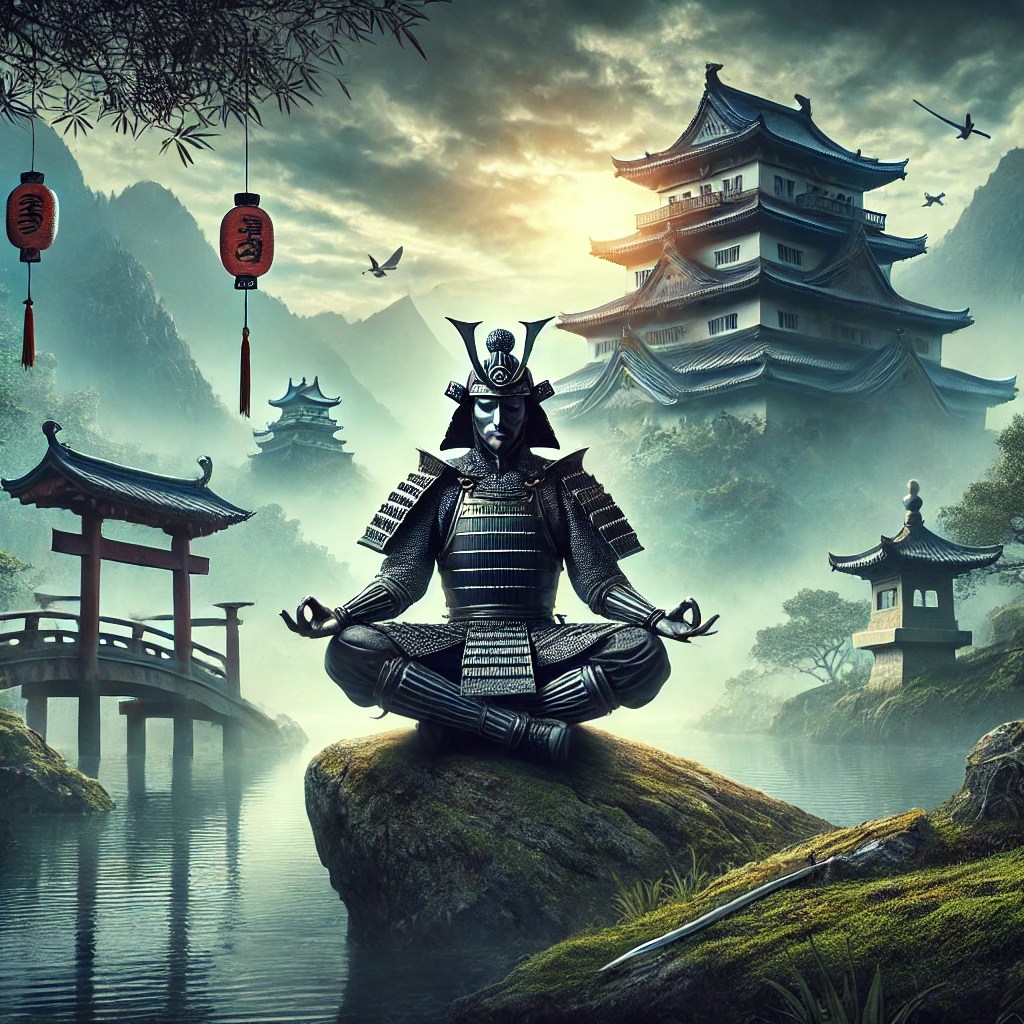
    The Samurai warriors practiced Zen to gain an edge in battle, and at the heart of Zen lies yoga.


    Yoga Asanas

    When most people think of yoga, images of contorted bodies twisted into pretzel-like poses often come to mind.

    While the physical asanas (postures) of yoga have gained tremendous popularity, especially in the West, they represent only one aspect of this ancient practice.

    What many overlook is the meditation and mental training that is deeply embedded within the roots of yoga, which not only offers spiritual enlightenment but also plays a pivotal role in the Art of War and the cultivation of true inner strength.

    The Deeper Roots of Yoga: Meditation Over Asanas

    Yoga has long been recognized as a path to spiritual awakening, but it’s crucial to understand that the physical postures are just the surface of a much deeper tradition.

    At its core, yoga is about stilling the mind—calming the endless chatter that often clouds our perception and hinders our ability to act decisively.

    This meditation aspect of yoga is far more powerful than just performing physical poses.

    It’s about transcending the ego and achieving a state of deep awareness, where one’s true self is realized and one can access a state of inner peace that is not shaken by external circumstances.

    In fact, this meditation aspect is so powerful that it became the foundation for other profound traditions, such as Chan Buddhism (which later evolved into Zen) in China.

    The story of Bodhidharma, the enlightened Indian guru who traveled to China, is a testament to how meditation in the form of yoga helped shape not only spirituality but warrior philosophies too.

    Bodhidharma (Dà Mó), the founder of Chan Buddhism and the key figure in elevating Shaolin Kung Fu.

    Bodhidharma’s journey from India to China is legendary.

    He arrived at the Shaolin Temple, where he established Chan Buddhism, a fusion of meditation and martial arts.

    This blend of mindfulness, discipline, chi (pranayama), and physical training would lay the foundation for what became the Shaolin monks’ renowned martial arts expertise, later influencing countless warriors around the world.

    This ancient tradition directly links yoga and meditation to the art of war, demonstrating that the true power of yoga lies not in the ability to perform physical poses but in the mental clarity, discipline, energization (chi), and fearlessness it fosters.

    The meditation-based aspects of yoga create a “no-mind” state—where actions flow effortlessly, free from hesitation, and without the clutter of doubt or distraction.

    This mental fortitude, honed through yoga and meditation, would become the edge in battle, just as it has in life.

    Lord Krishna instructing Arjuna

    The Bhagavad Gita: A Battle Between the Mind and the Self

    One of the most powerful texts that blends yoga, meditation, and warriorship is the Bhagavad Gita, the epic dialogue between Lord Krishna and the warrior prince Arjuna.

    The Gita isn’t just a spiritual treatise; it’s an internal battlefield where Arjuna struggles with his mind, emotions, and sense of duty.

    Through Krishna’s guidance, Arjuna learns to transcend his inner conflict and reach a state of clarity, allowing him to perform his duties without attachment or hesitation.

    This is the essence of the yoga of action—Karma Yoga—where the practitioner performs their duty without attachment to outcomes, free from the limitations of fear, desire, or ego.

    In this state, one is not swayed by external forces but remains anchored in the present moment, ready to take decisive action when necessary.

    This same mental discipline is key for warriors, athletes, and anyone who seeks to live with unwavering focus and clarity.

    The Warrior Caste and the Path of Zen

    Yoga’s connection to warrior philosophy is not just confined to the spiritual practices of ancient India.

    Buddha himself, who was born into the warrior caste, understood the discipline and mental training that warrior culture required.

    Though his journey took him away from the battlefield, the underlying principles of warrior ethos—such as fearlessness, discipline, and acting in the moment—remain closely tied to the teachings of Buddhism and the path of meditation.

    The Samurai of Japan, revered for their code of honor and exceptional skills, fully embraced Zen practice.

    Through Zen meditation, they cultivated a deep mental focus, allowing them to enter battle without fear or hesitation, fully present and aware of every movement.

    The Samurai’s Zen practice allowed them to move beyond themselves, acting as a vessel for the art of war.

    The ultimate goal was to reach a state of “no-self” or “no-mind”, where the mind does not interfere with action and one acts purely out of intuition and experience.

    No Mind, No Self: The Power of Yoga in Life and Battle

    The concept of “no-mind” (or “mushin”) is integral to both Zen and yoga, and it is perhaps one of the most powerful aspects of the practice.

    When we let go of the ego and the constant chatter of the mind, we open up to a state of pure presence, where our actions are aligned with the flow of life.

    This state of non-attachment is essential not only in meditation but also in battle, business, sports, and every area of life that demands focused action.

    In yoga, this concept is cultivated through deep meditation and mindful breathing, allowing the practitioner to reach a state where actions are effortless, clear, and precise.

    The “no-self” principle helps us overcome the limitations of the ego and the fear that often holds us back in life.

    Whether in war or in daily struggles, this mental discipline gives you the edge—the ability to act without hesitation, free from distractions, and aligned with your highest purpose.

    Yoga: More Than Just Feel-Good Poses

    So, the next time you think of yoga, remember: it’s not just about tying yourself in pretzel-like shapes or doing trendy stretches.

    At its core, yoga is about transcending the physical, finding inner peace, and cultivating the mental strength to face any challenge—be it on the battlefield or in the daily struggles of life.

    The meditation practices of yoga, developed over millennia, are the key to unlocking the true power within you.

    Just as the great warriors of history relied on the mental clarity and fearlessness gained through meditation and yoga, so too can we all benefit from its profound teachings.

    Yoga, when practiced in its fullest sense, is not just a physical exercise; it is a way to elevate your warriorship, to act with precision, and to live without fear or limitation.

    Final Thoughts

    Yoga is not just about the body.

    It is the way to train your mind, to enter a state of no-mind, and to cultivate the clarity and fearlessness necessary to face life’s battles—whether physical, mental, or spiritual.

    Just as the ancient warriors did, we too can embrace the meditation aspect of yoga and unlock the deeper power that lies within us all.

    Sri Paramahansa Yogananda

    BE CALMLY ACTIVE

    AND ACTIVELY CALM

    In short, don’t think all the time of just making money. Exercise, read, meditate, love God, and act peacefully, at all times. Learn to be calmly active and actively calm, carrying into your daily activities the calmness gained in the spiritual activity of meditation.

    In the Gita, Bhagwan Krishna teaches: “Remaining immersed in yoga, perform all actions, forsaking attachment (to their fruits). Remain indifferent to success and failure (while performing all actions). The mental evenness during all states of activities (resulting in success or failure) is termed yoga.

    – Sri Sri Paramahansa Yogananda

    MANS ETERNAL QUEST

    Chapter 47 page 402