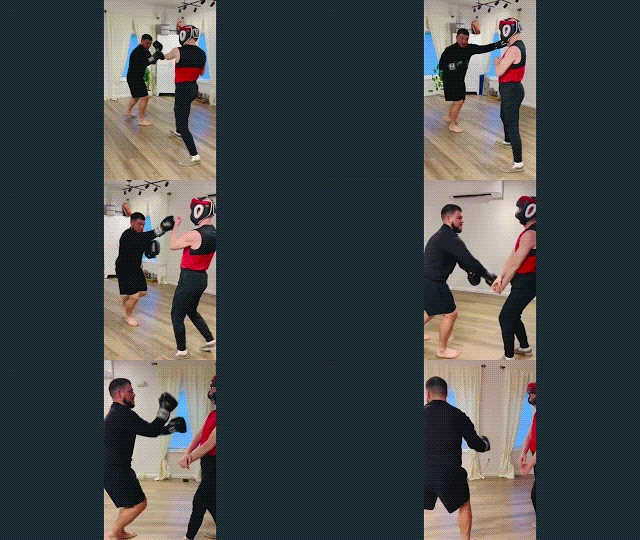
FOUR MONTH STUDENT DEMONSTRATION, NO PRIOR EXPERIENCE
OFFENSE IS DEFENSE
INITIAL MOVES
(2-, 3-, and 4-Move “Checkmates”)
ATTACK BY COMBINATION (ABC)
IMMOBILIZATION ATTACK (IA)
HOW TO NEUTRALIZE THE THREE TYPES OF FIGHTERS
SIX FOLLOW UP AND FINISHING MOVES
STREET BOXING AND COUNTER GRAPPLING
Stay on your feet in a street fight. Mounting someone traps you, depends on superior jiu-jitsu, and leaves you blind to danger. Their friends can surround you and kick your head in. Mobility is survival.
Weapons Training: Kubotan. Force multiplier, compact, and easy to carry. New Jersey law does not specifically prohibit kubotans, and they are commonly carried as self‑defense keychain tools.
SAFE BUT REAL: We wear eye goggles to protect the eyes and boxing gloves to allow light impact, ensuring that if the defender fails to block, they can safely learn from it—adding realism to our training.
On Guard!
PAIN PHASE:LOW SIDEKICK: use it Offensively to close the gap, or Defensively as an interception (proactive aggression as defense). Target the groin or lead leg.
PAIN PHASE: OFFENSE: An eye jab from Attack By Drawing (ABD) tactic. An eye jab can end a fight in seconds not rounds.
PAIN PHASE:DEFENSE: An elbow destruct can fracture their hand and end the fight in seconds not rounds(proactive aggression as defense). We do NOT attempt to out-box a superior boxer or a larger opponent. Instead, we focus on creating pain. Then we pressure, terminate, and if required, follow up, and finish.
PAIN PHASE:DEFENSE: A leopard fist destruct to the metacarpals could fracture their hand and end fights in seconds not rounds(proactive aggression as defense).Leopard is from Denis Decker’s Gung Fu.
PRESSURE PHASE: Straight Blast Training. In practical application, the punches would be directed to the chin or nose.
TERMINATION PHASE: Elbows.
TERMINATION PHASE: Headbutts.
WE ALSO HAVE THE FOLLOW UP AND FINISH PHASES – IF REQUIRED. SEE THE FINISIHING VIDEO ABOVE.
RAT SYNTHESIS COUNTER GROUND FIGHTING Finger Jab (snake) to trachea. We do NOT attempt to out-grapple a superior grappler or a larger opponent. Instead, we focus on creating pain and seizing opportunities to escape. Many of our stand-up techniques are just as effective on the ground. We prefer to be on our feet and mobile during a street fight, not on the ground where their buddies can stomp your head in.
SOME CONDITIONING METHODS.
RESISTANCE BAND TRAINING. Develop explosive movement and techniques.
FOCUS MITT TRAINING.
KICKING SHIELD TRAINING.
IRON HAND AND IRON BODY TRAINING. OPTIONAL. ADVANCED.
This is why you should consider Iron Hand training. Mike Tyson broke his hand in a street fight.
Also, I have been kicked hard in the hand during freestyle sparring and my hand was NOT broken.
The present moment is the nexus and the lever of reality, where thought, action, and universal flow converge. By mastering it, one gains the power to shape destiny effortlessly.
This is the Grandmaster’s Secret—life is not a struggle but a harmonious dance, where small, precise actions shift massive outcomes.
INTRODUCTION: THE GRANDMASTER’S SECRET.
What if you could shape reality with a single, effortless move—like a grandmaster executing the perfect strategy? What if life was not a struggle, but a dance, where you moved in harmony with existence, influencing outcomes with ease?
This is not fantasy. It is the art of mastering the moment.
Masters across disciplines—chess, martial arts, business, relationships, spirituality—all understand one thing: shape the now, and you shape everything.
From Yogananda’s mental broadcasting to Bruce Lee’s five ways of attack, from Zen’s effortless action (wu wei) to the principle of “four ounces moving a thousand pounds,” this revelation will transform the way you engage with life.
By the end of this journey, you will see that reality is not something to overpower—it is something to feel, steer, leverage, and flow with.
THE MOMENT: THE LEVER THAT MOVES REALITY
Every action, decision, and thought originates in the present. Mastering this fundamental truth gives you maximum influence over life.
“The moment is the steering wheel of reality.” → Awareness and action in the now shape your destiny.
“The moment is the lever.” → Small, precise actions shift massive outcomes.
“Dissolve into the eternal Now. (Mushin)” → Presence frees you from ego, fear, hesitation, and other limited programming, allowing perfect action.
Tai Chi Saying: “Four ounces can move a thousand pounds” (四两拨千斤). → Power lies in effortless, surgical precision—not brute force.
“The supreme art of war is to subdue the enemy without fighting.”
— Sun Tzu
Four Ounces can move one thousand pounds
ULTIMATE FLOW: HOW TO MASTER THE NOW.
Strategic Leverage → A well-timed move disrupts the game with minimal effort.
Mushin (No-Mind) → You act without hesitation, adapting instantly.
Master the Moment, Master Everything → Life is not a battle to be fought—it is a current to be steered.
DISSOLVE INTO THE NOW: THE ART OF LETTING GO
To truly master the moment, you must dissolve the self—your programmed limitations, fears, and resistance. True mastery is about moving beyond thought and merging with pure action.
The secret? Precision over force. Presence over struggle. Intuition over calculation.
REAL-WORLD APPLICATIONS: HOW MASTERS MOVE
Health & Vitality → A true master listens to the body and their intuition, making small yet precise adjustments in diet, breath, and movement to sustain lifelong energy.
Relationships → Mastering the moment means knowing when to speak, when to listen, and when to simply be.
Wealth & Business → The wisest leaders influence entire industries with a single, well-placed decision.
Success & Strategy (Chess) → The grandmaster waits for the perfect moment—one move that shifts the entire game.
Samurai → The master swordsman wins with a single, decisive strike—effortless, precise, and unstoppable.
Combat Sports → A champion conserves energy, striking with precision and timing to maximize impact while minimizing effort.
Martial Arts (Tai Chi & Kung Fu)→ A master redirects force with minimal effort, turning an opponent’s power against them.
Zen Archery → The master does not force the shot; he releases at the exact right moment, letting the arrow find its path.
THE MOMENT AS THE NEXUS: BRUCE LEE’S FIVE WAYS OF ATTACK
Bruce Lee’s strategic combat philosophy provides a perfect framework for leveraging the moment:
Single Direct Attack (SDA) → A precise, decisive action taken at the perfect moment.
Attack by Combination (ABC) → Fluid movements that break through resistance.
Attack by Drawing → A feint or redirection that sets up the true attack.
Immobilization Attack (IA) → Controlling an opponent’s response before striking.
Broken Rhythm → Disrupting patterns to create an opening.
These principles extend beyond combat:
In negotiations → A well-timed, confident pitch secures a deal (Single Direct Attack).
In personal transformation → A sequence of small, calculated changes leads to a major breakthrough (Attack by Combination).
In manifestation → Acting as if you’ve already achieved a goal, which influences your subconscious and external circumstances to align with it. (Attack by Drawing)
In leadership → Setting firm expectations and boundaries before addressing team issues ensures control of the dynamic (Immobilization Attack).
In creativity and innovation → Breaking habitual thought patterns sparks fresh ideas and unexpected solutions (Broken Rhythm).
THE ULTIMATE EDGE: MASTERING CONSCIOUSNESS ITSELF
“Jeet Kune Do is the art of fighting without fighting” – Bruce Lee
True mastery lies in conscious control of reality. The greatest teachers across time reveal the same truth:
Yogananda’s Third Eye Focus → Focus at the point between the eyebrows (spiritual eye), will calmly, and reality bends to your will.
Christ’s Teaching of Faith → Believe, and it shall be so.
Jesus taught third eye focus also: The light of the body is the eye: if therefore thine eye be single, thy whole body shall be full of light. Matthew 6:22
“Mind is the creator of everything. You should therefore guide it to create only good. If you cling to a certain thought with dynamic will power, it finally assumes a tangible out ward form. When you are able to employ your will always for constructive purposes, you become the controller of your destiny.”
– Sri Sri Paramahansa Yogananda, “The Law of Success”
Further, when you dissolve yourself into the eternal Now and tune into Divine Will through intuition, your will merges with the universal will. You don’t force reality—you steer it, effortlessly.
Consciousness contains a matrix and the universe is an infinite multiverse of possibilities—by consciously directing your reality, you shift to the timeline of your desired outcome.
💡The moment is the steering wheel. The mind is the driver. Faith is the fuel.The Now is the portal to Consciousness.
CONCLUSION: THE KEY TO UNLIMITED POWER
“Don’t think, feel. It’s like a finger pointing at the moon. Don’t concentrate on the finger, or you will miss all of the heavenly glory.” – Bruce Lee
Mastering the moment is the key to ultimate power. Whether through Yogananda’s mental broadcasting, Bruce Lee’s combat strategy, or the Zen principle of wu wei, the truth remains: shape the now, and you shape everything.
But this is not about overthinking. It is not about calculating every possibility. That’s too big and leads to paralysis. Instead, it is about dissolving the ego, feeling the flow, and moving with it effortlessly.
The grandmaster does not calculate—he senses the board and moves with precision.
The fighter does not count beats—he disrupts rhythm instinctively.
The visionary does not force change—he aligns with its unfolding.
And the moment is small. It’s right here. It’s right now. It’s manageable.
When you dissolve hesitation and merge thought, action, and reality into one seamless flow, you become unstoppable. Like the master making a single, decisive move, the fighter disrupting rhythm with perfect timing, or the leader shifting an entire market with one strategic decision—you do not struggle. You steer. You influence. You create.
The moment is the nexus of all possibility.
Master it, and the universe moves with you.
BECOME ONE WITH THE MOMENT. LEVERAGE THE ENTIRE UNIVERSE. BECOME THE GRANDMASTER OF YOUR DESTINY.
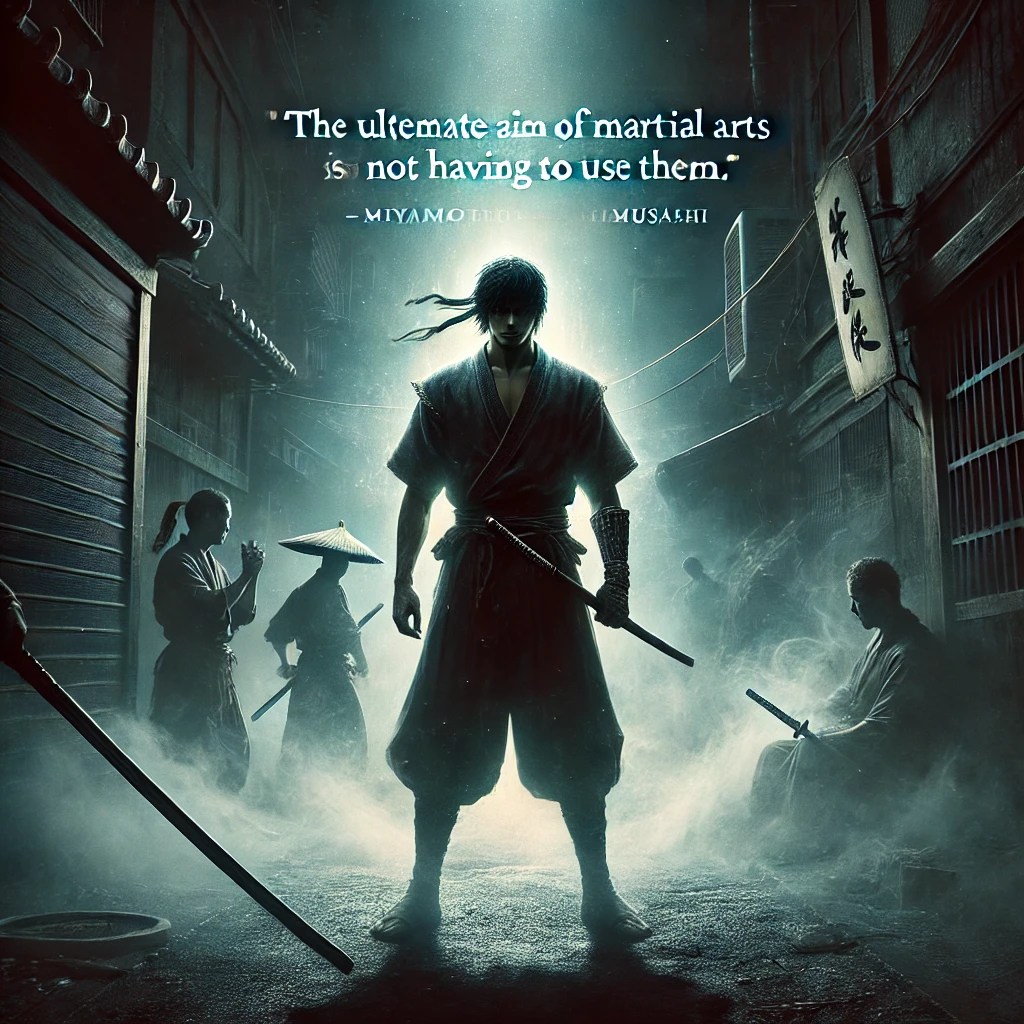
Miyamoto Musashi, the legendary samurai and undefeated duelist, once said, “The ultimate aim of martial arts is not having to use them.” These words come from a man who fought and won over 60 life and death duels in an era when Japan was filled with warriors roaming the land, eager to test their skill and prove their worth. Musashi was no pushover—he was a master of combat, yet he understood that true mastery lies in transcending the need for battle.
At first glance, this may seem paradoxical—why train for years in combat only to avoid it? Yet, this statement holds a deep truth: the warrior who has mastered themselves rarely needs to fight. Their presence (chi) alone commands respect, dissuading threats before they manifest.
The Warrior’s Aura: Why Muggers Don’t Pick the Strong
Violence is rarely random. Predators—whether in the animal kingdom or the streets of a city—seek easy prey. They don’t attack the strong; they target the distracted, the timid, and the unaware. A trained warrior, one who has internalized the principles of martial arts and strategy, exudes an unmistakable energy—a silent but powerful message:
🚫 “Not this one.”
Compare two individuals walking down the street:
The Unaware Civilian – Eyes locked on their phone, shoulders slumped, mind elsewhere. Their body language screams distraction, vulnerability, and a lack of control over their environment. They might be daydreaming, lost in worries, or simply untrained in reading energy. To a predator, they look like an easy mark.
The Trained Warrior – Walking with calm confidence, head up, peripheral vision scanning naturally, breathing deep and steady. There’s no tension—only readiness. They are not fearful but also not looking for a fight. They simply exist in a state of total awareness, in tune with the flow of the moment.
The difference is not just physical but metaphysical. It’s an emanation of mindset which emanates chi (qi), prana, bioelectric energy—the subtle yet powerful force that martial artists cultivate through breath, meditation, and training. This energy extends beyond mere body language; it is a field that others unconsciously register.
This is why seasoned warriors rarely get into fights. Not because they run, but because the fight never comes to them.
In a true confrontation, the trained warrior does not react from fear or ego. Instead, they enter mushin (無心)—the state of “no mind.” “They” are not there to be frightened, they are egoless (no-self). This is not apathy or passivity but a heightened state of intuition and presence. The mind is empty of thoughts, yet fully aware. It does not dwell on past or future, on fear or hesitation. It simply acts.
The untrained person, when faced with a threat, either: ❌ Panics, letting fear take over, leading to poor decisions and freezing up. ❌ Overreacts, engaging in unnecessary conflict due to a fragile ego.
But the warrior trained in mushin sees the reality of the situation with clarity. They know if the threat is real or just an illusion. They sense whether to engage or simply walk away. There is no hyperbole in this—it is the direct result of deep training in martial arts, meditation, and strategic thinking.
Intuition: Knowing When to Strike and When to Walk Away
A well-trained martial artist does not act out of impulse, anger, or insecurity. They act from pure awareness.
👉 If a situation does not warrant combat, the warrior sees it immediately and moves on, avoiding unnecessary conflict.
👉 If a situation requires action, there is no hesitation, no wasted movement—just pure execution, whether that means striking, deflecting, or using words to de-escalate.
This level of mastery means that the ego is not in control—the higher self is. The need to “prove something” disappears. There is no need to dominate or posture. Instead, the warrior moves through life with grace, like a river flowing around obstacles rather than smashing through them.
The Metaphysics of Combat and Non-Combat
Everything in existence vibrates at a certain frequency. Fear, insecurity, and distraction vibrate at a low frequency, attracting chaos. Confidence, centeredness, and training vibrate at a high frequency, repelling conflict before it manifests.
A skilled warrior aligns themselves with the Tao, the flow of life, where battle is neither sought nor feared. In this way, they embody the deepest truth of martial arts:
✅ Train for war, but live in peace. ✅ Be capable of destruction, but embody restraint. ✅ Be so strong that you never need to fight.
True Strength is Invisible
In the end, Musashi’s words reflect a universal truth:those who seek violence are weak, and those who master violence become peaceful. The ultimate goal is not to win fights—it’s to transcend them entirely. To move through life untouchable—not because you fight, but because you don’t have to.
In the RAT Synthesis™ fighting method, we integrate Mike Tyson–inspired kickboxing into our offensive, follow-up, and finishing phases. Rather than bobbing and weaving, we emphasize interception, destruction, and simultaneous block-striking. Iron Mike–style Street Kickboxing makes up 20% of the RAT Synthesis™ system.
This video is a Masterclass in Mike Tyson’s boxing style:
Peek-a-boo guardwith head movement to slip punches and close distance
Jab
Jab-Jab
Blinding Jab-overhand
Hooks – Body and Head
Lead hook head, rear uppercut chin
Hook to the Body, then Uppercut (same hand) (open guard, lift chin)
Uppercut to the Chin in Close Range (capitalize on tight space)
Left Hook (signature weapon, powerful finisher)
“Punches in bunches”
“Throw punches with bad intentions“
Breaking Down Mike Tyson’s Signature Uppercut | His Most Dangerous Punch 🥊
Mike Tyson’s Deadliest Combos (Breakdown)
Animals Wide 23 📅 January 27 at 4:10 PM
Kevin Rooney was asked when Mike Tyson was at his absolute prime. His answer? 😳
“When he beat Michael Spinks… He knocked out Michael Spinks in 90 seconds. It wasn’t a joke. I mean, he knocked him out. So l think that fighter, in my opinion, could have and should have probably beaten anybody that was in his path. Anybody including Rocky Marciano and Muhammad Ali. Well, I’ll give Muhammad Ali and Rocky, well it could have been different, I mean, Rocky punched like hell. Muhammad punched like hell. Rocky had beat everyone. Muhammad had heart and was hard to hit. The fights would have been interesting. But I believe that Mike would have come out the better. Because he punched very hard. I believe that Mike is one of the hardest punchers in history. He punches harder than Rocky. Punches harder than Joe Louis. Punches harder than George Foreman.”
Core Combat Principles:
Indomitable Warrior Spirit
Psychological Warfare
Discipline and Simplicity
Adaptability and Resilience
Peek-a-Boo Style
Power Punching
Aggressive Counterpunching
Body Attacks and Combinations
Angles and Footwork
Mike Tyson is a lifelong student, deeply dedicated to learning. He meticulously studied the techniques of the old-time great fighters and drew inspiration from legendary warriors throughout history. His success wasn’t merely the result of raw power and physical prowess; it was built on a foundation of profound knowledge, strategy, and insight. Beyond the ring, Tyson is a highly intelligent individual and a reflective philosopher. Despite facing his share of flaws and challenges, he has grown and matured significantly over the years, embodying resilience and transformation.
This blend of intelligence, strategy, and resilience has made Tyson a living legend in the world of boxing. His ability to master both the mental and physical aspects of his craft serves as a powerful example of achieving greatness. Let’s break down the key components of Tyson’s mindset and strategic principles that propelled him to the top and explore how these principles can be applied to success in any endeavor.
The Mindset: A Foundation of Strength and Resilience
Mike Tyson’s mindset was shaped by his difficult upbringing and the guidance of his trainer, Cus D’Amato. Below are the essential elements that define Tyson’s powerful mental game:
1. Unwavering Confidence
Tyson’s belief in himself was a cornerstone of his mindset. From the very beginning, he was taught by D’Amato to visualize success and maintain a positive self-image. Tyson was certain of his greatness and knew that without this unshakeable confidence, he would lose before the fight even began. His confidence allowed him to take on any opponent, no matter the odds.
2. Mind Over Matter
Tyson understood that controlling his mind was just as important as controlling his body. He learned to channel fear into aggression, using mental conditioning to push through pain and doubt. By visualizing his opponents folding before him, Tyson was able to dominate the psychological aspect of his fights, gaining a mental edge over his adversaries.
Tyson’s ability to visualize his opponents folding aligns with the Law of Attraction, which emphasizes the power of focused thought and belief in manifesting outcomes. By visualizing victory and mentally dominating his opponents, Tyson tapped into the energy of his intentions, attracting success and psychological dominance in the ring.
3. Discipline and Relentless Work Ethic
Despite his chaotic public persona, Tyson was known for his intense work ethic. Under D’Amato’s mentorship, he developed a disciplined approach to training that included mastering the fundamentals, conditioning, and mental preparation. Tyson’s mindset was one of constant improvement—never satisfied with “good enough,” he was always striving for excellence.
“If someone is doing more than me, I’ll do more. If he gets up at 5 to go running, I get up at 4. If he gets up at 4, I get up at 3. If he gets up at 3, I won’t sleep.” — Mike Tyson
4. Focus on the Present Moment
Tyson emphasized the importance of focusing entirely on the present moment, particularly in the ring. He left behind distractions like fame or external pressures and concentrated solely on the task at hand. This intense focus allowed him to stay in the zone, operating with precision and clarity during his fights.
Tyson’s intense focus on the present moment mirrors the essence of Zen and yoga, where mindfulness and presence are key to mastering both the mind and body. Just as Tyson shut out distractions to perform with precision, Zen and yoga teach us to center our attention, shedding external pressures and embracing the flow of the present to achieve clarity and inner power.
5. Embracing Fear
Rather than being paralyzed by fear, Tyson learned to harness it. Fear, to him, was a natural emotion that could be transformed into energy. By embracing fear and using it as fuel, Tyson became more intense and aggressive, turning an obstacle into a powerful motivator.
Tyson’s ability to transmute fear into powerful motivation mirrors the yogic practice of transmutation, where negative emotions are transformed into positive energy. Just as yogis convert inner turmoil into strength, Tyson harnessed fear, turning it from a hindrance into a driving force that propelled him to greater intensity and focus.
6. Anger as Motivation
Tyson often channeled his anger into his fights. His personal struggles, from his troubled upbringing to his turbulent emotions, gave him the fire to fight harder. Anger became a source of energy that propelled him to perform with even more intensity in the ring.
In RAT Synthesis, anger is not something to channel or use as fuel. A yogi doesn’t engage with anger but either cuts it off or simply observes it as a passing phenomenon, detached from the self. Tyson’s approach of using anger as motivation contrasts with this teaching, where emotional mastery and detachment are key to maintaining clarity and inner peace.
7. Mental Toughness and Resilience
Tyson’s life was filled with obstacles, from growing up in poverty to facing legal issues. Yet, he always believed he could rise above these challenges. This mental toughness and resilience made him a formidable force, allowing him to handle pressure and adversity like few others.
8. The Will to Win
Tyson’s mindset wasn’t just about physical preparation—it was about an unrelenting psychological drive to win. His desire to dominate in the ring was so intense that he couldn’t imagine losing. This drive, combined with his skill and mental focus, made him an overwhelming opponent.
9. The Influence of Cus D’Amato
Cus D’Amato played a pivotal role in shaping Tyson’s mindset. Beyond teaching Tyson boxing techniques, D’Amato instilled in him the belief in his own invincibility. D’Amato’s coaching taught Tyson the importance of mental strength and the development of a champion’s mindset, which became one of Tyson’s most valuable tools.
Yoga teaches the invincibility of the soul, a concept embodied by Arjuna in the Bhagavad Gita, who realizes that his true self is beyond the limitations of the body and mind.
10. Humility and Self-Awareness
In his later years, Tyson reflected on the destructive power of unchecked pride and ego. He recognized the importance of humility and balance, seeking peace within himself. This self-awareness became a key aspect of his mindset as he continued to grow, learn, and evolve.
Masters embrace egolessness because it allows them to remain open to learning and growth. By letting go of unchecked pride and ego, they cultivate humility and inner peace, which creates the space for true wisdom and adaptability. This self-awareness, as Tyson discovered later in life, becomes a powerful advantage, enabling one to transcend limitations and evolve both personally and professionally.
The Strategy: Aggression, Adaptability, and Psychological Mastery
Tyson’s strategic approach in the ring was built on a blend of intense preparation, psychological warfare, and sheer aggression. Here are the key elements of his strategy:
1. Intense Preparation
Preparation was the foundation of Tyson’s success. He trained rigorously, mastering both his physical and mental skills. This included perfecting his fundamentals, conditioning, and mental resilience. Tyson believed that preparation wasn’t just about the body—it was about ensuring that the mind was equally prepared to face the challenge ahead.
Sun Tzu, like Tyson, emphasized the importance of preparation as the key to success. In The Art of War, he stresses that victory is won long before the battle begins, through careful planning, strategy, and mental readiness. Sun Tzu believed that thorough preparation of both the body and mind is essential to achieving victory, a principle that Tyson applied both in and out of the ring.
2. Fearlessness and Aggression
“A good offense is the best defense”
Tyson’s approach to fighting was rooted in fearlessness and aggression. He was known for overwhelming his opponents right from the start, using his speed and power to take control of the fight. Tyson believed that the key to success was to never back down and to be the aggressor in every fight.
The Samurai Warriors, particularly under figures like Miyamoto Musashi, were trained in the art of swift, aggressive action. Musashi’s philosophy emphasized striking first, using speed and precision to overwhelm the opponent.
Similarly, Bruce Lee’s martial arts philosophy was about dominating with precision and fluidity. Lee believed in creating the action rather than waiting for the opponent, staying one step ahead at all times.
3. Adaptability and Flexibility
While Tyson was known for his aggressive style, he also understood the importance of adaptability. He didn’t rely on a single strategy but adjusted his approach based on the strengths and weaknesses of his opponent. This flexibility allowed him to stay unpredictable and maintain control over the flow of the fight.
Similarly, Joe Lewis, the karate champion, used Bruce Lee’s five ways of attack to defeat different fighter archetypes. By blending speed, timing, and the right choice of attack, Lewis was able to adapt his strategy to overwhelm counterfighters, defensive fighters, and aggressive fighters, much like Tyson, remaining unpredictable and in control of the fight’s flow.
4. Intimidation and Psychological Warfare
Tyson was a master of psychological warfare. He used his intense presence and reputation to break down his opponents mentally before the fight even began. Whether through staring them down, trash-talking, or simply projecting dominance, Tyson’s ability to plant seeds of doubt in his opponent’s mind was a key component of his strategy.
Like Tyson, MuhammadAli used psychological tactics such as trash talk and mind games to break his opponents before the fight. His ability to dominate mentally as well as physically was a key part of his strategy, famously using his trash talk to get into the heads of fighters like Sonny Liston and George Foreman.
Bruce Lee used psychological warfare by projecting confidence and unpredictability to unsettle his opponents. His intense presence, quick movements, and direct eye contact often created a mental edge, destabilizing adversaries before the fight even began. Lee’s adaptability and calm focus also kept opponents guessing, giving him control both mentally and physically.
5. Simplicity and Directness
Tyson’s in-ring strategy was simple yet effective. His coach, Cus D’Amato, taught him the “peek-a-boo” style, focusing on quick movements, head fakes, and powerful combinations. Tyson’s strategy was to keep things direct and to the point, minimizing the risk of mistakes while maximizing his offensive power.
Similarly, Bruce Lee embraced simplicity and directness in his approach, favoring efficiency over complexity. Lee’s philosophy of “absorb what is useful” was about using the most effective techniques with minimal movement, eliminating unnecessary actions to create maximum impact. Both Tyson and Lee understood the power of clarity and focus in achieving success.
6. The Power of the First Punch
Tyson believed that the first punch could change the trajectory of the fight. His strategy often centered on delivering a powerful, decisive blow early on to set the tone and gain the psychological advantage. This first punch often left his opponents reeling, both physically and mentally.
Under leaders like Miyamoto Musashi, samurai often struck first to gain the initiative. Musashi’s philosophy of “sword drawing first” emphasized the importance of taking control from the start to dominate the opponent both physically and mentally.
Bruce Lee’s approach in martial arts also revolved around striking first, using speed and fluidity to surprise opponents. His emphasis on controlling the fight from the start aligned with Tyson’s principle of taking the initiative early.
7. Control and Domination
Ultimately, Tyson’s strategy was about controlling the pace and rhythm of the fight. He aimed to dominate every aspect—physically, mentally, and emotionally—by staying aggressive and keeping his opponent on the defensive.
Conclusion: The Tyson Mindset and Strategy for Success
Mike Tyson’s mindset and strategic approach were essential to his rise as one of the greatest boxers in history. His blend of confidence, fearlessness, mental toughness, and adaptability helped him dominate in the ring. Tyson’s strategy, which combined psychological mastery with aggressive offense, became a blueprint for success.
The lessons from Tyson’s mindset and strategy aren’t confined to boxing. They can be applied to any area of life—whether it’s business, personal growth, or overcoming challenges. By developing an unshakable belief in yourself, embracing fear, staying disciplined, and adapting to changing circumstances, you can unleash your own power and achieve success, just like Tyson did.
SIFU RUSSO’S BOXING AND KICKBOXING EXPERIENCE
Guro Martin Gross Extensive training in Jeet Kune Do, Kali/Eskrima, and Kickboxing under the mentorship of Guro Martin Gross, a student of Dan Inosanto at the Inosanto Academy of Martial Arts in the 1970s.
Tony Bersani Studied some western boxing under the tutelage of Tony Bersani, Fitness Works Boxing Center, Philadelphia, PA.
Multiple sparring sessions with other practitioners, including a Golden Gloves-level amateur boxer.
Twelve Rounds with Mike Tyson
Sifu Russo completed 12 Rounds with Tyson, a transformative program designed by Mike Tyson to help individuals develop a champion’s mindset for success.
The Fundamentals of the Peekaboo & Power Punching by Mike Tyson
Sifu Russo completed The Fundamentals of the Peekaboo & Power Punching by Mike Tyson, an online course from Dynamic Striking where the legendary boxer shared his iconic Peekaboo style and the secrets behind his unparalleled power and speed.
Generally speaking, the Way of the warrior is resolute acceptance of death – Miyamoto Musashi
Face insurmountable odds with unwavering purpose—like a samurai throwing away their scabbard.
Act with force, focus, and absolute confidence in the outcome, harnessing the Law of Attraction.
Set your intent, draw in the energy, step aside, and let God provide the tools.
Your task? Accept and act.
Rose Cross, symbol of the enlightenmentAligning with the structure of Yin/Yang/Tao brings harmony with reality and avoids partial outcomes.The Way Of The Samurai-Yogi: RAT Synthesis Transformational Leadership Coaching
You are not confined by the perceptions of others. As a child of the Infinite, you possess latent powers waiting to be awakened—your abilities are limitless, and your potential knows no bounds.
There are always voices in the crowd that will try to bring you down. They’ll tell you to stop dreaming big, to lower your expectations, to accept mediocrity. You’ll hear them say things like, “Who do you think you are, working so hard? You’ll never be as great as the legends. They were born with special talents, but you’re just average. Accept it.”
But here’s the truth: the masters of every craft—whether in art, sport, business, or life—didn’t come to inspire us by setting a limit on what we can achieve. They came to show us what’s possible and to push us to strive for greatness. They didn’t set the bar to create a glass ceiling. Instead, they broke through it and showed us that greatness is attainable for anyone willing to put in the effort.
Arnold Schwarzenegger, a man who has achieved greatness in multiple fields, whether you love him or hate him, famously said, “Don’t listen to the naysayers.” This wisdom is invaluable, especially in today’s world, where negativity and doubt can seem overwhelming. Schwarzenegger doesn’t just ignore the critics—he doesn’t even let them into his head. He’s shared that he avoids reading negative comments or listening to social media naysayers, and he focuses solely on his goals.
And he’s right—the biggest naysayer often comes from within. The self-doubt, the inner critic that tries to convince you that you’re not capable, not worthy, or that you’ll never be as great as those who came before you. This internal voice is the real enemy. But if you ignore it and push forward, you’ll find that you have limitless potential.
So, what are the true limits of your potential? Are there truly boundaries on what you can achieve, or is it just that we haven’t yet reached the peak? I say let’s give it our all and find out. Let’s aim to become the greatest versions of ourselves during this lifetime. The masters who came before us are here to inspire us, not to keep us in a box. They broke through the barriers so we could keep breaking them down.
Consider this: what if one of Yip Man’s senior disciples told a young Bruce Lee, “Who the heck do you think you are?” From what I understand his senior classmates probably did say something like that to him. If Bruce had listened to these kind of discouraging remarks, we wouldn’t have his legendary movies, his revolutionary philosophy, or his creation of Jeet Kune Do. We wouldn’t have witnessed the birth of a martial arts legend who inspired millions worldwide. Bruce Lee’s greatness was not defined by the limitations others tried to impose on him, but by his refusal to accept them.
And the same can be said for anyone pursuing greatness. Every trailblazer faced naysayers—whether it was a family member, a friend, a colleague, or even a stranger. But the ones who achieve greatness are those who push forward regardless of the noise. They trust in their potential and keep working relentlessly toward their goals.
Even the greatest of all, Jesus Christ, inspired his followers with the reminder that “Ye are gods.” These words tell us that we are capable of more than we often believe. If we embrace our divinity, our potential, and the greatness within us, we can achieve things that go beyond what anyone has ever imagined.
The world is full of naysayers, but the world is also full of greatness waiting to be unlocked. Don’t let the negative voices define your path. Ignore them. Step into your power. Embrace your potential. Dream big. And most importantly, take action toward your dreams.
You are capable of achieving greatness. Don’t let anyone tell you otherwise.
Then Levi held a great banquet for Jesus at his house, and a large crowd of tax collectors and others were eating with them. But the Pharisees and the teachers of the law who belonged to their sect complained to his disciples, “Why do you eat and drink with tax collectors and sinners?”
Jesus answered them, “It is not the healthy who need a doctor, but the sick. I have not come to call the righteous, but sinners to repentance.”
BOOM! Jesus wasn’t here just for the egotists who thought they had it all together; He came for the sinners, the broken, and the lost, offering them the chance for repentance and transformation, while still extending grace to all.
Anyone who tells you that you’re not worthy is mistaken. Jesus teaches that beneath the layers of illusion, God resides within every person. When you begin to identify with that Divine Consciousness, immense power awakens within you. So, ignore the naysayers and embrace your true nature.
Be victorious. Be unstoppable. Embrace your full potential, and show the world what you’re made of.
“Fall seven times, stand up eight.” – Japanese proverb
What does it mean to be truly unstoppable? To forge a path in life that no obstacle, no hardship, and no failure can hinder? The answer lies in cultivating an indomitable spirit—a force within that thrives on relentless action, fearless resolve, and unwavering focus. This timeless mindset is reflected in the teachings of great masters like Miyamoto Musashi, Sun Tzu, and even Calvin Coolidge, who have gifted humanity with insights to conquer life’s challenges.
The Warrior’s Way: Accepting Death to Embrace Life
Miyamoto Musashi, the legendary Japanese swordsman, summed up the core of the warrior ethos with his profound words:
“Generally speaking, the way of the warrior is the resolute acceptance of death.”
At first glance, this might seem grim, but it is a call to freedom. By embracing the inevitability of death, we liberate ourselves from fear. Hesitation vanishes, and the warrior acts with unshakable resolve. When you believe you have nothing to lose, you realize you have everything to gain.
Life is fleeting, but your mission can transcend time. Musashi’s philosophy isn’t just about physical combat; it’s a metaphor for any battle in life. The resolute acceptance of risk allows you to take bold steps toward your goals, unshackled by fear of failure.
The Strategy of Invincibility
Sun Tzu, the ancient Chinese strategist and author of The Art of War, offers another layer of wisdom:
“The good fighters of old first put themselves beyond the possibility of defeat, and then waited for an opportunity of defeating the enemy.”
This is the ultimate preparation mindset. To be undefeatable is to build your foundation so solidly that no external force can topple you. Develop your skills, hone your mind, and fortify your spirit. When challenges arise, you will be prepared not only to endure but to thrive.
Here’s the kicker: even in failure, there is no true defeat. Life is cyclical. Many traditions believe in reincarnation, where the soul returns for another chance to fulfill its mission. Whether you embrace this view literally or metaphorically, it offers a powerful reminder: as long as you persist, your mission is never over.
The Attitude of Inevitable Success
The bridge between ancient warrior wisdom and modern-day success lies in your attitude. With the right mindset, success becomes inevitable.
Growth Mindset: View challenges as opportunities for growth, not as setbacks. Every failure is a lesson, every obstacle a chance to grow stronger.
Relentless Action: Take bold and consistent steps toward your goals. It’s not about avoiding failure but about persisting until you succeed.
Inner Resolve: Block out the noise of external opinions. It’s not about what others say, think, or do—it’s about what you say, think, and do.
Calvin Coolidge, the 30th President of the United States, famously said:
“Nothing in this world can take the place of persistence. Talent will not; nothing is more common than unsuccessful men with talent. Genius will not; unrewarded genius is almost a proverb. Education will not; the world is full of educated derelicts. Persistence and determination alone are omnipotent.”
Persistence is the cornerstone of the indomitable spirit. Talent, intelligence, or luck can only take you so far. It is relentless effort—day in and day out—that guarantees your success.
How to Cultivate an Indomitable Spirit
Adopt a Warrior’s Mindset: Begin each day by accepting life’s impermanence. This isn’t about pessimism but about clarity. With nothing to lose, every action becomes purposeful.
Build an Unshakable Foundation: Develop your skills, strengthen your body, and sharpen your mind. Prepare yourself so thoroughly that defeat becomes an impossibility.
Take Persistent Action: Define your mission clearly and take consistent, bold steps toward it. Progress, no matter how small, is still progress.
Stay Grounded in Your Vision: Block out distractions and naysayers. Keep your eyes fixed on your goal, and remember that success is not about if—it’s about when.
Transform Setbacks into Opportunities: When challenges arise, lean into them. View failures as lessons and use them as stepping stones to greater achievements.
Becoming Unstoppable
The indomitable spirit is not a gift bestowed upon a lucky few—it is a quality anyone can cultivate. It’s the fire that burns within when all seems lost, the voice that says, “Get up,” when you’re knocked down, and the unyielding drive to keep moving forward no matter what.
Musashi embraced death to live fully. Sun Tzu prepared to be invincible before striking. Coolidge championed persistence above all else. Their collective wisdom reminds us that success is not a matter of chance or fate—it is a matter of will.
So, rise each day with the heart of a warrior, the strategy of a master, and the persistence of a champion. Success is inevitable when you embody the indomitable spirit.
Now, what is your mission? And what are you waiting for? Take the first step—your victory awaits.