Victory comes not from thinking of yourself, but from dissolving the self, entering the moment, and letting flow guide your body and mind.
In the quiet moments before a chess grandmaster makes his move, in the split second before a martial artist throws a decisive strike, or even in the silent calm before a wrestler executes a perfect takedown, there exists a hidden force that separates the ordinary from the extraordinary. It is not brute strength. It is not preparation, not raw talent, not even strategy alone. It is the absence of self.
When we focus on ourselves—our fears, our desires, our insecurities—the ego takes the wheel. The “I” becomes the center of the universe. Neuroscience shows us exactly what happens: the prefrontal cortex, the region of the brain responsible for self-reflection, over-activates. Cortisol, the stress hormone, spikes. Our muscles tighten, our reflexes slow, our decision-making becomes clouded. In other words, thinking about yourself is biologically self-sabotaging. You are literally wiring yourself for failure.
Chess offers a subtle but profound illustration. When a player obsesses over winning, over what others think, over the potential shame of losing, hesitation creeps in. The mind calculates but cannot see. Patterns blur, combinations slip past, and mistakes multiply. Contrast this with the player who is “in the moment,” fully immersed in the board yet detached from ego. Moves flow effortlessly. Threats are anticipated not as personal attacks but as objective patterns. The brain releases dopamine and norepinephrine, enhancing attention and pattern recognition. The body and mind are aligned. This is flow. This is mushin—the “no-mind, no-self” of Zen warriors and samurai.
Martial arts amplifies this principle dramatically. In sparring, if the fighter worries about his record, about looking skilled, about impressing his opponent, the body stiffens. Reflexes slow. Hesitation creeps in. A punch that could have been a decisive strike glances off, a block is late, a takedown fails. Cortisol surges, anxiety spikes, and the fight becomes a battle against oneself rather than the opponent.
But the practitioner who has cultivated mushin—the mind of no-mind—experiences something extraordinary. Awareness is heightened, yet the ego has dissolved. The self disappears; only movement exists. Every strike, block, and feint becomes natural, uncontrived. Heart rate stabilizes, alpha brain waves rise, and the body releases endorphins and dopamine in a balanced cascade. This is the predator flow state: focused, fearless, fluid, and almost preternaturally intuitive. The fighter moves not as an “I” but as the moment itself, and in this way, the odds of success dramatically increase.
This is not mysticism alone. Science confirms it. Studies of elite athletes, musicians, and meditators show that the “selfless” state—often called flow—reduces cortisol, enhances motor coordination, improves reaction time, and sharpens perception. Neural networks synchronize; the conscious mind steps aside, and the brain enters a pattern-recognition superstate. You are no longer “thinking”—you are responding, adapting, thriving.
Consider the duality: ego-driven striving versus selfless presence. Ego says: I must win. I must not fail. I must be the best. The body tenses; the brain is hyper-aware of its own actions; performance suffers. Selfless presence says: The moment is what it is. My role is to act appropriately, fully, without attachment. The body relaxes, the mind expands, and the outcome—whether in chess, combat, or life itself—is far more likely to be victorious.
Martial artists know this intuitively. Samurai trained for years not just in strikes and counters, but in zen meditation and discipline to dissolve the self. Chess masters study openings and endgames not to boast, but to internalize them, letting intuition guide the next move without ego interference. Even modern athletes employ mindfulness to enter flow, a state of effortless, high-performance presence.
Victory, therefore, is rarely about thinking about yourself. It is about forgetting yourself entirely. It is about dissolving the “I” and becoming the moment, the move, the strike, the thought, and the feeling simultaneously. Mushin is no-mind. No-self. Pure presence. In this state, your biology, your consciousness, and your environment align. You spike the chemicals that enhance performance, creativity, and precision. You quiet the stress responses that sabotage you. You step into a zone where time dilates, perception sharpens, and the impossible becomes natural.
So next time you step onto the mat, face an opponent, or sit before a chessboard, remember this: thinking of yourself is a trap. It binds you to cortisol, hesitation, and fear. Let go of the self. Dissolve ego. Enter the flow of the moment. Become the strike, the move, the play. Biology, psychology, and ancient wisdom all converge here: the selfless warrior is the victorious one.
In the end, it is not “you” who wins. It is the universe flowing through you.
Back in 1989, I ditched martial arts for almost a year and jumped headfirst into a Weider bodybuilding program. I started with the beginner workouts, moved up to intermediate, and quickly realized I had walked into a volume nightmare. Many hours in the gym weekly. Exhaustion. Pain. Aspirins just to push through.
Did I get results? Sure. But not the results I wanted. I didn’t look like a bodybuilder poster boy with hulking muscles. Something was wrong.
Years later, the truth hit me: most bodybuilders and athletes aren’t just working hard—they’re juiced up on steroids. Their insane volume works because their bodies recover unnaturally fast. For those of us training naturally, high volume is a trap.
Enter the real teachers: Mike Mentzer’s Heavy Duty and Arthur Jones, the founder of Nautilus. Their philosophy? Forget spending hours in the gym. Focus on high-intensity training. Hit it hard, then rest. Recover. Let your body do the work. Natural bodybuilding courses confirmed the same thing: intensity, not volume, is the key.
Fast forward, and the lesson hit me in martial arts too. Bruce Lee said training is like sculpting—chiseling away, not piling on. Michelangelo probably would’ve agreed. Less is more.Simple. Focused. Intense. Rested. Repeated.
Now? I get a killer martial arts workout in 2-3 sessions of 45 minutes a week and I cover many of my techniques. No burnout. Just results.
“The successful warrior is the average man with laser-like focus” – Bruce Lee
Most people scatter their energy like sparks in the wind — chasing every distraction, fighting every battle. And so their fire never ignites.
But the true warrior, the strategist, the awakened one — knows the secret: Concentrate power where it counts.
Eighty percent of your results come from twenty percent of your effort. The rest is noise. Distraction. Illusion.
A swordsman doesn’t strike at shadows — he strikes once, with precision. A general doesn’t fight everywhere — he hits where the enemy is weakest. The master doesn’t do more — he does what matters most.
Focus is a blade. Cut away the unnecessary. Sharpen the essential.
Strategically — find the few actions that truly move you forward. Tactically — say no to everything that doesn’t serve your mission. Channel your will like a laser until even one strike becomes unstoppable.
Power unfocused is weakness. But when concentrated — it becomes destiny.
Concentrate power where it counts… and the world will yield before you.
If you want to dive deeper into the warrior’s path—into strategy, mindset, and mastery of body, mind, and spirit—check out Sifu Matt Russo’s books on Amazon. Forge your purpose. Master your mind. Live as a modern day warrior-sage.
The Samurai warriors practiced Zen to gain an edge in battle, and at the heart of Zen lies yoga.
Yoga Asanas
When most people think of yoga, images of contorted bodies twisted into pretzel-like poses often come to mind.
While the physical asanas (postures) of yoga have gained tremendous popularity, especially in the West, they represent only one aspect of this ancient practice.
What many overlook is the meditation and mental training that is deeply embedded within the roots of yoga, which not only offers spiritual enlightenment but also plays a pivotal role in the Art of War and the cultivation of true inner strength.
The Deeper Roots of Yoga: Meditation Over Asanas
Yoga has long been recognized as a path to spiritual awakening, but it’s crucial to understand that the physical postures are just the surface of a much deeper tradition.
At its core, yoga is about stilling the mind—calming the endless chatter that often clouds our perception and hinders our ability to act decisively.
This meditation aspect of yoga is far more powerful than just performing physical poses.
It’s about transcending the ego and achieving a state of deep awareness, where one’s true self is realized and one can access a state of inner peace that is not shaken by external circumstances.
In fact, this meditation aspect is so powerful that it became the foundation for other profound traditions, such as Chan Buddhism (which later evolved into Zen) in China.
The story of Bodhidharma, the enlightened Indian guru who traveled to China, is a testament to how meditation in the form of yoga helped shape not only spirituality but warrior philosophies too.
Bodhidharma’s Influence: Yoga’s Link to the Warrior Spirit
Bodhidharma (Dà Mó), the founder of Chan Buddhism and the key figure in elevating Shaolin Kung Fu.
Bodhidharma’s journey from India to China is legendary.
He arrived at the Shaolin Temple, where he established Chan Buddhism, a fusion of meditation and martial arts.
This blend of mindfulness, discipline, chi (pranayama), and physical training would lay the foundation for what became the Shaolin monks’ renowned martial arts expertise, later influencing countless warriors around the world.
This ancient tradition directly links yoga and meditation to the art of war, demonstrating that the true power of yoga lies not in the ability to perform physical poses but in the mental clarity, discipline, energization (chi), and fearlessness it fosters.
The meditation-based aspects of yoga create a “no-mind” state—where actions flow effortlessly, free from hesitation, and without the clutter of doubt or distraction.
This mental fortitude, honed through yoga and meditation, would become the edge in battle, just as it has in life.
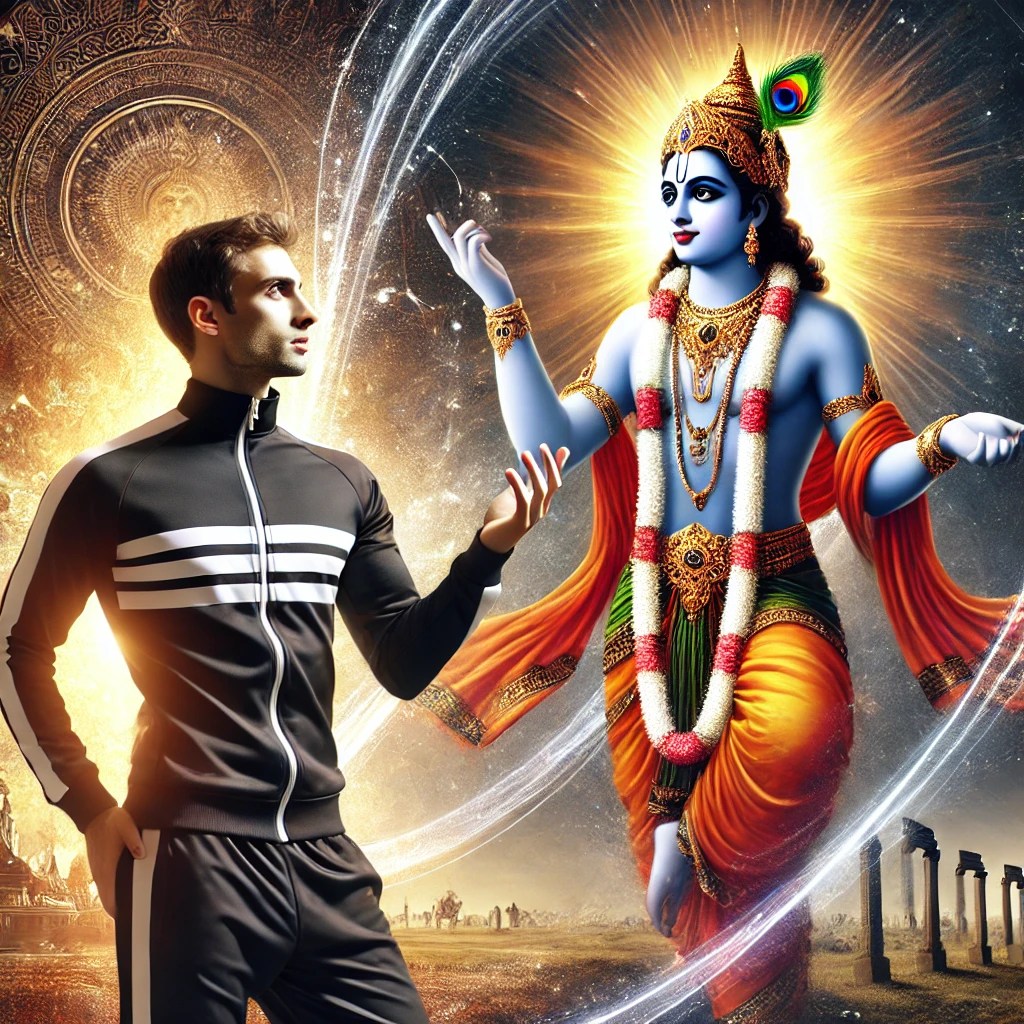
Lord Krishna instructing Arjuna
The Bhagavad Gita: A Battle Between the Mind and the Self
One of the most powerful texts that blends yoga, meditation, and warriorship is the Bhagavad Gita, the epic dialogue between Lord Krishna and the warrior prince Arjuna.
The Gita isn’t just a spiritual treatise; it’s an internal battlefield where Arjuna struggles with his mind, emotions, and sense of duty.
Through Krishna’s guidance, Arjuna learns to transcend his inner conflict and reach a state of clarity, allowing him to perform his duties without attachment or hesitation.
This is the essence of the yoga of action—Karma Yoga—where the practitioner performs their duty without attachment to outcomes, free from the limitations of fear, desire, or ego.
In this state, one is not swayed by external forces but remains anchored in the present moment, ready to take decisive action when necessary.
This same mental discipline is key for warriors, athletes, and anyone who seeks to live with unwavering focus and clarity.
The Warrior Caste and the Path of Zen
Yoga’s connection to warrior philosophy is not just confined to the spiritual practices of ancient India.
Buddha himself, who was born into the warrior caste, understood the discipline and mental training that warrior culture required.
Though his journey took him away from the battlefield, the underlying principles of warrior ethos—such as fearlessness, discipline, and acting in the moment—remain closely tied to the teachings of Buddhism and the path of meditation.
The Samurai of Japan, revered for their code of honor and exceptional skills, fully embraced Zen practice.
Through Zen meditation, they cultivated a deep mental focus, allowing them to enter battle without fear or hesitation, fully present and aware of every movement.
The Samurai’s Zen practice allowed them to move beyond themselves, acting as a vessel for the art of war.
The ultimate goal was to reach a state of “no-self” or “no-mind”, where the mind does not interfere with action and one acts purely out of intuition and experience.
No Mind, No Self: The Power of Yoga in Life and Battle
The concept of “no-mind” (or “mushin”) is integral to both Zen and yoga, and it is perhaps one of the most powerful aspects of the practice.
When we let go of the ego and the constant chatter of the mind, we open up to a state of pure presence, where our actions are aligned with the flow of life.
This state of non-attachment is essential not only in meditation but also in battle, business, sports, and every area of life that demands focused action.
In yoga, this concept is cultivated through deep meditation and mindful breathing, allowing the practitioner to reach a state where actions are effortless, clear, and precise.
The “no-self” principle helps us overcome the limitations of the ego and the fear that often holds us back in life.
Whether in war or in daily struggles, this mental discipline gives you the edge—the ability to act without hesitation, free from distractions, and aligned with your highest purpose.
Yoga: More Than Just Feel-Good Poses
So, the next time you think of yoga, remember: it’s not just about tying yourself in pretzel-like shapes or doing trendy stretches.
At its core, yoga is about transcending the physical, finding inner peace, and cultivating the mental strength to face any challenge—be it on the battlefield or in the daily struggles of life.
The meditation practices of yoga, developed over millennia, are the key to unlocking the true power within you.
Just as the great warriors of history relied on the mental clarity and fearlessness gained through meditation and yoga, so too can we all benefit from its profound teachings.
Yoga, when practiced in its fullest sense, is not just a physical exercise; it is a way to elevate your warriorship, to act with precision, and to live without fear or limitation.
Final Thoughts
Yoga is not just about the body.
It is the way to train your mind, to enter a state of no-mind, and to cultivate the clarity and fearlessness necessary to face life’s battles—whether physical, mental, or spiritual.
Just as the ancient warriors did, we too can embrace the meditation aspect of yoga and unlock the deeper power that lies within us all.
Sri Paramahansa Yogananda
BE CALMLY ACTIVE
AND ACTIVELY CALM
In short, don’t think all the time of just making money. Exercise, read, meditate, love God, and act peacefully, at all times. Learn to be calmly active and actively calm, carrying into your daily activities the calmness gained in the spiritual activity of meditation.
In the Gita, Bhagwan Krishna teaches: “Remaining immersed in yoga, perform all actions, forsaking attachment (to their fruits). Remain indifferent to success and failure (while performing all actions). The mental evenness during all states of activities (resulting in success or failure) is termed yoga.
In the grand epic of the Mahabharata, Arjuna stands as the embodiment of the ultimate warrior—not merely because of his unmatched skill in battle, but because of his mastery of mind, spirit, and action. His journey, as told in the Bhagavad Gita, mirrors the path of all those who seek mastery in life, whether in combat, personal development, or spiritual enlightenment.
This journey—one of discipline, resilience, and transformation—is also the essence of RAT Synthesis, a system that fuses ancient wisdom with modern strategies for total life mastery. Just as Arjuna underwent intense training, faced his deepest fears, and ultimately transcended his limitations, the RAT Synthesis warrior follows a path of rapid adaptation, strategic execution, and transcendental awareness to unlock their highest potential.
Arjuna’s Mastery: The RAT Synthesis Blueprint
1. Training with Relentless Focus – The Science of Skill
Arjuna’s training under Guru Drona is legendary. He was not just naturally talented——like Mike Tyson, a modern warrior, he outworked everyone. His ability to focus solely on the target (as seen in the story where he sees only the bird’s eye) is the essence of single-pointed awareness, a core principle in RAT Synthesis.
🔹 RAT Principle: Precision & Execution – In RAT Synthesis training, mastery comes from deliberate practice and relentless refinement of technique—whether in combat, strategy, or life. Like Arjuna, the RAT Synthesis practitioner hones their skills until execution becomes instinctual.
2. Facing the Dark Night of the Soul – Overcoming Internal Conflict
Before the great battle of Kurukshetra, Arjuna experiences doubt, fear, and hesitation. He questions his purpose, the morality of war, and the very nature of existence. This mirrors what every warrior—physical or spiritual—must face: the inner battle against fear, doubt, and limitation.
🔹 RAT Principle: Psychological Warfare & Mental Resilience – RAT Synthesis teaches that the greatest battle is fought within. Through witnessing-monitoring meditation, breath control, and deep introspection, the warrior develops an unshakable mindset, moving beyond hesitation into decisive action.
When Krishna (God) reveals the ultimate truth to Arjuna in the Bhagavad Gita, Arjuna transcends self-doubt and enters a state of pure, unattached action—the Zen concept of mushin (no-mind). In this state, action is effortless, precise, and unstoppable.
🔹 RAT Synthesis Principle: Adaptation & Fluidity – Just as Arjuna becomes a divine instrument of action, the RAT Synthesis warrior learns to adapt instantly, responding with precision, rather than overthinking. This applies in combat, business, relationships, and any domain requiring mastery.
4. Fighting Without Attachment – The Grandmaster’s Code
Krishna teaches Arjuna the path of Nishkam Karma—acting without attachment to results. The true warrior fights not just for victory, but for duty, embodying pure, detached action.
🔹 RAT Synthesis Principle: Effortless Mastery & Wu Wei – In RAT Synthesis, mastery is achieved through effortless action, where mind, body, and spirit align. The RAT warrior doesn’t struggle—they flow, making every move intentional yet free from ego-driven desire.
Karma Yoga:
“You have a right to perform your prescribed duties, but you are not entitled to the fruits of your actions. Never consider yourself the cause of the results of your activities, and never be attached to not doing your duty.” – BG 2.47: Chapter 2, Verse 47
Perform your duty with full dedication and heart.
Let go of attachment to results and surrender the ego.
You are not the Doer—God acts through you; you are His instrument.
Avoid laziness or spiritual bypassing—escapism is not true spirituality.
5. The Warrior’s Dharma – Aligning with Higher Purpose
A true warrior fights not for personal gain but for a higher cause. Arjuna’s dharma (duty) is to uphold righteousness, just as the RAT warrior’s path is one of continuous growth, service, and transcendence.
🔹 RAT Synthesis Principle: Transcendental Life Mastery – RAT Synthesis is not just about combat or success—it’s about transcendence. The ultimate goal is to rise above fear, ego, and limitation, merging skill with wisdom, power with humility.
Become the Arjuna of Your Own Life
Arjuna’s journey is the warrior’s journey—your journey. Whether you seek to master martial arts, business, relationships, or your own inner world, the path remains the same:
✅ Train with relentless focus ✅ Face and conquer your inner battles ✅ Enter the flow state—become effortless in action ✅ Detach from results—embrace the process ✅ Align with a higher purpose—transcend the ordinary
Through RAT Synthesis, this path is not just philosophy—it’s a living system. By training your body, sharpening your mind, and elevating your spirit, you unlock the warrior within—one who moves with power, wisdom, and ultimate freedom.
🔥 Arjuna was the ultimate warrior of his time. Will you be the ultimate warrior of yours? 🔥
In the RAT Synthesis™ fighting method, we integrate Mike Tyson–inspired kickboxing into our offensive, follow-up, and finishing phases. Rather than bobbing and weaving, we emphasize interception, destruction, and simultaneous block-striking. Iron Mike–style Street Kickboxing makes up 20% of the RAT Synthesis™ system.
This video is a Masterclass in Mike Tyson’s boxing style:
Peek-a-boo guardwith head movement to slip punches and close distance
Jab
Jab-Jab
Blinding Jab-overhand
Hooks – Body and Head
Lead hook head, rear uppercut chin
Hook to the Body, then Uppercut (same hand) (open guard, lift chin)
Uppercut to the Chin in Close Range (capitalize on tight space)
Left Hook (signature weapon, powerful finisher)
“Punches in bunches”
“Throw punches with bad intentions“
Breaking Down Mike Tyson’s Signature Uppercut | His Most Dangerous Punch 🥊
Mike Tyson’s Deadliest Combos (Breakdown)
Animals Wide 23 📅 January 27 at 4:10 PM
Kevin Rooney was asked when Mike Tyson was at his absolute prime. His answer? 😳
“When he beat Michael Spinks… He knocked out Michael Spinks in 90 seconds. It wasn’t a joke. I mean, he knocked him out. So l think that fighter, in my opinion, could have and should have probably beaten anybody that was in his path. Anybody including Rocky Marciano and Muhammad Ali. Well, I’ll give Muhammad Ali and Rocky, well it could have been different, I mean, Rocky punched like hell. Muhammad punched like hell. Rocky had beat everyone. Muhammad had heart and was hard to hit. The fights would have been interesting. But I believe that Mike would have come out the better. Because he punched very hard. I believe that Mike is one of the hardest punchers in history. He punches harder than Rocky. Punches harder than Joe Louis. Punches harder than George Foreman.”
Core Combat Principles:
Indomitable Warrior Spirit
Psychological Warfare
Discipline and Simplicity
Adaptability and Resilience
Peek-a-Boo Style
Power Punching
Aggressive Counterpunching
Body Attacks and Combinations
Angles and Footwork
Mike Tyson is a lifelong student, deeply dedicated to learning. He meticulously studied the techniques of the old-time great fighters and drew inspiration from legendary warriors throughout history. His success wasn’t merely the result of raw power and physical prowess; it was built on a foundation of profound knowledge, strategy, and insight. Beyond the ring, Tyson is a highly intelligent individual and a reflective philosopher. Despite facing his share of flaws and challenges, he has grown and matured significantly over the years, embodying resilience and transformation.
This blend of intelligence, strategy, and resilience has made Tyson a living legend in the world of boxing. His ability to master both the mental and physical aspects of his craft serves as a powerful example of achieving greatness. Let’s break down the key components of Tyson’s mindset and strategic principles that propelled him to the top and explore how these principles can be applied to success in any endeavor.
The Mindset: A Foundation of Strength and Resilience
Mike Tyson’s mindset was shaped by his difficult upbringing and the guidance of his trainer, Cus D’Amato. Below are the essential elements that define Tyson’s powerful mental game:
1. Unwavering Confidence
Tyson’s belief in himself was a cornerstone of his mindset. From the very beginning, he was taught by D’Amato to visualize success and maintain a positive self-image. Tyson was certain of his greatness and knew that without this unshakeable confidence, he would lose before the fight even began. His confidence allowed him to take on any opponent, no matter the odds.
2. Mind Over Matter
Tyson understood that controlling his mind was just as important as controlling his body. He learned to channel fear into aggression, using mental conditioning to push through pain and doubt. By visualizing his opponents folding before him, Tyson was able to dominate the psychological aspect of his fights, gaining a mental edge over his adversaries.
Tyson’s ability to visualize his opponents folding aligns with the Law of Attraction, which emphasizes the power of focused thought and belief in manifesting outcomes. By visualizing victory and mentally dominating his opponents, Tyson tapped into the energy of his intentions, attracting success and psychological dominance in the ring.
3. Discipline and Relentless Work Ethic
Despite his chaotic public persona, Tyson was known for his intense work ethic. Under D’Amato’s mentorship, he developed a disciplined approach to training that included mastering the fundamentals, conditioning, and mental preparation. Tyson’s mindset was one of constant improvement—never satisfied with “good enough,” he was always striving for excellence.
“If someone is doing more than me, I’ll do more. If he gets up at 5 to go running, I get up at 4. If he gets up at 4, I get up at 3. If he gets up at 3, I won’t sleep.” — Mike Tyson
4. Focus on the Present Moment
Tyson emphasized the importance of focusing entirely on the present moment, particularly in the ring. He left behind distractions like fame or external pressures and concentrated solely on the task at hand. This intense focus allowed him to stay in the zone, operating with precision and clarity during his fights.
Tyson’s intense focus on the present moment mirrors the essence of Zen and yoga, where mindfulness and presence are key to mastering both the mind and body. Just as Tyson shut out distractions to perform with precision, Zen and yoga teach us to center our attention, shedding external pressures and embracing the flow of the present to achieve clarity and inner power.
5. Embracing Fear
Rather than being paralyzed by fear, Tyson learned to harness it. Fear, to him, was a natural emotion that could be transformed into energy. By embracing fear and using it as fuel, Tyson became more intense and aggressive, turning an obstacle into a powerful motivator.
Tyson’s ability to transmute fear into powerful motivation mirrors the yogic practice of transmutation, where negative emotions are transformed into positive energy. Just as yogis convert inner turmoil into strength, Tyson harnessed fear, turning it from a hindrance into a driving force that propelled him to greater intensity and focus.
6. Anger as Motivation
Tyson often channeled his anger into his fights. His personal struggles, from his troubled upbringing to his turbulent emotions, gave him the fire to fight harder. Anger became a source of energy that propelled him to perform with even more intensity in the ring.
In RAT Synthesis, anger is not something to channel or use as fuel. A yogi doesn’t engage with anger but either cuts it off or simply observes it as a passing phenomenon, detached from the self. Tyson’s approach of using anger as motivation contrasts with this teaching, where emotional mastery and detachment are key to maintaining clarity and inner peace.
7. Mental Toughness and Resilience
Tyson’s life was filled with obstacles, from growing up in poverty to facing legal issues. Yet, he always believed he could rise above these challenges. This mental toughness and resilience made him a formidable force, allowing him to handle pressure and adversity like few others.
8. The Will to Win
Tyson’s mindset wasn’t just about physical preparation—it was about an unrelenting psychological drive to win. His desire to dominate in the ring was so intense that he couldn’t imagine losing. This drive, combined with his skill and mental focus, made him an overwhelming opponent.
9. The Influence of Cus D’Amato
Cus D’Amato played a pivotal role in shaping Tyson’s mindset. Beyond teaching Tyson boxing techniques, D’Amato instilled in him the belief in his own invincibility. D’Amato’s coaching taught Tyson the importance of mental strength and the development of a champion’s mindset, which became one of Tyson’s most valuable tools.
Yoga teaches the invincibility of the soul, a concept embodied by Arjuna in the Bhagavad Gita, who realizes that his true self is beyond the limitations of the body and mind.
10. Humility and Self-Awareness
In his later years, Tyson reflected on the destructive power of unchecked pride and ego. He recognized the importance of humility and balance, seeking peace within himself. This self-awareness became a key aspect of his mindset as he continued to grow, learn, and evolve.
Masters embrace egolessness because it allows them to remain open to learning and growth. By letting go of unchecked pride and ego, they cultivate humility and inner peace, which creates the space for true wisdom and adaptability. This self-awareness, as Tyson discovered later in life, becomes a powerful advantage, enabling one to transcend limitations and evolve both personally and professionally.
The Strategy: Aggression, Adaptability, and Psychological Mastery
Tyson’s strategic approach in the ring was built on a blend of intense preparation, psychological warfare, and sheer aggression. Here are the key elements of his strategy:
1. Intense Preparation
Preparation was the foundation of Tyson’s success. He trained rigorously, mastering both his physical and mental skills. This included perfecting his fundamentals, conditioning, and mental resilience. Tyson believed that preparation wasn’t just about the body—it was about ensuring that the mind was equally prepared to face the challenge ahead.
Sun Tzu, like Tyson, emphasized the importance of preparation as the key to success. In The Art of War, he stresses that victory is won long before the battle begins, through careful planning, strategy, and mental readiness. Sun Tzu believed that thorough preparation of both the body and mind is essential to achieving victory, a principle that Tyson applied both in and out of the ring.
2. Fearlessness and Aggression
“A good offense is the best defense”
Tyson’s approach to fighting was rooted in fearlessness and aggression. He was known for overwhelming his opponents right from the start, using his speed and power to take control of the fight. Tyson believed that the key to success was to never back down and to be the aggressor in every fight.
The Samurai Warriors, particularly under figures like Miyamoto Musashi, were trained in the art of swift, aggressive action. Musashi’s philosophy emphasized striking first, using speed and precision to overwhelm the opponent.
Similarly, Bruce Lee’s martial arts philosophy was about dominating with precision and fluidity. Lee believed in creating the action rather than waiting for the opponent, staying one step ahead at all times.
3. Adaptability and Flexibility
While Tyson was known for his aggressive style, he also understood the importance of adaptability. He didn’t rely on a single strategy but adjusted his approach based on the strengths and weaknesses of his opponent. This flexibility allowed him to stay unpredictable and maintain control over the flow of the fight.
Similarly, Joe Lewis, the karate champion, used Bruce Lee’s five ways of attack to defeat different fighter archetypes. By blending speed, timing, and the right choice of attack, Lewis was able to adapt his strategy to overwhelm counterfighters, defensive fighters, and aggressive fighters, much like Tyson, remaining unpredictable and in control of the fight’s flow.
4. Intimidation and Psychological Warfare
Tyson was a master of psychological warfare. He used his intense presence and reputation to break down his opponents mentally before the fight even began. Whether through staring them down, trash-talking, or simply projecting dominance, Tyson’s ability to plant seeds of doubt in his opponent’s mind was a key component of his strategy.
Like Tyson, MuhammadAli used psychological tactics such as trash talk and mind games to break his opponents before the fight. His ability to dominate mentally as well as physically was a key part of his strategy, famously using his trash talk to get into the heads of fighters like Sonny Liston and George Foreman.
Bruce Lee used psychological warfare by projecting confidence and unpredictability to unsettle his opponents. His intense presence, quick movements, and direct eye contact often created a mental edge, destabilizing adversaries before the fight even began. Lee’s adaptability and calm focus also kept opponents guessing, giving him control both mentally and physically.
5. Simplicity and Directness
Tyson’s in-ring strategy was simple yet effective. His coach, Cus D’Amato, taught him the “peek-a-boo” style, focusing on quick movements, head fakes, and powerful combinations. Tyson’s strategy was to keep things direct and to the point, minimizing the risk of mistakes while maximizing his offensive power.
Similarly, Bruce Lee embraced simplicity and directness in his approach, favoring efficiency over complexity. Lee’s philosophy of “absorb what is useful” was about using the most effective techniques with minimal movement, eliminating unnecessary actions to create maximum impact. Both Tyson and Lee understood the power of clarity and focus in achieving success.
6. The Power of the First Punch
Tyson believed that the first punch could change the trajectory of the fight. His strategy often centered on delivering a powerful, decisive blow early on to set the tone and gain the psychological advantage. This first punch often left his opponents reeling, both physically and mentally.
Under leaders like Miyamoto Musashi, samurai often struck first to gain the initiative. Musashi’s philosophy of “sword drawing first” emphasized the importance of taking control from the start to dominate the opponent both physically and mentally.
Bruce Lee’s approach in martial arts also revolved around striking first, using speed and fluidity to surprise opponents. His emphasis on controlling the fight from the start aligned with Tyson’s principle of taking the initiative early.
7. Control and Domination
Ultimately, Tyson’s strategy was about controlling the pace and rhythm of the fight. He aimed to dominate every aspect—physically, mentally, and emotionally—by staying aggressive and keeping his opponent on the defensive.
Conclusion: The Tyson Mindset and Strategy for Success
Mike Tyson’s mindset and strategic approach were essential to his rise as one of the greatest boxers in history. His blend of confidence, fearlessness, mental toughness, and adaptability helped him dominate in the ring. Tyson’s strategy, which combined psychological mastery with aggressive offense, became a blueprint for success.
The lessons from Tyson’s mindset and strategy aren’t confined to boxing. They can be applied to any area of life—whether it’s business, personal growth, or overcoming challenges. By developing an unshakable belief in yourself, embracing fear, staying disciplined, and adapting to changing circumstances, you can unleash your own power and achieve success, just like Tyson did.
SIFU RUSSO’S BOXING AND KICKBOXING EXPERIENCE
Guro Martin Gross Extensive training in Jeet Kune Do, Kali/Eskrima, and Kickboxing under the mentorship of Guro Martin Gross, a student of Dan Inosanto at the Inosanto Academy of Martial Arts in the 1970s.
Tony Bersani Studied some western boxing under the tutelage of Tony Bersani, Fitness Works Boxing Center, Philadelphia, PA.
Multiple sparring sessions with other practitioners, including a Golden Gloves-level amateur boxer.
Twelve Rounds with Mike Tyson
Sifu Russo completed 12 Rounds with Tyson, a transformative program designed by Mike Tyson to help individuals develop a champion’s mindset for success.
The Fundamentals of the Peekaboo & Power Punching by Mike Tyson
Sifu Russo completed The Fundamentals of the Peekaboo & Power Punching by Mike Tyson, an online course from Dynamic Striking where the legendary boxer shared his iconic Peekaboo style and the secrets behind his unparalleled power and speed.
Through the knowledge of harmony comes endurance. From endurance, illumination shines forth. By increasing life, fortune is bestowed. Controlling energy with the mind reveals true power.
– Lao Tzu
These qualities, and many more, are cultivated through the practice of martial arts.