This blog post is a blueprint for transcending human limits and evolving into a superhuman. Through RAT Synthesis, Mind Range™, and Mushin, it trains mastery of mind, body, and destiny.
By overcoming fear, hesitation, and ego, individuals unlock peak performance, ultimate awareness, and unshakable freedom—becoming unstoppable forces in life.
Warrior of Stillness:
No-self, No-mind.
The enemy cannot penetrate—for who is there to be penetrated?
Into a soul absolutely free From thoughts and emotion, Even the tiger finds no room To insert its fierce claws.
One and the same breeze passes Over the pines on the mountain And the oak trees in the valley; And why do they give different notes?
No thinking, no reflecting, Perfect emptiness; Yet therein something moves, Following its own course.
The eye sees it, But no hands can take hold of it – The moon in the stream.
Clouds and mists, They are midair transformations; Above them eternally shine the sun and the moon.
Victory is for the one, Even before the combat, Who has no thought of himself, Abiding in the no-mind-ness of Great Origin.
KAMON (FAMILY CREST): RAT SYNTHESIS WAY OF THE SAMURAI-YOGI
Miyamoto Musashi once said, “The way of the warrior is the resolute acceptance of death.”
Does this mean one should seek death? Should a warrior simply surrender to fate in battle?
No. The meaning runs much deeper—it is not about dying physically but about letting go of self-centeredness. It is about removing the limitations of the ego, fear, and hesitation. This teaching, mirrored in both Eastern philosophy and Christianity’s concept of “dying to self,” is the key to mastering combat and life itself.
The Power of Mushin: No Mind, No Fear
The RAT Synthesis system of Mind Range™ instills Mushin—the state of “no-mind, no-self.” This is the warrior’s ultimate edge in combat and life. When in Mushin, the fighter is free from self-conscious thought, worry, and doubt. The mind does not dwell on success or failure—it simply acts with pure clarity and precision.
Musashi also stated, “If you make your opponent flinch, you have already won.”Why is this so powerful?
Because flinching means hesitation. Hesitation comes from self-centeredness—the fear of losing, the fear of pain, the fear of failure. Remember Mike Tyson in the ring and how he would intimidate his opponents? Bruce Lee was also a master of psychological warfare.
When an enemy is preoccupied with their survival, their actions become reactive, not strategic. They are not meditating; they are panicking. Their responses become weak, erratic, and fear-driven.
A warrior trained in Mushin, however, does not react—he responds. He plays chess in the middle of battle. His counterattacks are not egoistic, fear-based, or selfish; they are efficient, devastating, and inevitable.
Mind Range™: The Key to Ultimate Awareness
Mind Range™ in RAT Synthesis is the practice of expanding one’s awareness beyond the self. It trains a practitioner to:
By mastering Mind Range™, the warrior is no longer trapped in the narrow perspective of “me vs. them.” Instead, they become one with the Moment and the opponent, intuit their intentions, and flow with the fight, becoming an unstoppable force.
This principle extends beyond combat. In life, those who are attached to their fears and doubts hesitate. They operate within limited programming. They second-guess opportunities. They remain in the prison of their own limitations.
But those who embody Mind Range™ and Mushin act decisively, embracing life with a warrior’s resolve.
Mastering the Art of No-Self
To truly win—whether in battle or in life—one must remove the distractions of self-importance. Arrogance, fear, hesitation, and overthinking are all obstacles. The path of the warrior is to transcend these limitations.
Through RAT Synthesis and Mind Range™, you can achieve Mushin and cultivate a level of awareness that grants absolute control in any situation. Whether you are fighting an opponent, navigating a business deal, or making a life-changing decision, the principles remain the same:
Meditate and Let go of self-centeredness. Dissolve into the eternal Now.
Act without fear
Master your responses
The moment is the nexus to all of reality(the matrix of Consciousness).
The moment is the lever.
By following this path, you embody the warrior’s ultimate truth: total freedom and unshakable mastery over yourself and your destiny.
Are you ready to embrace Mushin and unlock your full potential? The path is before you. Step forward without hesitation.
“When you focus on being a blessing, God makes sure that you are always blessed in abundance.” — Joel Osteen
Imagine moving through life with the clarity of a Zen master, the intuition of a grandmaster, and the adaptability of a warrior. The Witnessing-Monitoring™ Meditation Method of RAT Synthesis is your gateway to this state—a form of meditation that is stillness within activity and woven seamlessly into the fabric of daily life.
Similar to Vipassana meditation but taken beyond the cushion, this is meditation in motion. You are not sitting in a lotus position, isolating yourself from the world. Instead, you remain engaged, fully immersed in the battlefield of life while dwelling in the stillness of pure awareness. Having removed yourself from the equation, all that is left is the Universe.
The Observer Within: You Are Not Your Thoughts
At the core of this method is the realization that you are not your thoughts, your senses, your emotions, or even your body. You are the Witness—the Awareness behind all phenomena. Your essence is the individualized reflection of God, the Soul, watching the ebb and flow of existence without attachment.
From this inner distance of detachment, observe your senses and thoughts. Notice their movements, but do not become entangled. Like the sky remains untouched by passing clouds, your awareness remains unshaken by transient emotions and thoughts.
The Source of Your Reality
Every moment, you are choosing between two polarities:
Delusion (Satan/Mara): Fear, hatred, repulsion, aggression, hostility, anger, confusion, doubt, attachment, selfishness—losing yourself in illusion and suffering. Non-peace.
Divine Consciousness (God, the Masters, and the Saints): Bliss, love, faith, hope, compassion, wisdom, clarity, surrender, selflessness, equanimity—rising into truth, freedom, and divine light. Peace.
Which will you align with?
Your thoughts are magnetic. If you focus on problems, you attract more problems. If you focus on blessings, you invite abundance. Every thought, every emotion, is a move on the chessboard of life. Will you play strategically, or be a pawn to circumstance?
Karma vs. The New Mind
Your current reality is the result of past programming—karma. Also, what you have focused on in the past-The Law Of Attraction. But you have the power to choose a new path. God gives us free will. Using your will,reject the negative, embrace the positive, and at the very least, remain neutral.
The Power of Non-Intention: Effortless Action in Motion
Bruce Lee understood this principle deeply. He taught that true mastery comes not just from speed, but from Non-Intention. This is different from non-telegraphing, which simply avoids giving away an attack. Non-Intention means striking without the conscious intention to strike, allowing for explosive speed, unpredictability, and supreme efficiency.
“When the opponent expands, I contract. When he contracts, I expand. And, when there is an opportunity, I do not hit – IT hits all by itself.”
– Bruce Lee.
What is this IT? The Universe.
Adopting Non-Intention into your meditation practice means flowing through life without hesitation, without fear, without inner resistance. When you move from a state of No-Mind, No-Self (Mushin), your actions arise spontaneously from a place of absolute clarity and intuition.
Your self dissolves into the moment the eternal Now. The Pure Awareness. Having removed yourself from the equation, all that is left is the universe.
Living in the Mushin Mindset 24/7
The Samurai trained to maintain this mindset constantly, allowing them to respond to a sword flying toward their jugular with instantaneous precision. Likewise, top executives and strategists around the world study Samurai principles to gain an edge in business and life.
To take your Life Chess Game to the next level, you must engage in meditation in motion throughout your day. When you remain centered in Awareness, you eliminate fear and hesitation, unlock your full intelligence, and move beyond the conditioned self.
The Still Center: The Key to Mastery
When you react, you are controlled by the environment, your senses, your past programming. You are playing a low-level game of chess.
But when you dwell in the Still Center, you become the grandmaster of your own destiny. From this place, you:
Eliminate fear and internal resistance.
Tap into pure intuition and rapid decision-making.
Move faster, think sharper, and respond with superhuman intelligence.
Master life instead of being controlled by it.
Embrace the Art of Strategic Living
Witnessing-Monitoring™ Meditation is more than a practice—it is a way of life. A method for operating at peak levels of awareness, flow, and strategy, ensuring you are no longer a victim of external circumstances but an unstoppable force of mastery and precision.
“To be caught up in fear, anger, greed, or any violent or impulsive emotion is to forget God. If your senses, which govern your emotions, are under your control, you are a saint. No one knows better than yourself whether you are a master of your senses or a slave to them. Remember, anything that overrules your self-control leads your nervous system to destruction. The greedy man eats, and the man of self-control eats. One eats for the well-being of his body, and the other overeats for sensual gratification. If one’s love is concentrated more on God and less on the senses, then all sensory abuse will be overcome. When tempted, pray to the Lord, “Make Thyself more tempting than temptation. No matter how You test me, Lord, I shall cling to You. When your nervous system is filled with peaceful, loving thoughts of God, your nerves become recharged with His power.
Movie stars and other professional entertainers are considered the beautiful people of America. But why are their personal lives so often in a shambles of unhappiness and multiple divorces? Most of them live too much on nervous energy concentrated in the senses. Overeating, promiscuous sex, the intoxication of wine and drugs-all produce a pseudo happiness. In God alone one finds fulfillment of all desires.”
For deeper insights into meditation in motion, life strategy, and playing the ultimate game of chess with life, explore RAT Synthesis Life Strategy and step into your highest potential.
“You are not this body. You are the soul. You are the infinite, immortal spirit, untouched by material conditions. You are a part of God, and when you realize that, you transcend the limitations of this world.” – See Yogananda
Throughout history, the greatest spiritual and philosophical minds have echoed the same profound truth: freedom comes through detachment. Jesus, Musashi, Tsunetomo, Blake, and Rumi—each from different cultures and traditions—point toward the same reality.
To truly live, we must first let go of our desperate clinging to life, self, and the illusions that bind us.
Jesus Christ on freedom from the Matrix: Be in the world, but not of it.
The Paradox of Losing to Gain
Jesus declares, “Whoever seeks to save his life will lose it, and whoever loses his life will preserve it.” At first glance, this teaching seems contradictory, but upon deeper reflection, it reveals a profound truth: attachment to the ego, to possessions, to status, and even to life itself creates suffering.
When we loosen our grip, we find that we are not diminished but expanded. In surrendering control, we gain true life, unshackled from the fears that limit us.
Samurai Warrior
The Warrior’s Path: Embracing Death
Miyamoto Musashi, Japan’s legendary swordsman, states, “The Way of the warrior is resolute acceptance of death.” Similarly, Yamamoto Tsunetomo, the samurai philosopher, teaches that “For a samurai to be brave, he must have no fear of death.” What do these warriors mean?
They are not advocating recklessness but rather an unshakable presence in the moment, free from fear and hesitation. To fully engage in life, one must not be enslaved by the dread of losing it.
This mindset is not limited to the battlefield. It applies to every aspect of life. The more we fear loss—whether of our health, relationships, or security—the more we imprison ourselves in hesitation and anxiety. Only by accepting the impermanence of all things can we move through life with true courage and clarity.
When we do this, pain no longer controls us as it once did. The suffering that comes from attachment and resistance fades, and we find a new strength in simply being.
William Blake
Joy and the Art of Letting Go
William Blake beautifully expresses this principle in poetic form: “He who binds to himself a joy does the winged life destroy; but he who kisses the joy as it flies lives in eternity’s sunrise.” Clinging to pleasure, like clinging to life, suffocates the very thing we desire.
When we hold onto happiness with grasping hands, it slips through our fingers. But when we embrace joy in the present, without attachment, we experience the infinite.
Rumi
Die Before You Die
Rumi, the great Sufi mystic, delivers a striking command: “Die before you die, so that when death comes, there is nothing left to take.” This is the ultimate detachment—the death of the ego, the shedding of false identity, the surrender of the self. In doing so, we are reborn into a life of freedom, no longer ruled by fear, loss, or suffering.
Skip the debate and go directly to the Masters.
The Singular Truth Beyond Division
“All the masters agree. The disciples argue. The truth is singular, but the mind seeks division.” This final insight reminds us that wisdom is not about intellectual debate but direct experience. All great teachers have pointed toward detachment as the key to liberation, yet the mind complicates what is simple.
True understanding is not in words, but in being. It is in the willingness to let go, to release attachment, and to embrace each moment with full presence.
Liberation Through Detachment
When we release our desperate hold on life, we paradoxically find the deepest sense of aliveness. When we embrace death—not as an end, but as a transformation—we become fearless and still inside.
When we cease clinging to joy, it visits us more frequently. And when we surrender our ego, we awaken to the vast, boundless reality beyond it. Pain no longer controls us, for we are no longer resisting life’s natural ebb and flow.
This is the path of the sage, the warrior, the poet, and the mystic. And it is open to each of us, here and now. Will you let go and be free?
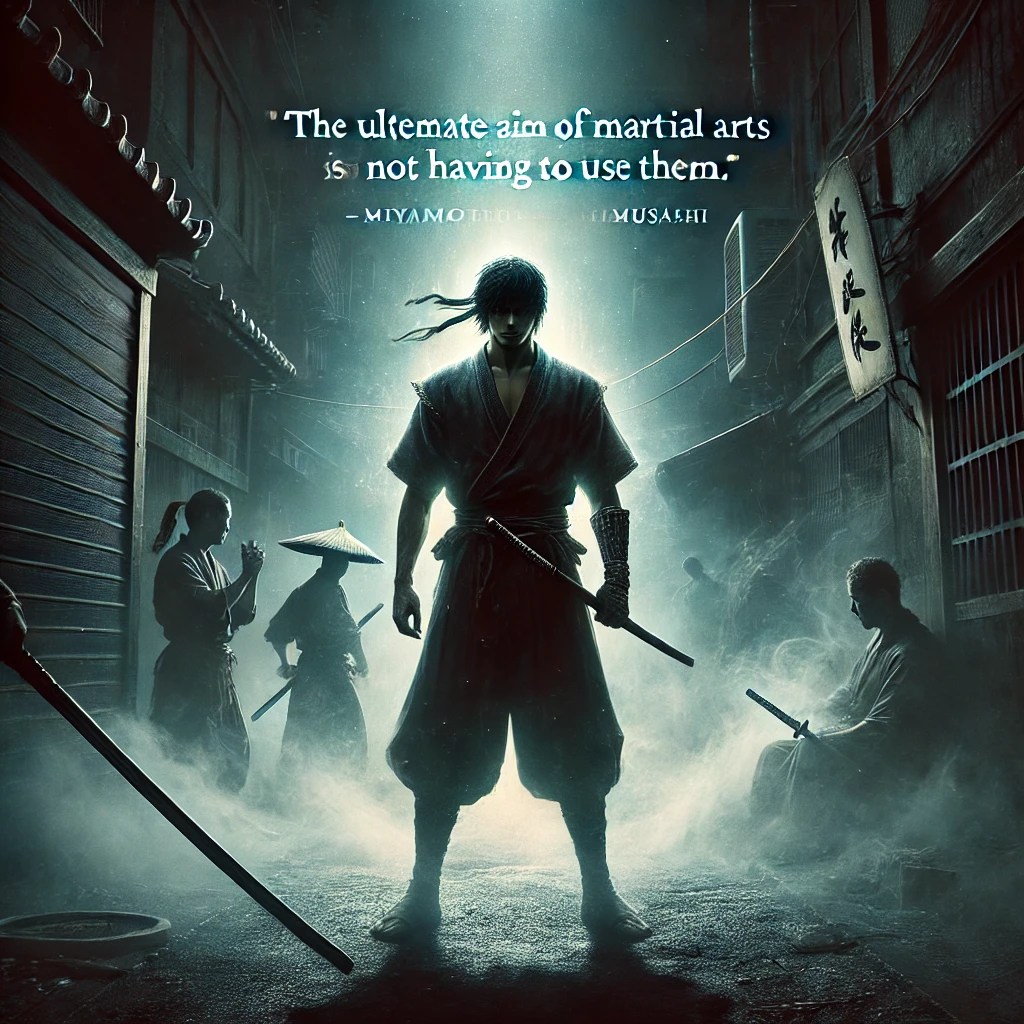
Miyamoto Musashi, the legendary samurai and undefeated duelist, once said, “The ultimate aim of martial arts is not having to use them.” These words come from a man who fought and won over 60 life and death duels in an era when Japan was filled with warriors roaming the land, eager to test their skill and prove their worth. Musashi was no pushover—he was a master of combat, yet he understood that true mastery lies in transcending the need for battle.
At first glance, this may seem paradoxical—why train for years in combat only to avoid it? Yet, this statement holds a deep truth: the warrior who has mastered themselves rarely needs to fight. Their presence (chi) alone commands respect, dissuading threats before they manifest.
The Warrior’s Aura: Why Muggers Don’t Pick the Strong
Violence is rarely random. Predators—whether in the animal kingdom or the streets of a city—seek easy prey. They don’t attack the strong; they target the distracted, the timid, and the unaware. A trained warrior, one who has internalized the principles of martial arts and strategy, exudes an unmistakable energy—a silent but powerful message:
🚫 “Not this one.”
Compare two individuals walking down the street:
The Unaware Civilian – Eyes locked on their phone, shoulders slumped, mind elsewhere. Their body language screams distraction, vulnerability, and a lack of control over their environment. They might be daydreaming, lost in worries, or simply untrained in reading energy. To a predator, they look like an easy mark.
The Trained Warrior – Walking with calm confidence, head up, peripheral vision scanning naturally, breathing deep and steady. There’s no tension—only readiness. They are not fearful but also not looking for a fight. They simply exist in a state of total awareness, in tune with the flow of the moment.
The difference is not just physical but metaphysical. It’s an emanation of mindset which emanates chi (qi), prana, bioelectric energy—the subtle yet powerful force that martial artists cultivate through breath, meditation, and training. This energy extends beyond mere body language; it is a field that others unconsciously register.
This is why seasoned warriors rarely get into fights. Not because they run, but because the fight never comes to them.
In a true confrontation, the trained warrior does not react from fear or ego. Instead, they enter mushin (無心)—the state of “no mind.” “They” are not there to be frightened, they are egoless (no-self). This is not apathy or passivity but a heightened state of intuition and presence. The mind is empty of thoughts, yet fully aware. It does not dwell on past or future, on fear or hesitation. It simply acts.
The untrained person, when faced with a threat, either: ❌ Panics, letting fear take over, leading to poor decisions and freezing up. ❌ Overreacts, engaging in unnecessary conflict due to a fragile ego.
But the warrior trained in mushin sees the reality of the situation with clarity. They know if the threat is real or just an illusion. They sense whether to engage or simply walk away. There is no hyperbole in this—it is the direct result of deep training in martial arts, meditation, and strategic thinking.
Intuition: Knowing When to Strike and When to Walk Away
A well-trained martial artist does not act out of impulse, anger, or insecurity. They act from pure awareness.
👉 If a situation does not warrant combat, the warrior sees it immediately and moves on, avoiding unnecessary conflict.
👉 If a situation requires action, there is no hesitation, no wasted movement—just pure execution, whether that means striking, deflecting, or using words to de-escalate.
This level of mastery means that the ego is not in control—the higher self is. The need to “prove something” disappears. There is no need to dominate or posture. Instead, the warrior moves through life with grace, like a river flowing around obstacles rather than smashing through them.
The Metaphysics of Combat and Non-Combat
Everything in existence vibrates at a certain frequency. Fear, insecurity, and distraction vibrate at a low frequency, attracting chaos. Confidence, centeredness, and training vibrate at a high frequency, repelling conflict before it manifests.
A skilled warrior aligns themselves with the Tao, the flow of life, where battle is neither sought nor feared. In this way, they embody the deepest truth of martial arts:
✅ Train for war, but live in peace. ✅ Be capable of destruction, but embody restraint. ✅ Be so strong that you never need to fight.
True Strength is Invisible
In the end, Musashi’s words reflect a universal truth:those who seek violence are weak, and those who master violence become peaceful. The ultimate goal is not to win fights—it’s to transcend them entirely. To move through life untouchable—not because you fight, but because you don’t have to.
RAT Synthesis Street Warriors, liberated from their own limitations, masters of life and whatever challenges it throws their way.
“Although the world is full of suffering, it is also full of the overcoming of it”
– Helen Keller
Abstract:The Warrior’s Path to Liberation explores the transformative journey of transcending pain, conquering suffering, and forging inner strength through mindfulness, meditation, and spiritual discipline. Rooted in the teachings of RAT Synthesis, this path empowers warriors to embrace pain as a teacher rather than a foe.
By practicing detachment, even-minded endurance (Titiksha), and cultivating positive karma, one can overcome the mental and emotional turmoil that amplifies suffering. These principles guide individuals toward breaking free from the cycles of negativity and mastering life’s challenges with grace and resilience.
Through acceptance, inner awareness, and alignment with divine grace, the warrior discovers unbreakable resilience and liberation. Life’s challenges are transformed into opportunities for personal and spiritual growth, revealing the ultimate freedom that comes with letting go.
Pain is inevitable; suffering is optional. Embrace life fully, and find freedom in letting go.
INTRODUCTION.
As warriors, we understand that pain is an unavoidable part of life. From physical challenges in battle to emotional trials in our personal journey, pain will inevitably arise. But suffering—mental and emotional turmoil—is optional.
The key to transcending both pain and suffering lies within the warrior’s mastery over their mind and emotions. The path is clear: pain, which is transient, can be endured, and suffering can be overcome.
Escape into the pain – Shinzen Young
Shinzen Young, a renowned meditation teacher, succinctly captured the relationship between pain and suffering: “Suffering = Pain x Resistance.” Pain is a natural physical sensation, but suffering is the mental and emotional turmoil we create about the pain.
The warrior, therefore, does not resist pain. Instead, they embrace it, meditatively observe it, and transcend it. They do not generate tension, which only amplifies the pain and blocks the flow of life. Rather, they accept it, feel into it, and relax with it—even invoking love towards it.
While this may seem counterintuitive, it is not about seeking pain or masochism. We do not invite pain into our lives, but when it inevitably arises, we use it as training and choose to relax into it, accepting it as part of our journey. For example, when it is very cold outside, instead of resisting the discomfort, we embrace it. Feel into it, knowing that you are a child of God, stronger than any circumstance the universe can throw at you. In doing so, we reclaim control, and pain no longer dictates our responses or choices. Pain can be transcended.
The nervous system can be retrained. Discipline Equals Freedom said Jocko Willink, ex Navy SEAL. The key is to do the opposite of resisting or escaping: relax, accept, feel into the pain, and even love it—not in the sense of liking it, but through the transformative power of love. Like Jesus going to the cross.
Understanding Pain vs. Suffering
First, we must draw a distinction between pain and suffering. Pain is a physical sensation, a response of the body to injury, stress, or discomfort. It is sensory and natural, an experience we cannot escape. However, suffering is the emotional and mental turmoil that arises when we react to the pain. It is our thinking about the pain—our judgment of it—that transforms it from a mere sensation into something much more overwhelming.
Imagine the pain of a warrior who has been struck in battle. The physical pain is intense, but the true suffering begins when the warrior begins to think thoughts like, “This pain is unbearable,” or “I can’t take it anymore.” The pain, though real, becomes amplified through the mind’s resistance. The warrior who has mastered their mind, however, can see the pain as it is—a sensation that will come and go—and can choose not to engage in the suffering that would otherwise follow.
The Warrior’s Meditation: Developing Inner Strength
The first step to transcending pain and suffering is the cultivation of inner strength through meditation. Meditation, like formal breath-focused sessions, is the practice of detaching from the mind’s automatic reactions. It is the warrior’s training ground, where we learn to become observers of our thoughts, emotions, and sensations, not identify with them, nor become their prisoner.
Start by dedicating just a few minutes each day to formal meditation. Focus on your breath, allowing your mind to quiet and your body to relax. Gradually increase your meditation session to 30 minutes. This will build the mental and emotional fortitude needed to confront life’s inevitable challenges. The longer you meditate, the stronger your center becomes—until eventually, you are able to carry that calm and inner strength with you throughout the day.
Practicing Mindfulness: Detach and Observe
Mindfulness is the practice of being fully present in the moment, observing your thoughts, feelings, and sensations without judgment, while exercising detachment, equanimity, wisdom, and compassion.
Throughout the day, practice mindfulness. Whenever pain or suffering arises—whether physical or emotional—detach from it. Observe it as if it were a movie playing before you, with no attachment to the storyline. Just as you would watch an actor in a film, you watch your thoughts, emotions, and sensations from a distance. Become impartial.
As Shinzen Young stated, By practicing mindfulness in the presence of pain, you can reduce suffering, and the pain may even transform into a stream of pure energy.
When suffering arises, change your mind using your willpower. Remember, suffering is the thinking and emotions about the situation not the situation itself. In the beginning, this may be difficult, but the warrior persists. If you cannot change your thoughts at first, simply observe them without judgment. “This too shall pass,” you tell yourself. In time, you will train your nervous system to stop engaging with suffering and to remain neutral, even in the face of great emotional turmoil.
Transcending Pain: Mindfulness in Action
Pain, whether physical or emotional, can be transformed through mindfulness meditation. Rather than resisting it, we observe it. We feel it, but we do not let it control us. In moments of physical discomfort, such as when a warrior sustains an injury, the key is to bring mindfulness to the experience. Feel the pain deeply, but without clinging to it. Allow it to flow through you like a wave, knowing that it will eventually subside.
This practice of acceptance, of feeling the pain without resistance, retrains the nervous system. Resistance to pain increases its intensity, but acceptance diminishes it. Through this process, pain itself begins to lose its power over you. And in time, you may even find that pain can transform into a source of strength—a reminder of your resilience and your ability to endure.
The Power of Titiksha: Even-Minded Endurance
In addition to mindfulness, the warrior also practices Titiksha, or even-minded endurance. This concept, rooted in ancient spiritual traditions, teaches us to bear pain and discomfort without losing our balance. It is the practice of maintaining equanimity, no matter the circumstances.
Titiksha allows us to endure pain without reacting to it. We do not try to escape or numb ourselves. We simply remain present, accepting the pain as part of our journey. The warrior’s motto here is simple: This too shall pass. Through Titiksha, we develop the inner strength to endure even the most difficult challenges without becoming overwhelmed.
Let Go of Attachment: The Key to Freedom
Attachment to craving is a primary cause of suffering. When we crave comfort, safety, or pleasure, we create resistance to the natural flow of life. We become attached to the idea that life should be without pain or discomfort, or should happen in a certain way or form, and this attachment causes suffering.
The warrior learns to release attachment, particularly to the idea that life should be pain-free. Meditation and mindfulness help us to detach from desires and cravings, allowing us to face each moment as it is, without clinging to what we want or pushing away what we do not want. In this way, we stop the cycle of suffering and begin to transcend it.
The Power of Good Karma
Finally, the warrior remembers that their actions have consequences. Positive karma—doing good deeds and being of service to others—creates an energetic shield that can help mitigate or even erase negative karma. Good actions generate positive energy, and this energy can alleviate suffering in the long run.
When we practice kindness, compassion, and generosity, we shift our vibration and attract positive experiences into our lives. This doesn’t mean that pain and suffering will never arise, but it does mean that we will have the internal resources to handle them with grace and wisdom. Our good karma becomes an armor, protecting us from the mental and emotional suffering that often accompanies pain.
Furthermore, good karma not only counteracts the negative karma from our present actions but also helps to dissolve the effects of past karma—whether from this lifetime or previous ones. And even beyond the workings of karma, there is the grace of God. If we live a good and noble life and make a sincere effort, God’s grace can lift the burdens of karma, offering us a spiritual reprieve and guiding us toward greater peace. In this way, we are not bound by the past, but are free to move forward, supported by divine grace and the positive energy we cultivate through virtuous living.
Conclusion: The Warrior’s Path
The path of the warrior is one of constant practice and refinement. Pain will come, but suffering is optional. Through meditation, mindfulness, Titiksha, and good karma, the warrior learns to transcend the pain of life and rise above the mental and emotional turmoil that often follows.
By embracing discomfort, detaching from desires, and cultivating inner strength, the warrior not only survives pain but becomes stronger because of it. In this way, we transform suffering from something to avoid into a tool for spiritual and personal growth.
As you embark on this path, remember: This too shall pass. And with every passing moment, you become stronger, wiser, and more deeply aligned with your true self.
“Free yourself from the chains of attachment, for it is not the world that binds you, but your own mind. In the quiet stillness of the inner self, discover the boundless freedom that exists beyond thought and emotion. True liberation is found not in escaping life, but in embracing it fully without clinging or aversion. Let go, and in letting go, you will find peace.”
“You must not let your life run in the ordinary way; do something that nobody else has done, something that will dazzle the world”– Yogananda
“Whatever you make up your mind to do, you can do. God is the sum total of everything, and His image is within you. He can do anything, and so can you, if you learn to identify yourself with His inexhaustible nature.” -Sri Sri Paramahansa Yogananda, “Man’s Eternal Quest”
Discover Paramahansa Yogananda’s powerful teachings on meditation, energy mastery, Divine love, and spiritual success. Learn how to transform your life with ancient wisdom and daily discipline.
Core Principles:
Self-realization as the ultimate goal – Unity consciousness, Divine Love.
Unity of all religions
Meditation and Kriya Yoga for spiritual growth
God is within every individual
Direct personal experience of God
Living a balanced life: harmony of body, mind, and spirit
Love and service as expressions of spirituality
The power of positive thinking and affirmation. Magnetism (Law of Attraction).
Detachment from materialism while living in the world
Spiritual freedom through mastery of the mind
Awake: The Life of Yogananda Official Trailer 1 (2014) – Documentary HD
Paramahansa Yogananda, the legendary yogi and spiritual teacher, offered humanity a profound blueprint for spiritual growth and self-discovery. His daily practices provide a practical yet transformative path for those seeking peace, vitality, and divine connection. This blog dives into Yogananda’s core teachings and their life-changing benefits, guiding you to incorporate them into your daily routine.
Yogananda’s teachings illuminated the deeper spiritual essence of Jesus Christ’s message, revealing Christ as an enlightened super Master—a divine spiritual superhero—like Buddha and Lao Tzu, who embodied and taught the universal principles of Dharma (gospel).
Dharma is the natural law, duty, or righteous path that aligns one with truth and harmony. It represents one’s purpose, ethical responsibilities, and the way to live in alignment with God and His cosmic order. In Hinduism, Buddhism, and Jainism, dharma is the foundation of spiritual and moral life, guiding individuals toward balance, fulfillment, and liberation.
Yogananda teaches that by strengthening our will through self-discipline and meditation, we align with our divine power, enabling us to master our fate. Ye are gods – Jesus
Yogananda’s Essential Teachings for Success in Spirituality
THE CORE PRACTICES
Meditation: Tuning into the Divine Meditation is at the heart of Yogananda’s teachings. He recommended meditating in the stillness of the early morning or evening to quiet the mind and connect with your inner divinity. Regular meditation not only brings serenity but also aligns you with the deeper truths of life, helping you navigate challenges with grace and clarity. Yogananda also taught that focusing on the spiritual eye—the point between the eyebrows—is a gateway to experiencing God.
Pranayama: The Breath of Life Yogananda emphasized the importance of controlling prana (life force energy, also known as qi) through breathwork. Techniques such as pranayama and energization exercises calm the nervous system, boost energy levels, and clear the mind. This practice is the key to accessing deeper states of meditation and spiritual awareness. “God is in the spine.” – Paramahansa Yogananda
Affirmations: Reprogramming the Subconscious With positive affirmations, Yogananda taught that you could transform your thoughts and align your subconscious with higher aspirations. Simple yet potent, affirmations instill self-confidence, optimism, and gratitude, fostering a mindset of abundance and joy. “I am the Infinite” – Paramahansa Yogananda
Devotion and Divine Love Devotional practices like chanting, prayer, and hymns open the heart to divine love and uplift the spirit. They dissolve ego barriers and cultivate an intimate connection with God, helping you to feel the boundless joy of divine presence.
Self-Reflection: The Mirror of Growth Yogananda encouraged daily self-analysis to uncover inner strengths and weaknesses. By reflecting on your actions, thoughts, and attitudes, you can identify areas for growth and overcome limiting patterns, paving the way for greater self-mastery.
Service to Others: The Spirit of Giving Selfless service is a cornerstone of Yogananda’s teachings. Through acts of kindness, charity, and compassion, you expand your heart and bring light into the lives of others. This practice purifies the soul and deepens your connection to the divine.
Study of Sacred Texts: Wisdom for the Soul Regular study of spiritual teachings, like the Bhagavad Gita or the Bible, provides timeless insights into the nature of existence. Yogananda encouraged his followers to draw strength and inspiration from sacred scriptures to stay rooted on their path.
Satsang: The Power of Spiritual Fellowship Yogananda highlighted the importance of connecting with like-minded individuals through spiritual gatherings, group meditation, and discussions. The shared energy and support of satsang foster greater focus and inspiration on the spiritual journey. “Environment is stronger than willpower”, said Yogananda.
The Transformative Benefits
Inner Peace and Clarity: Meditation and pranayama calm the mind and harmonize emotions, allowing you to experience profound peace.
Vitality and Resilience: Breath control and positive thinking strengthen your body, mind, and spirit, making you more adaptable to life’s challenges. 💫 “You have more strength than you’ll ever need to overcome any trial—because you’re a child of God.” — Paramahansa Yogananda
Divine Connection: Devotional practices and meditation open the door to experiencing divine love and guidance.
Self-Mastery: Self-reflection and sacred study nurture wisdom and self-awareness, empowering you to navigate life with purpose.
Joyful Living: Service to others and spiritual fellowship bring immense joy and a sense of unity with all beings.
A Daily Blueprint for Transformation
To embody Yogananda’s teachings, begin with small, consistent steps:
Dedicate time each morning to meditation and breathwork.
Use affirmations to reframe your thoughts during the day.
Set aside moments for introspection and sacred study in the evening.
Integrate devotional practices and acts of service into your routine.
With dedication and sincerity, these practices will lead you toward inner peace, divine joy, and ultimate self-realization.
Yogananda’s Essential Teachings for Success in Life
Beyond daily spiritual practices, Yogananda offered key insights into success—both in the material world and in self-realization. Here we extract the core principles that create the greatest impact with the least wasted effort:
1. Success Begins with Energy Mastery
Yogananda taught that energy is the foundation of success—not just physical energy, but mental, emotional, and spiritual energy. His Energization Exercises train the body to absorb cosmic energy, increasing vitality, focus, and resilience. Without high energy levels, success remains out of reach.
“The greater the will, the greater the flow of energy. The greater the flow of energy, the greater the magnetism (law of attraction).” — Paramahansa Yogananda
2. The Magnetic Power of Thoughts and Intentions (Law Of Attraction)
Thoughts are living forces—they attract circumstances and shape destiny. Yogananda emphasized conscious thought control, urging students to:
Visualize success with clarity.
Affirm goals with conviction.
Cultivate unwavering faith in the desired outcome.
This magnetic principle governs both spiritual realization and material prosperity.
Therefore I tell you, all things whatever you pray and ask for, believe that you have received them, and you shall have them. Mark 11:24
Jesus asked if people believed before performing miracles, as belief unlocks the flow of divine energy, while doubt blocks it.
“Between the eyebrows is the door to heaven. This center in the brain is the seat of will. When you concentrate deeply there and calmly will, whatever you are willing shall come about.” – Yogananda, Man’s Eternal Quest, p42
3. Deep Work and Concentration Over Struggle
Yogananda was a proponent of focused, deep work over exhausting struggle. He advised:
Single-minded focus on one goal at a time.
Eliminating distractions that drain willpower.
Engaging in work with joy and presence, as an act of divine service.
Efficiency in action, not just hard work, leads to the highest achievements.
4. The Science of Success: Willpower + Divine Guidance
Yogananda revealed that willpower, aligned with divine consciousness, is unstoppable. Success comes when you:
Strengthen your will through self-discipline.
Tune into inner guidance before making big decisions.
Act with faith, knowing the universe supports you.
He taught that “When you make up your mind to do something, God will send you the means.”
“When you make up your mind to do good things, you will accomplish them if you use dynamic will power to follow through. No matter what the circumstances are, if you go on trying, God will create the means by which your will shall find its proper reward.” – Yogananda
MAN IS KEPT HYPNOTIZED WITH DELUSION
You see, this world is a world of MAYA, delusion, and man is kept hypnotized with that delusion. Our mind has convinced us of so many limitations. Someone says, “I must have my coffee.” Another says,”I must have my juicy peak of steak,” and so on. It is a crazy world. I see it so clearly. But I follow the rules – as much as I want to, and then I say, “DOWN WITH RULES! IT IS THE MIND THAT RULES.” And it works.
Death was such a reality, life was such a reality, but they are no more real for me. Never was I born, though in my dreams of earth life I was born many times. And never have I died, though many times I dreamed the death of my body in this dream world. In this one incarnation I can sleep and dream that I am born in England as a powerful king. Then I die and dream I am born a devout man. And then I die again and am born as a successful lawyer. Again I die and am born as Yogananda. But they are all dreams. That is what I am saying. I used to find such pleasure in discovering my past incarnations. But that has lost its enchantment. They are just so many dreams. When I realized everything is mind stuff, and that it is God’s thought which is creating all these things, all these dreams all the time, then it had a different meaning for me. God can dissolve these dreams any time and bring them back again in better forms. But nothing is erased from the Infinite Mind; every dream is eternally imprinted there.
Delusion is so strong that it is pretty hard to believe it is delusion when you have needs and no money to meet them. It is difficult to believe that this world is MAYA when you are sick, and suffering. But when you constantly keep your mind in God, you will realize that this world is His dream.
This is why in India we don’t pay as much attention to physical healing as to the healing of the soul’s ignorance. To heal the soul of ignorance – that is, to remove the delusion that covers the soul – is the greatest of all healings, because that healing is lasting. And when you heal the soul, then you realize the body is nothing but a dream shell in which the soul resides.
~ SRI SRI PARAMAHANSA YOGANANDA,
HARMONIZING PHYSICAL, MENTAL, AND SPIRITUAL METHODS OF HEALING,
THE DIVINE ROMANCE, Pg 169
5. Right Association: The Fastest Way to Transform
“You are the sum of the company you keep.” Yogananda emphasized satsang (spiritual community) and avoiding negativity. He advised:
Surrounding yourself with uplifting, high-energy people.
Seeking mentors and spiritual teachers who embody wisdom.
Guarding against negative influences that weaken your mind and resolve.
Just as iron sharpens iron, greatness is contagious.
6. Detachment and Fearlessness: The Supreme Advantage
“Yoga teaches that where God is, there is no fear, no sorrow. The successful yogi can stand unshaken midst the crash of breaking worlds”
– Paramahansa Yogananda
Yogananda taught that attachment breeds suffering, while detachment leads to power. The most successful people:
Let go of fear, knowing the soul is eternal.
Detach from results, focusing only on the effort.
Embrace change, trusting that every shift is divine will.
By cultivating a fearless, unattached mindset, you become unshakable in any challenge.
Always follow conscience: Always choose conscience over selfishness. At times, it may demand sacrifice—even blood. But this is the path of the spiritual warrior.
7. Joy as the Measure of True Success
Yogananda’s ultimate teaching: Success without joy is failure. He urged his students to:
Pursue work that brings deep fulfillment.
Balance ambition with inner peace.
Cultivate divine joy daily—through meditation, gratitude, and service.
By applying these essential teachings, one can achieve life’s highest success—spiritually and materially. Yogananda’s path shows that true success is not just external achievement, but a life radiating energy, wisdom, and divine joy.
As Yogananda said, “Make your heart a temple of love, your mind a temple of peace, and your soul a temple of God.”
Start today and transform your life into a radiant expression of your highest self.
“God will not tell you that you should desire Him above all else, because He wants your love to be freely given, without “prompting.” That is the whole secret in the game of this universe. He who created us yearns for our love.
He wants us to give it spontaneously, without His asking. Our love is the one thing God does not possess, unless we choose to bestow it. So, you see, even the Lord has something to attain: our love. And we shall never be happy until we give it.”
-Sri Sri Paramahansa Yogananda,
“How You Can Talk With God”
Babaji, the deathless “Revered Father,” leads the sacred line of Kriya Yoga Gurus. The reincarnation of Krishna himself, Babaji and Jesus Christ are in divine partnership for the upliftment of humanity and the awakening of souls.
Spiritual Eye
MASTER YOGANANDA: THE ULTIMATE GURU. Metal Rock Epic soulful ballad
“NUMEROUS ARE THE SCARS I BEAR FOR DOING GOOD. And if they mattered I wouldn’t be here; I would be in the Himalayas.
But such scars are worthwhile, for they help you to grow spiritually. Only those who live the life of Christ and meet his tests find him. To them Christ comes. He would never have come to me if I had indulged in pride or anger, or if I had slapped back when others treated me unjustly.
People will treat you unjustly—that is the way of the world.”
SIFU MATT RUSSO IS A DEVOTED DISCIPLE OF THE GREAT MASTER SRI PARAMAHANSA YOGANANDA.
For over 20 years, Sifu Matt has been an active member of a devout yoga group dedicated to studying and living the teachings of Paramahansa Yogananda and Christ. His philosophy, along with Divine Love and the principles of Dharma, remains central to Sifu Matt’s existence. While Sifu Matt is not authorized to teach the sacred Kriya Yoga technique, he is authorized to teach the supporting practices and integrates these teachings into the RAT Synthesis Mind Range™ sessions.
Are you ready to embark on a journey of self-discovery, empowerment, and holistic development? Meet Sifu Matt Russo, an accomplished Author, Martial Arts Instructor, and Transcendental Life Mentor who is here to guide you through an exhilarating experience that goes beyond the ordinary.
In the realm of self-discovery, Sifu Matt Russo is not just an instructor; he’s an innovator, a catalyst for transformation. His approach transcends conventional limits, focusing on mental, emotional, and spiritual growth. Through a unique blend of mindfulness, meditation, martial arts, and goal-setting strategies, Sifu Matt facilitates a harmonious integration of mind, body, and spirit.
The essence of his mentorship lies in empowering individuals to break free from self-imposed constraints, awaken their inner potential, set and achieve meaningful goals, and align with their life purpose. Drawing upon universal wisdom and promoting conscious living, Sifu Matt aims to inspire a transformative experience that brings about a profound sense of wholeness and interconnectedness.
RAT Synthesis: Streetwise Self-Defense, Fitness, & Self-Mastery Transformation
Imagine a journey where self-defense is not just a skill but a transformative art. Welcome to RAT Synthesis, an innovative self-defense program curated by Sifu Matt Russo. This unique blend incorporates the power of Rapid Assault Tactics (R.A.T.), Kickboxing, and Chi Ling Pai® Gung Fu.
As you delve into RAT Synthesis, prepare to elevate yourself with streetwise skills, enhanced fitness, and heightened self-confidence. Join us on the path to self-mastery as you learn the art of scientific street fighting – intercepting, destroying, kicking, blasting, and ground fighting to safety.
Immerse yourself in dynamic workouts, striking mitts, and kicking shields. Enhance your self-defense capabilities with Kubotan training. It’s a simple, effective, and empowering approach that transcends the boundaries of traditional self-defense programs.
For Adults and Teens Age 13 and Above
Whether you’re an adult seeking personal growth or a teen looking to build confidence, RAT Synthesis welcomes individuals aged 13 and above.
To delve even deeper into the mind-range and unveil the keys to awakening your inner power, check out Sifu Matt Russo’s latest offering, RAT Synthesis Mind Range Guide: The Keys to Awaken Your Inner Power. Available on Kindle, this guide is your ticket to a life of purpose, empowerment, and self-mastery. The guide is designed to unlock your potential by aligning your conscious, subconscious, and universal minds into one powerful force, propelling you toward your deepest aspirations.
Don’t miss the chance to join Sifu Matt Russo on this transformative journey. Unleash your potential, discover the power within, and step into a life of balanced and purposeful living. It’s time to redefine self-defense, fitness, and self-mastery – the RAT Synthesis way!
Many of us live at the mercy of our senses, allowing our emotions and automatic reactions to dictate our lives. But what if we could break free from this cycle and cultivate a deeper sense of self-mastery? This guide, inspired by martial arts principles, offers insights into overcoming pain and achieving mental resilience.
Understanding Pain:
Pain is an inevitable part of life, both physical and emotional. While it serves an important biological function, it can also become a source of suffering. Shinzen Young’s insightful quote, “Pain x Resistance = Suffering,” highlights the key to overcoming this struggle. By accepting the pain and not resisting it, we can minimize its impact on our well-being.
Mindfulness and Acceptance:
Mindfulness meditation plays a crucial role in this process. By observing our thoughts and emotions without judgment, we begin to detach ourselves from the pain and its associated suffering. This practice allows us to see the pain for what it is – a temporary sensation – and prevents it from overwhelming us.
Titiksha: Evenness of Mind in the Face of Suffering:
The concept of titiksha, meaning even-mindedness in the face of suffering, further strengthens our resolve. By acknowledging the pain and accepting it as a transient experience, we cultivate a sense of equanimity and inner peace. This allows us to move through challenging situations with grace and resilience.
Unattachment and Processing Emotions:
Unattachment, the ability to let go of desires and aversions, is another essential tool. When we cling to pleasant experiences or resist unpleasant ones, we perpetuate the cycle of suffering. By practicing non-attachment, we can learn to process painful emotions without getting caught up in them.
Practical Techniques:
Martial arts Training. By gradually acclimating to intense training you can learn to go past barriers and master pain rather than pain mastering you.
Witnessing-Monitoring Meditation: Throughout your day, practice observing your thoughts, emotions, and sensations with a non-attached awareness. This allows you to disengage from their influence and choose how to respond rather than react automatically.
Formal Meditation: Dedicate time each day to sitting meditation. Focus on techniques like breath counting to cultivate focus and mental clarity. This builds your inner strength and enables you to maintain your composure in the face of pain. For a good example of a formal meditation practice, click HERE
Positive Affirmations: Recite affirmations that align with your goals and aspirations. This reinforces positive self-belief and empowers you to overcome challenges. For some example affirmations, click HERE
Subliminal Audio: Consider using subliminal audio recordings to subtly influence your subconscious mind with positive messages. This can be a supportive tool for enhancing your emotional resilience.
Conclusion:
Overcoming pain is a journey, not a destination. By incorporating mindfulness, acceptance, titiksha, and unattachment into your practice, you can cultivate the self-mastery needed to navigate life’s challenges with grace and strength. Remember, pain is inevitable, but suffering is optional, attributed to Buddha. You have the power to choose how you respond, and by embracing these practices, you can build the inner resilience needed to thrive in the face of adversity.
It’s crucial to practice patience with yourself and avoid getting discouraged if progress seems slow, as retraining the mind and emotions takes time.
For more information on Shinzen Young’s method of natural pain management, please click HERE