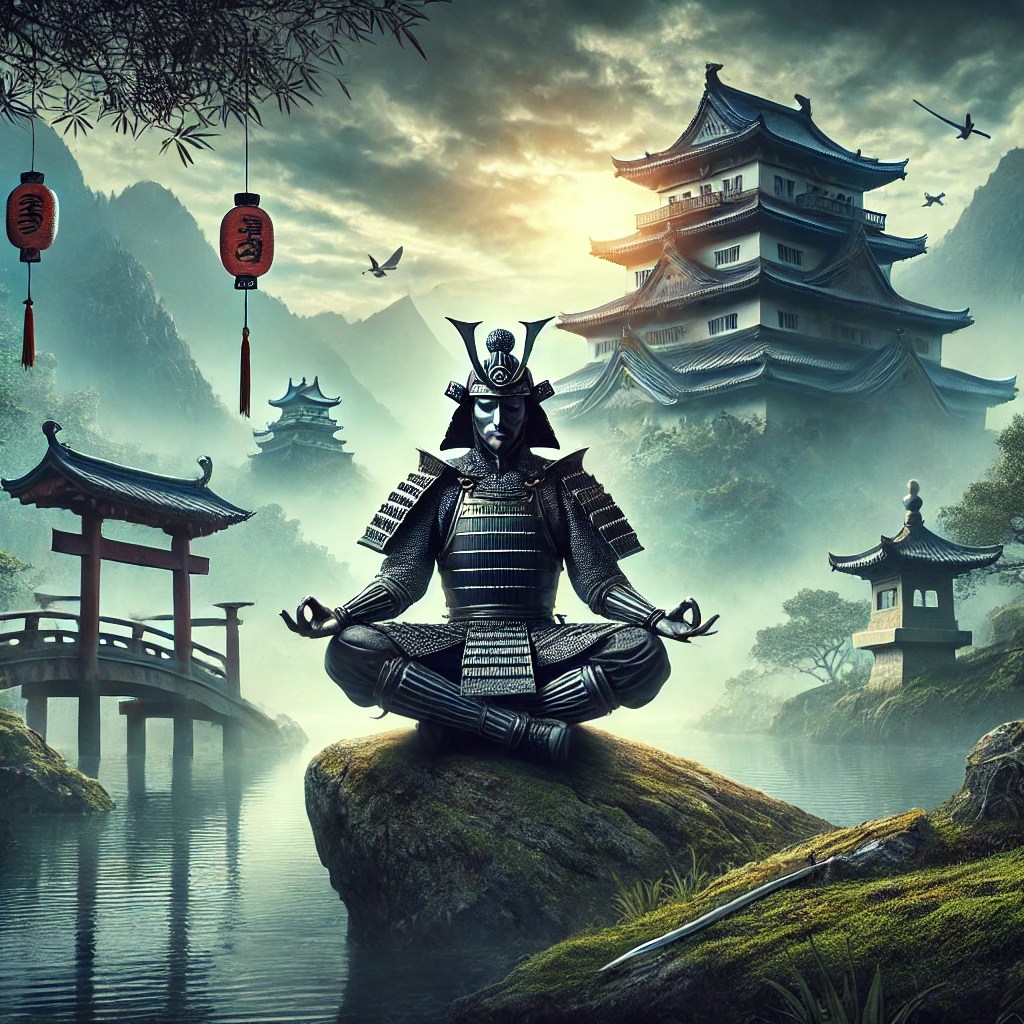
The Samurai warriors practiced Zen to gain an edge in battle, and at the heart of Zen lies yoga.
Yoga Asanas
When most people think of yoga, images of contorted bodies twisted into pretzel-like poses often come to mind.
While the physical asanas (postures) of yoga have gained tremendous popularity, especially in the West, they represent only one aspect of this ancient practice.
What many overlook is the meditation and mental training that is deeply embedded within the roots of yoga, which not only offers spiritual enlightenment but also plays a pivotal role in the Art of War and the cultivation of true inner strength.
The Deeper Roots of Yoga: Meditation Over Asanas
Yoga has long been recognized as a path to spiritual awakening, but it’s crucial to understand that the physical postures are just the surface of a much deeper tradition.
At its core, yoga is about stilling the mind—calming the endless chatter that often clouds our perception and hinders our ability to act decisively.
This meditation aspect of yoga is far more powerful than just performing physical poses.
It’s about transcending the ego and achieving a state of deep awareness, where one’s true self is realized and one can access a state of inner peace that is not shaken by external circumstances.
In fact, this meditation aspect is so powerful that it became the foundation for other profound traditions, such as Chan Buddhism (which later evolved into Zen) in China.
The story of Bodhidharma, the enlightened Indian guru who traveled to China, is a testament to how meditation in the form of yoga helped shape not only spirituality but warrior philosophies too.
Bodhidharma’s Influence: Yoga’s Link to the Warrior Spirit
Bodhidharma (Dà Mó), the founder of Chan Buddhism and the key figure in elevating Shaolin Kung Fu.
Bodhidharma’s journey from India to China is legendary.
He arrived at the Shaolin Temple, where he established Chan Buddhism, a fusion of meditation and martial arts.
This blend of mindfulness, discipline, chi (pranayama), and physical training would lay the foundation for what became the Shaolin monks’ renowned martial arts expertise, later influencing countless warriors around the world.
This ancient tradition directly links yoga and meditation to the art of war, demonstrating that the true power of yoga lies not in the ability to perform physical poses but in the mental clarity, discipline, energization (chi), and fearlessness it fosters.
The meditation-based aspects of yoga create a “no-mind” state—where actions flow effortlessly, free from hesitation, and without the clutter of doubt or distraction.
This mental fortitude, honed through yoga and meditation, would become the edge in battle, just as it has in life.
Lord Krishna instructing Arjuna
The Bhagavad Gita: A Battle Between the Mind and the Self
One of the most powerful texts that blends yoga, meditation, and warriorship is the Bhagavad Gita, the epic dialogue between Lord Krishna and the warrior prince Arjuna.
The Gita isn’t just a spiritual treatise; it’s an internal battlefield where Arjuna struggles with his mind, emotions, and sense of duty.
Through Krishna’s guidance, Arjuna learns to transcend his inner conflict and reach a state of clarity, allowing him to perform his duties without attachment or hesitation.
This is the essence of the yoga of action—Karma Yoga—where the practitioner performs their duty without attachment to outcomes, free from the limitations of fear, desire, or ego.
In this state, one is not swayed by external forces but remains anchored in the present moment, ready to take decisive action when necessary.
This same mental discipline is key for warriors, athletes, and anyone who seeks to live with unwavering focus and clarity.
The Warrior Caste and the Path of Zen
Yoga’s connection to warrior philosophy is not just confined to the spiritual practices of ancient India.
Buddha himself, who was born into the warrior caste, understood the discipline and mental training that warrior culture required.
Though his journey took him away from the battlefield, the underlying principles of warrior ethos—such as fearlessness, discipline, and acting in the moment—remain closely tied to the teachings of Buddhism and the path of meditation.
The Samurai of Japan, revered for their code of honor and exceptional skills, fully embraced Zen practice.
Through Zen meditation, they cultivated a deep mental focus, allowing them to enter battle without fear or hesitation, fully present and aware of every movement.
The Samurai’s Zen practice allowed them to move beyond themselves, acting as a vessel for the art of war.
The ultimate goal was to reach a state of “no-self” or “no-mind”, where the mind does not interfere with action and one acts purely out of intuition and experience.
No Mind, No Self: The Power of Yoga in Life and Battle
The concept of “no-mind” (or “mushin”) is integral to both Zen and yoga, and it is perhaps one of the most powerful aspects of the practice.
When we let go of the ego and the constant chatter of the mind, we open up to a state of pure presence, where our actions are aligned with the flow of life.
This state of non-attachment is essential not only in meditation but also in battle, business, sports, and every area of life that demands focused action.
In yoga, this concept is cultivated through deep meditation and mindful breathing, allowing the practitioner to reach a state where actions are effortless, clear, and precise.
The “no-self” principle helps us overcome the limitations of the ego and the fear that often holds us back in life.
Whether in war or in daily struggles, this mental discipline gives you the edge—the ability to act without hesitation, free from distractions, and aligned with your highest purpose.
Yoga: More Than Just Feel-Good Poses
So, the next time you think of yoga, remember: it’s not just about tying yourself in pretzel-like shapes or doing trendy stretches.
At its core, yoga is about transcending the physical, finding inner peace, and cultivating the mental strength to face any challenge—be it on the battlefield or in the daily struggles of life.
The meditation practices of yoga, developed over millennia, are the key to unlocking the true power within you.
Just as the great warriors of history relied on the mental clarity and fearlessness gained through meditation and yoga, so too can we all benefit from its profound teachings.
Yoga, when practiced in its fullest sense, is not just a physical exercise; it is a way to elevate your warriorship, to act with precision, and to live without fear or limitation.
Final Thoughts
Yoga is not just about the body.
It is the way to train your mind, to enter a state of no-mind, and to cultivate the clarity and fearlessness necessary to face life’s battles—whether physical, mental, or spiritual.
Just as the ancient warriors did, we too can embrace the meditation aspect of yoga and unlock the deeper power that lies within us all.
Sri Paramahansa Yogananda
BE CALMLY ACTIVE
AND ACTIVELY CALM
In short, don’t think all the time of just making money. Exercise, read, meditate, love God, and act peacefully, at all times. Learn to be calmly active and actively calm, carrying into your daily activities the calmness gained in the spiritual activity of meditation.
In the Gita, Bhagwan Krishna teaches: “Remaining immersed in yoga, perform all actions, forsaking attachment (to their fruits). Remain indifferent to success and failure (while performing all actions). The mental evenness during all states of activities (resulting in success or failure) is termed yoga.
– Sri Sri Paramahansa Yogananda
MANS ETERNAL QUEST
Chapter 47 page 402